Deep Learning of Electrocardiograms Predicts Long-Term Ischemic Stroke Risk by Detecting Atrial Abnormalities
Highlight
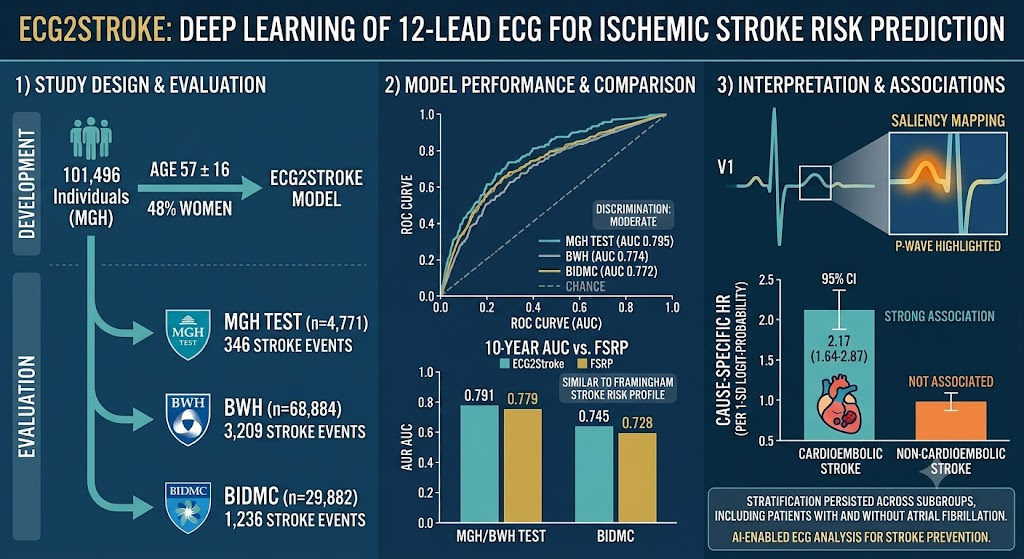
Deep learning applied to 12-lead ECG signals enables estimation of 10-year ischemic stroke risk with moderate discrimination and good calibration.
ECG-based AI risk predictions perform comparably to the established Framingham Stroke Risk Profile and remain accurate across multiple independent hospital cohorts.
Saliency mapping identifies the P-wave as a key ECG signature reflecting atrial cardiopathy, strongly linked to cardioembolic stroke subtype.
ECG2Stroke provides a scalable, noninvasive tool potentially facilitating early prioritization for targeted stroke prevention strategies.
Study Background
Ischemic stroke remains a leading cause of death and disability worldwide, with significant clinical and socio-economic burdens. Current stroke risk stratification strategies often rely on clinical risk scores that require comprehensive clinical data collection and may underperform in individuals without clear atrial fibrillation (AF) or apparent cardioembolic sources. Early identification of patients at high risk of ischemic stroke, especially those with underlying atrial cardiopathy before manifestation of AF, could facilitate prompt preventive interventions to reduce stroke incidence.
Electrocardiograms (ECGs) are routinely obtained, noninvasive cardiac investigations offering rich physiological data. Recent advances in artificial intelligence (AI), especially deep learning, provide opportunities to extract complex predictive features from ECGs beyond conventional metrics. However, whether AI-analyzed 12-lead ECGs can estimate long-term ischemic stroke risk and whether such predictions relate to mechanistically plausible atrial substrates has not been fully explored.
Study Design
This large-scale, retrospective, multicenter study developed and validated an artificial intelligence model, ECG2Stroke, based on a convolutional neural network trained on 12-lead ECG data from 101,496 patients receiving longitudinal care at Massachusetts General Hospital (MGH).
The model aimed to predict 10-year risk of incident ischemic stroke. It integrated neural network-derived stroke probabilities with age and sex variables into a Cox proportional hazards framework for outcome prediction. The model was evaluated in an internal MGH test set (n=4,771) and two independent external cohorts from Brigham and Women's Hospital (BWH, n=68,884) and Beth Israel Deaconess Medical Center (BIDMC, n=29,882).
Stroke event adjudication used standard clinical definitions, focusing on ischemic stroke and subtypes including cardioembolic versus noncardioembolic strokes. The predictive performance was compared to the revised Framingham Stroke Risk Profile (FSRP), an established clinical risk model. Model discrimination was assessed by area under the receiver operating characteristic curve (AUC) and calibration by integrated calibration index (ICI). Saliency mapping techniques and correlations with structured ECG markers, especially P-wave indices, were applied to interpret the neural network's predictive focus and underlying pathophysiology.
Key Findings
ECG2Stroke demonstrated robust and generalizable prediction capacity for 10-year ischemic stroke risk across all cohorts. The AUCs were 0.795 in the MGH Test set, 0.774 in BWH, and 0.772 in BIDMC, indicating moderate discrimination. Calibration errors were low (ICI ≤ 0.03), affirming reliable risk estimation without systemic biases.
Compared with the Framingham Stroke Risk Profile, ECG2Stroke achieved similar performance (AUC differences ≤ 0.02) in all tested cohorts, supporting its clinical utility as an alternative or complementary predictive tool, especially as it only requires ECG, age, and sex data.
Subgroup analyses revealed consistent stratification performance regardless of atrial fibrillation status, demonstrating the model's ability to detect stroke risk beyond overt AF diagnosis.
Saliency mapping highlighted significant attention to the ECG P-wave segment, implicating atrial electrical activity abnormalities. Structured ECG features correlated strongly with risk estimates, suggesting that the model captures atrial cardiopathy markers, a known substrate for cardioembolic stroke.
Further analysis linked ECG2Stroke's predictive power specifically to cardioembolic stroke subtype risk (hazard ratio 2.17 per one standard deviation increase in logit-transformed probability), while showing no significant association with noncardioembolic stroke, indicating mechanistic specificity.
Expert Commentary
The study provides compelling evidence that AI-enhanced ECG analysis can serve as a noninvasive, accessible, and scalable approach to stroke risk stratification. Importantly, by isolating P-wave abnormalities, the model taps into atrial remodeling and dysfunction phenomena that precede or occur independently of clinical atrial fibrillation. This mechanistic insight aligns with emerging concepts of atrial cardiopathy as an independent stroke risk factor.
While traditional clinical risk scores require multiple clinical parameters and laboratories, the ECG2Stroke model leverages routinely collected ECGs, potentially facilitating widespread screening. However, prospective validation, assessment of impact on clinical decision-making, and cost-effectiveness studies are necessary before clinical implementation.
Limitations include retrospective design, potential selection bias from hospital-based cohorts, and reliance on electronic health record stroke adjudication. The model’s performance in diverse populations and outpatient settings requires further study. Additionally, integrating ECG2Stroke with other biomarkers or imaging may enhance personalized risk prediction.
Conclusion
ECG2Stroke embodies a novel, AI-enabled approach to long-term ischemic stroke risk prediction, performing comparably to established clinical risk scores while uniquely capturing atrial electrical abnormalities linked to cardioembolism. This approach holds promise for more efficient stroke prevention by enabling earlier identification of high-risk individuals through widely accessible ECG data. Future prospective studies should explore integration into clinical workflows and potential to guide preventive therapies.
Funding and ClinicalTrials.gov
The study was supported by institutional resources of Massachusetts General Hospital and co-investigating centers. Specific grant funding was not disclosed in the abstract. There is no indication that the study was registered on ClinicalTrials.gov.
References
Mahajan R, Pace DF, Friedman SF, et al. ECG Signatures and Long-Term Ischemic Stroke Risk: A Deep Learning Analysis of 200,000 Patients. J Am Coll Cardiol. 2026 May 13;88(2):205-223. PMID: 42126358.
Chauveau P, Rangé G, Peltier M, et al. Atrial Cardiopathy: A New Stroke Mechanism. Curr Cardiol Rep. 2021;23(11):155.
O'Donnell MJ, Xavier D, Liu L, et al. Risk Factors for Ischemic and Intracerebral Hemorrhagic Stroke in 22 Countries (the INTERSTROKE Study): A Case-Control Study. Lancet. 2010;376(9735):112-123.
Lim HS, Park JH, Park CB. Deep Learning in Electrocardiography: Advances, Challenges, and Future Perspectives. Korean Circ J. 2021;51(9):690-707.
This article was created using several editorial tools, including AI, as part of the process. Human editors reviewed this content before publication.