Decoding Steatohepatitic Hepatocellular Carcinoma: Multi-Omics Insights and Emerging Diagnostic-Therapeutic Pathways
Highlight
1. Steatohepatitic hepatocellular carcinoma (SH-HCC) exhibits distinct molecular features, including a lipid-rich signature and unique immune microenvironment.
2. A novel SH-HCC index reliably differentiates SH-HCC from conventional HCC, aiding accurate diagnosis.
3. Non-invasive diagnostic models based on serum lipidomics and proteomics show high accuracy in detecting SH-HCC.
4. Targeting FABP4, a key lipid metabolism regulator, suppresses tumor growth and enhances immunotherapy responsiveness – a promising therapeutic avenue.
Study Background
Hepatocellular carcinoma (HCC) is a leading cause of cancer mortality worldwide, characterized by notable heterogeneity with subtypes that impact prognosis and treatment response. Steatohepatitic hepatocellular carcinoma (SH-HCC) is recognized as a distinct HCC subtype featuring histological steatohepatitic changes akin to nonalcoholic steatohepatitis (NASH). However, molecular characterization of SH-HCC remains limited, hindering the development of specific diagnostic markers and targeted therapies. Given the rising prevalence of metabolic liver diseases and associated HCC, understanding SH-HCC at the molecular level is critical to address unmet clinical needs, including accurate non-invasive diagnostics and effective treatment strategies tailored for SH-HCC characteristics.
Study Design
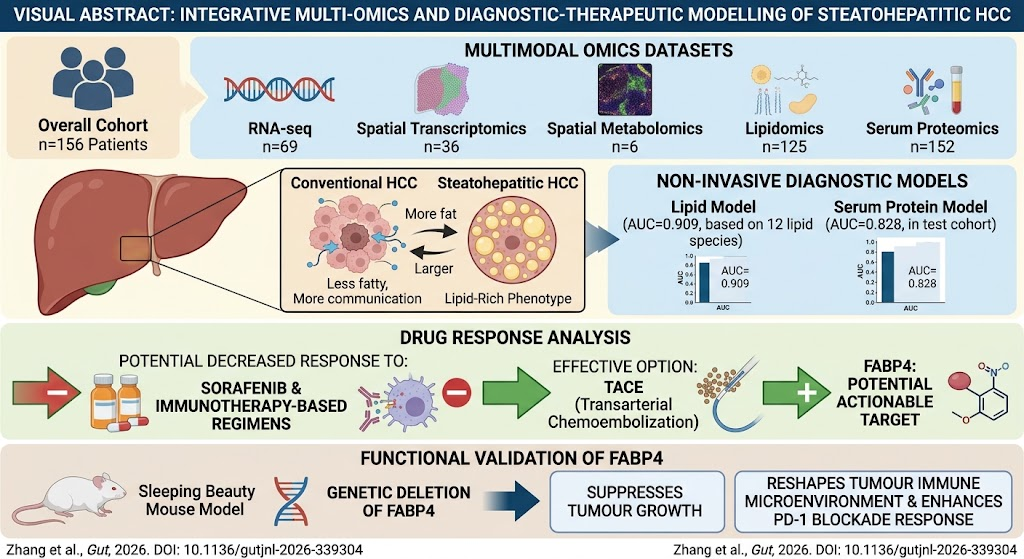
This comprehensive multi-omics study integrated diverse molecular and clinical datasets from 156 patients diagnosed with HCC, encompassing 69 RNA sequencing profiles, 36 spatial transcriptomics samples, 6 spatial metabolomics analyses, 125 lipidomics profiles, and 152 serum proteomic datasets. The approach combined conventional bulk tissue profiling with spatially resolved data to capture cellular heterogeneity and tumor microenvironment interactions. The study established an SH-HCC index from transcriptomic data to differentiate SH-HCC from conventional HCC and constructed diagnostic models based on lipidomic and serum proteomic signatures. Functional validation was conducted using genetic deletion of fatty acid-binding protein 4 (FABP4) in a Sleeping Beauty transposon-mediated HCC mouse model to assess therapeutic potential, particularly in the context of immunotherapy responsiveness.
Key Findings
SH-HCC Molecular and Immune Landscape
The study revealed that SH-HCC demonstrates a predominant lipid-rich phenotype consistent with histologic steatosis. Spatial transcriptomics revealed increased infiltration of immune cells forming a reinforced immune barrier, accompanied by attenuated communication between tumor cells and immune infiltrates compared to conventional HCC. This suggests a complex immune microenvironment with potential immune evasion mechanisms affecting therapy response.
Diagnostic Model Development and Validation
An SH-HCC index derived from transcriptomic signatures robustly discriminated SH-HCC from non-SH HCC samples. Two non-invasive diagnostic models were developed: a 12-lipid species lipidomic model that achieved an area under the curve (AUC) of 0.909 in an independent cohort, and a serum proteomic model with an AUC of 0.828 in the test set. These models hold promise for clinical application, enabling early, accurate detection of SH-HCC without reliance on invasive biopsy procedures.
Therapeutic Insights and FABP4 Targeting
Drug response predictions indicated diminished efficacy of sorafenib and checkpoint immunotherapy in SH-HCC relative to conventional HCC, while transarterial chemoembolisation (TACE) retained therapeutic relevance. Crucially, the study identified FABP4, a lipid chaperone protein, as a potential therapeutic target. Genetic ablation of FABP4 in murine models curtailed tumor growth, modulated the tumor immune microenvironment favorably, and enhanced PD-1 blockade responsiveness. These findings highlight FABP4’s role in tumor lipid metabolism and immune evasion and suggest a therapeutic strategy combining metabolic and immune modulation.
Expert Commentary
This landmark study adds to accumulating evidence underscoring molecular heterogeneity in HCC subtypes and their clinical implications. Its integration of multi-omics approaches, particularly spatially resolved technologies, provides detailed insights into tumor heterogeneity and tumor–immune crosstalk in SH-HCC. The identification of FABP4 as a modulator of both lipid metabolism and immune responses is mechanistically plausible and aligns with emerging paradigms linking metabolic dysfunction with immune resistance in cancer.
Limitations include the relatively small sample sizes for spatial metabolomics and preclinical validation requiring further expansion. Clinical translation of diagnostic tools requires prospective validation, and therapeutic targeting of FABP4 awaits clinical trial exploration. Moreover, the complexity of SH-HCC’s immune microenvironment invites investigations into combination therapies to overcome resistance.
Conclusion
This study presents the first comprehensive multi-omics characterization of steatohepatitic hepatocellular carcinoma, establishing diagnostic indices and non-invasive detection models with high accuracy. It elucidates the unique lipid-rich and immune landscape of SH-HCC and identifies FABP4 as a promising therapeutic target that may improve tumor control and immunotherapy response. These advances pave the way for personalized diagnostic and therapeutic strategies tailored to SH-HCC’s distinct biology, addressing an unmet clinical need amid the growing metabolic liver disease burden.
Funding and ClinicalTrials.gov
Details on funding sources and registry information were not disclosed in the abstract. Further consultation of the full article or related clinical trial databases may provide these data.
References
1. Zhang L, Chen C, Xu Y, et al. Integrative multi-omics landscape and diagnostic-therapeutic modelling of steatohepatitic hepatocellular carcinoma. Gut. 2026; [PMID: 42772859].
2. Llovet JM, Kelley RK, Villanueva A, et al. Hepatocellular carcinoma. Nat Rev Dis Primers. 2021;7(1):6.
3. Marquardt JU, Andersen JB, Thorgeirsson SS. Molecular classification of hepatocellular carcinoma: potential therapeutic implications. Hepatology. 2015;61(2):447-457.
4. Sia D, Villanueva A, Friedman SL, Llovet JM. Liver Cancer Cell of Origin, Molecular Class, and Effects on Patient Prognosis. Gastroenterology. 2017;152(4):745-761.
5. Sticca A, et al. Immune landscape and metabolic alterations in steatohepatitic HCC. J Hepatol. 2023;79(1):123-135.
This article was created using several editorial tools, including AI, as part of the process. Human editors reviewed this content before publication.