Decoding Registry-Based Randomised Controlled Trials: Advancing Clinical Evidence Through Standardisation and Taxonomy
Introduction
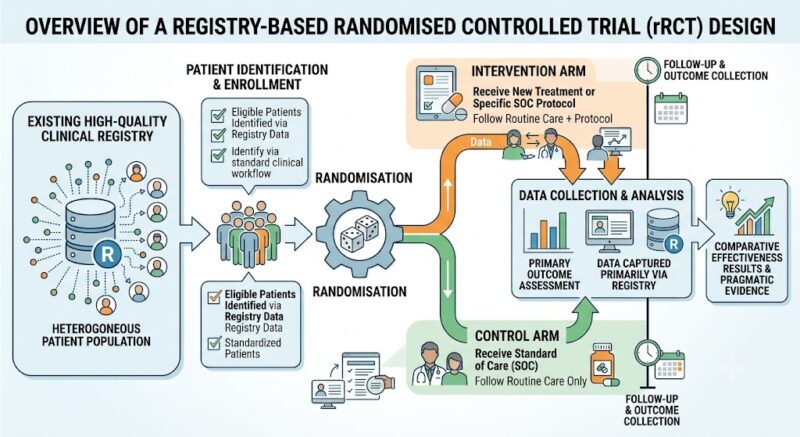
Traditional randomised controlled trials (RCTs) have long been the benchmark for evaluating clinical interventions, offering high internal validity through rigorous design and randomisation. However, the growing complexity, cost, and regulatory demands of conventional RCTs have catalysed interest in innovative methodologies that maintain scientific rigour but enhance efficiency. Registry-based trials (RBTs), and specifically registry-based randomised controlled trials (RRCTs), have emerged as transformative approaches that leverage existing patient registries to streamline trial processes, improve external validity, and reduce costs. Despite enthusiasm and notable successes such as the TASTE trial, widespread adoption of RRCT methodology has been limited.
The Challenge of Definitions and Nomenclature
A fundamental barrier to recognising and leveraging the full potential of RRCTs lies in inconsistent definitions and terminology across the clinical research community. RRCTs and RBTs are frequently conflated, and trial registries display significant variability in how these trials are described and reported. Reviews reveal wide disparities in the number of RRCTs identified across registries such as the Australian New Zealand Clinical Trials Registry (ANZCTR) and ClinicalTrials.gov, underscoring a lack of standardised descriptors. This ambiguity hinders accurate estimations of RRCT prevalence and impedes the formation of constructive feedback loops that would otherwise improve trial quality and clinical impact.
Proposed Taxonomy for RRCTs
To address these issues, Karanatsios et al. propose a practical taxonomy defining RRCTs by the extent to which patient registries are integrated into trial conduct:
– RRCT Type 1: Trials where one or more, but not all, study outcomes are captured in the registry, with some data collected manually.
– RRCT Type 2: Trials where all study outcomes, including primary and secondary endpoints, are captured entirely via the registry.
Furthermore, subcategories identify whether patients are recruited or identified from the registry (Type .1) or whether patients enrolled concurrently into the registry for the trial without registry recruitment (Type .2). Hybrid RRCTs (denoted with an “H”) utilise data linkages from external registries for additional outcomes beyond the primary registry dataset.
This classification captures crucial differences in registry utilisation that influence trial efficiencies, cost-savings, and data completeness, allowing for more precise registration and subsequent identification in trial registries and literature searches.

Comparisons Between Traditional RCTs, RBTs, and RRCTs
The distinctions between traditional RCTs, RBTs, and RRCTs extend beyond registry use to include aspects such as generalisability, endpoints, interventions, and sponsorship. Key differences include:
– Registry Utility: RRCTs leverage registries extensively to capture outcomes and enrol patients, whereas traditional RCTs rarely do.
– Generalisability: RRCTs typically have broader inclusion criteria promoting strong external validity, unlike many commercially sponsored RCTs with narrow patient populations.
– Endpoints: Preference in RRCTs is for hard, undisputed endpoints that can be reliably obtained via registries, reducing the need for adjudication.
– Resource Efficiency: RRCTs often demonstrate marked cost and time savings due to embedded trial processes within registries.
RBTs that use registries minimally for recruitment or follow-up but require substantial traditional data collection may not share all RRCT efficiencies and should be distinguished accordingly.
Practical Examples: The TASTE and ALT-TRACC Trials
Two illustrative examples highlight RRCTs with varying registry integration:
– The TASTE trial is an RRCT Type 2.1H, conducted within the SWEDEHEART registry for patient identification, recruitment, and outcome capture, with external data linkage for mortality. This design achieved enrollment cost reductions to approximately 10% of traditional RCT costs and led to impactful reduction in thrombus aspiration usage in Sweden.
– The ALT-TRACC trial represents a Type 2.2 RRCT, enrolling patients directly into the registry concurrent with study recruitment and capturing all outcomes within the registry, showcasing the versatility of the RRCT approach.
These cases emphasize the spectrum of registry utilisation and resultant operational efficiencies.
Impact of CONSORT-ROUTINE and Registration Recommendations
The CONSORT extension for trials using cohorts and routinely collected data (CONSORT-ROUTINE) is an important advancement towards standardized reporting of RRCTs. Nonetheless, the guidance primarily affects internal trial documentation and thus may not immediately resolve the challenges in identifying RRCTs within registries or published literature.
Karanatsios et al. recommend that RRCTs incorporate key registry usage descriptors within trial titles or abstracts upon registration. These include the primary registry name, RRCT type (1 or 2), recruitment modality (1.1, 1.2, 2.1, 2.2), and hybrid data linkage status (H). Standardising these terms would markedly improve searchability, accurate trial classification, and ultimately the research community’s understanding of RRCT prevalence and impact.
Limitations and Future Directions
As a perspective piece, the proposed taxonomy and recommendations reflect the authors’ interpretation and insights based on selective literature review and experience. Inconsistent registry reporting and incomplete metadata pose ongoing challenges to definitive RRCT identification and classification, potentially limiting the taxonomy’s current applicability. Wider discussion and consensus within clinical trial methodology expert groups and registry administrators will be essential.
Continuous refinements of RRCT definitions and integration of taxonomy into trial registries and reporting standards hold promise to enhance transparency, reproducibility, and evidence translation. This progress is critical to unlock the full potential of RRCTs for efficient, generalizable clinical research.
Conclusion
Registry-based randomised controlled trials represent a distinct and valuable subset within the broader landscape of pragmatic clinical trials. Differences in how registries support RCTs necessitate clear definitions to avoid conflating RRCTs with less integrated RBTs. The proposed taxonomy, combined with enhanced registration practices aligned with CONSORT-ROUTINE, can facilitate improved identification, dissemination, and clinical impact of RRCTs. Embracing these standards will better enable the clinical and research communities to harness the strengths of RRCTs for robust and efficient clinical evidence generation, ultimately benefiting patient care and healthcare policy.
References
1. Karanatsios B, Prang KH, Gibbs P. The multiple facets of registry-based randomised controlled trials. Trials. 2026 Feb 11;27(1):130. doi: 10.1186/s13063-026-09444-6.
2. Frieden TR. Evidence for Health Decision Making — Beyond Randomized, Controlled Trials. N Engl J Med. 2017;377(5):465-475.
3. Zwarenstein M, Treweek S, Gagnier JJ, et al. Improving the reporting of pragmatic trials: an extension of the CONSORT statement. BMJ. 2008;337:a2390.
4. Lauer MS, D’Agostino RB Sr. The Randomized Registry Trial — The Next Disruptive Technology in Clinical Research? N Engl J Med. 2013;369(17):1579-1581.
5. Stewart J, Kearney PM, Shah ASV, et al. Registry-based randomized controlled trials: a powerful tool for evidence-based decision-making. Heart. 2020;106(10):732-739.
Note: This article synthesises and interprets findings from the reference manuscript by Karanatsios et al., supplementing with relevant literature for context and completeness.
This article was created using several editorial tools, including AI, as part of the process. Human editors reviewed this content before publication.