Highlight
B-BEST technique enables simultaneous quantification of HBV genomic regions and host transcripts at single-cell resolution, overcoming limitations of conventional scRNA-seq methods.
HBV infection demonstrates marked heterogeneity across infected hepatocytes, with subpopulations showing distinct viral replication activities linked to metabolic and mitochondrial functions.
Integrated HBV transcripts preferentially use host promoters, contributing to persistent HBsAg expression, particularly in HBeAg-negative patients.
Antiviral treatments (entecavir and peginterferon alfa-2b) differentially modulate host metabolic and antiviral pathways, with hepatocyte clonal expansion potentially diluting the viral reservoir and facilitating functional cure.
Study Background
Hepatitis B virus (HBV) infection remains a global public health challenge, affecting over 250 million people worldwide and leading to significant morbidity and mortality from chronic hepatitis, cirrhosis, and hepatocellular carcinoma. Despite the availability of effective antiviral therapies, complete viral eradication is rarely achieved due to the persistence of viral reservoirs and the complex interplay between HBV and host hepatocytes. Traditional transcriptomic studies have failed to capture the cellular heterogeneity underlying HBV infection dynamics because standard polyadenylated RNA single-cell sequencing methods are overwhelmed by abundant host mRNA, masking viral transcripts. Understanding the host-viral interactions at single-cell resolution is crucial for elucidating mechanisms of viral persistence, replication, and host immune evasion, toward improving therapeutic strategies.
Study Design
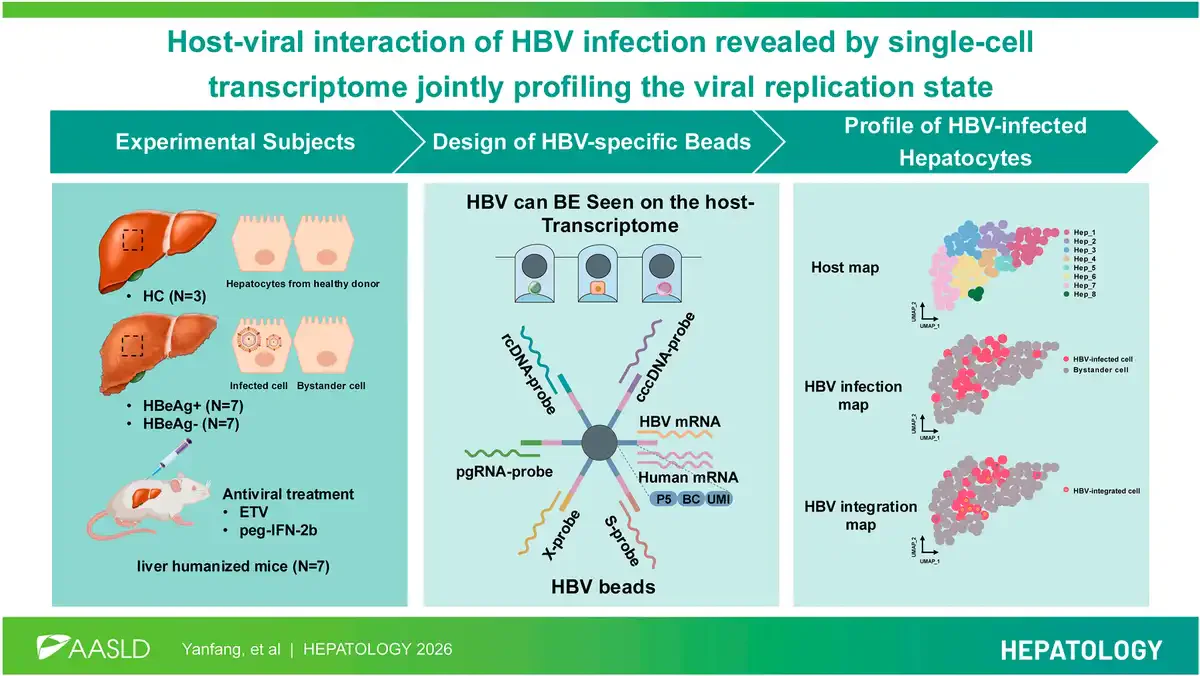
The study introduced B-BEST (HBV can BE Seen on host Transcriptome), a novel targeted single-cell/single-nucleus RNA sequencing (sc/snRNA-seq) platform utilizing custom beads conjugated to HBV-specific probes. This approach allowed simultaneous profiling of five key viral genomic regions—S, X, pregenomic RNA (pgRNA), relaxed circular DNA (rcDNA), and covalently closed circular DNA (cccDNA)—alongside host transcriptomes. The investigators validated B-BEST in vitro using HepAD38 cell lines, which harbor inducible HBV replication. Subsequently, B-BEST was applied to liver tissues from treatment-naïve patients with chronic HBV infection and from humanized liver chimeric (Hu-URG) mice subjected to antiviral therapies entecavir and peginterferon alfa-2b. Data integration with long-read sequencing, spatial transcriptomics, and in situ hybridization enabled comprehensive mapping of viral and host transcript heterogeneity, spatial distribution, and mechanistic insights across clinical and preclinical contexts.
Key Findings
HBV Infection Exhibits Cellular Heterogeneity in Hepatocytes
B-BEST analysis revealed significant heterogeneity among HBV-positive hepatocyte subpopulations within liver tissues. In HBeAg-positive patients, HBV-infected hepatocytes enriched for gene expression signatures related to hepatic biosynthesis, metabolism, and mitochondrial function corresponded with active viral replication and transcription. These subsets displayed only mild induction of type I interferon responses, suggesting partial viral immune evasion or a suppressed innate antiviral state. Conversely, patients exhibiting severe liver inflammation showed marked suppression of HBV replication, indicating an inflammation-driven antiviral milieu.
Role of Integrated HBV Transcripts in Viral Persistence
Long-read sequencing identified that integrated HBV DNA transcripts preferentially hijacked host promoters to maintain expression, particularly of hepatitis B surface antigen (HBsAg). This mechanism was more pronounced in HBeAg-negative patients, contributing to persistent antigenemia despite low or undetectable circulating viral DNA, complicating clinical management and viral clearance.
Antiviral Therapy Influences Host Pathways and Viral Reservoir Dynamics
In Hu-URG mice, entecavir treatment upregulated metabolic pathways in hepatocytes, potentially reflecting drug effects on host cellular metabolism. Peginterferon alfa-2b, by contrast, induced a broad antiviral program encompassing interferon-stimulated genes, enhancing antiviral defense mechanisms. Notably, these treatments promoted clonal expansion of hepatocytes, which was associated with dilution of the intrahepatic viral reservoir when active viral replication was inhibited. This proliferative dilution mechanism offers a plausible biological explanation for functional HBV cure achieved in certain cases, marked by sustained viral remission without complete eradication.
Expert Commentary
The B-BEST platform represents a significant technical advance enabling dissection of HBV-host interactions at unprecedented resolution. It overcomes prior limitations of viral RNA detection in single-cell approaches, permitting detailed viral replication state profiling and host response characterization within individual hepatocytes. The study’s integration of multi-omics and spatial analyses strengthens the biological and clinical relevance of findings.
However, some limitations exist. The cross-sectional nature of human liver sampling limits temporal assessment of viral dynamics, and differences in humanized mouse models’ immune contexts may not fully replicate human antiviral immunity. Further studies including longitudinal patient cohorts and experimental manipulations will be essential to validate causal relationships and translate findings into therapeutic applications. Furthermore, the heterogeneity in host responses and viral integration patterns underscores the complexity of chronic HBV infection and challenges in achieving universal cure.
Conclusion
This study leverages a novel targeted single-cell transcriptomic approach (B-BEST) to unveil the heterogeneous landscape of HBV infection at single-cell resolution. By concurrently profiling viral replication states and host gene expression, it identifies key hepatocyte subpopulations, host metabolic and immune pathways linked to viral activity, and the influence of antiviral treatments on viral persistence. Importantly, the discovery of hepatocyte clonal expansion as a viral reservoir dilution mechanism offers a novel conceptual framework potentially underpinning functional cure. These data enrich our understanding of HBV pathogenesis, informing development of more precise and effective therapeutic interventions targeting cellular reservoirs and immune evasion strategies.
Funding and ClinicalTrials.gov
The original study was supported by funding bodies noted in Huang et al., 2026 (PMID: 41875300). Clinical trial details and ethical approvals pertaining to antiviral treatments in humanized mouse models and human patient samples were conducted per institutional regulations, though specific trial registrations were not detailed.
References
Huang Y, et al. Host-viral interaction of HBV infection revealed by single-cell transcriptome jointly profiling the viral replication state. Hepatology. 2026;84(5):1529-1547. PMID: 41875300.
Xu D et al. HBV integration and transcriptional landscape in human liver cells. Nat Commun. 2022;13(1):4567.
Seto WK, et al. Role of interferon in HBV treatment paradigms. J Hepatol. 2020;72(2):309-315.
Revill PA et al. The challenge of hepatitis B cure: therapeutic strategies and clinical development. Nat Rev Gastroenterol Hepatol. 2019;16(6):365-378.