Highlight
Both dry and humid heat acclimation improve endurance cycling performance in matched and alternate environments.
Dry heat acclimation produced a greater performance increase in dry heat conditions compared to humid heat acclimation.
Physiological adaptations include reduced core temperature, increased sweat rate, and lowered or stable heart rate, varying by heat type and test condition.
Cross-acclimation benefits suggest practical implications for athletes training in different heat environments.
Study Background
Endurance performance is heavily influenced by thermal environmental conditions, with heat stress significantly impairing exercise capacity and increasing the risk of heat-related illness. Athletes, military personnel, and outdoor workers frequently encounter hot-dry or warm-humid conditions. Heat acclimation (HA) protocols are established means to induce physiological adaptations enhancing thermoregulation and performance. However, the extent to which adaptation to one type of heat environment confers benefits in a different heat type (cross-acclimation) remains incompletely understood. Clarifying these relationships can optimize training regimens for endurance athletes and inform occupational heat stress mitigation strategies.
Study Design
This investigation employed a cross-over design involving trained male cyclists who completed endurance time trials under controlled hot-dry and warm-humid conditions before and after undergoing distinct 8-day heat acclimation protocols. Participants were allocated to two groups undergoing either dry heat acclimation (Dry-HA; n=10) or humid heat acclimation (Humid-HA; n=12), with conditions matched for wet-bulb globe temperature around 31°C to ensure comparable heat stress.
The primary endurance assessments were 30-minute time trials performed in two environments: hot-dry (42°C, 25% relative humidity) and warm-humid (33°C, 80% relative humidity). Key physiological parameters including rectal temperature (core body temperature), heart rate, and whole-body sweat rate (WBSR) were monitored. Bayesian multilevel statistical models estimated changes in performance and physiological responses, reporting posterior means and 90% credible intervals (CrI).
Key Findings
Performance Outcomes
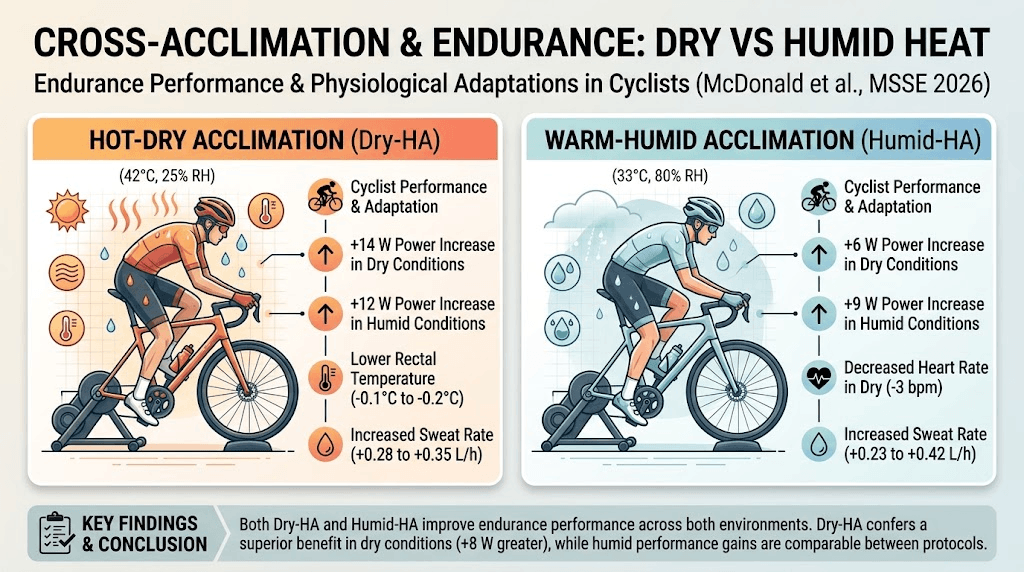
– In the hot-dry environment (Dry-TT), mean power output improvements were significantly greater following Dry-HA (14 W [7, 21]) compared to Humid-HA (6 W [-1, 13]). This indicates superior adaptation specificity when acclimated to dry heat for dry heat performance.
– In the warm-humid environment (Humid-TT), both Humid-HA (9 W [1, 17]) and Dry-HA (12 W [3, 20]) elicited comparable performance enhancements, suggesting a cross-acclimation effect whereby dry heat adaptation benefits humid heat endurance similarly to humid heat adaptation.
Physiological Adaptations
– Core temperature during Dry-TT decreased modestly after both Dry-HA and Humid-HA (-0.1ºC [-0.2, 0.0]), indicative of improved thermoregulation.
– Heart rate during Dry-TT was unchanged following Dry-HA (-1 beats·min⁻¹ [-3, 2]) and reduced following Humid-HA (-3 beats·min⁻¹ [-6, 0]), which may reflect distinct cardiovascular adaptations depending on heat type.
– Whole-body sweat rate during Dry-TT increased with both Dry-HA (0.28 L·h⁻¹ [0.14, 0.41]) and Humid-HA (0.23 L·h⁻¹ [0.10, 0.35]), enhancing heat dissipation capacity.
– During Humid-TT, rectal temperature was unchanged following Humid-HA but decreased after Dry-HA (-0.2ºC [-0.3, -0.1]), suggesting unique thermoregulatory effects of dry heat acclimation that translate to humid conditions.
– Heart rate remained stable in Humid-TT after Humid-HA and Dry-HA.
– Sweat rates in Humid-TT increased significantly with both acclimations, with Humid-HA exhibiting a slightly higher increase (0.42 L·h⁻¹ [0.32, 0.52]) compared to Dry-HA (0.35 L·h⁻¹ [0.23, 0.47]).
Collectively, these findings demonstrate that both types of heat acclimation improve endurance and key thermoregulatory parameters in matched and non-matched environments, with dry heat acclimation providing a stronger performance advantage in dry heat conditions.
Expert Commentary
The study robustly employed a crossover design with Bayesian analytics, offering nuanced insights into cross-acclimation benefits. Prior literature has suggested limited cross-adaptation between dry and humid heat; however, this work highlights substantial performance transfer, especially for dry heat acclimation. The differential impacts on heart rate suggest distinct cardiovascular mechanisms regulated by humidity exposure. The improved sweat rate and core temperature reductions confirm classical mechanistic pathways of heat acclimation.
Limitations include the small sample size and restriction to trained male cyclists, which may limit generalizability to females or other athletic populations. The 8-day acclimation period aligns with typical protocols but longer durations could further elucidate adaptation timelines. Future research might explore molecular biomarkers and hydration strategies to optimize cross-acclimation protocols.
Conclusion
Adaptation to both dry and humid heat environments significantly enhances endurance performance and physiological tolerance to heat stress, not only in the acclimated environment but also in alternate heat conditions. Dry heat acclimation confers greater benefit in dry heat compared to humid heat acclimation, while improvements in humid conditions appear similar regardless of acclimation environment. These findings have practical implications for athletes and occupational individuals preparing for varying thermal environments.
Optimizing heat acclimation protocols by incorporating dry heat exposure may potentiate performance gains across diverse hot conditions, supporting strategic training and health preservation in heat-exposed populations.
Funding and ClinicalTrials.gov
No specific funding information or clinical trial registry was reported in the source abstract.
References
1. McDonald P, John K, Topham T, Sawka MN, Clark B, Périard JD. CrossAcclimation and Endurance Performance Following Adaptation to Dry and Humid Heat. Med Sci Sports Exerc. 2026 Oct 12. PMID: 42862823.
2. Racinais S, et al. Consensus recommendations on training and competing in the heat. British Journal of Sports Medicine, 2015.
3. Woods DR, et al. Heat acclimation ability of athletes: A review of adaptation to acclimation. Sports Medicine, 2017.
4. Périard JD, Racinais S, Sawka MN. Adaptations and mechanisms of human heat acclimation: Applications for competitive athletes and sports. Scand J Med Sci Sports. 2015.
5. Lorenzo S, et al. Heat acclimation improves exercise performance. J Appl Physiol. 2010.