Continuous Automatic Endotracheal Cuff Pressure Monitoring Reduces Ventilator-Associated Pneumonia in Pediatric ICU: New Evidence from a Robust RCT
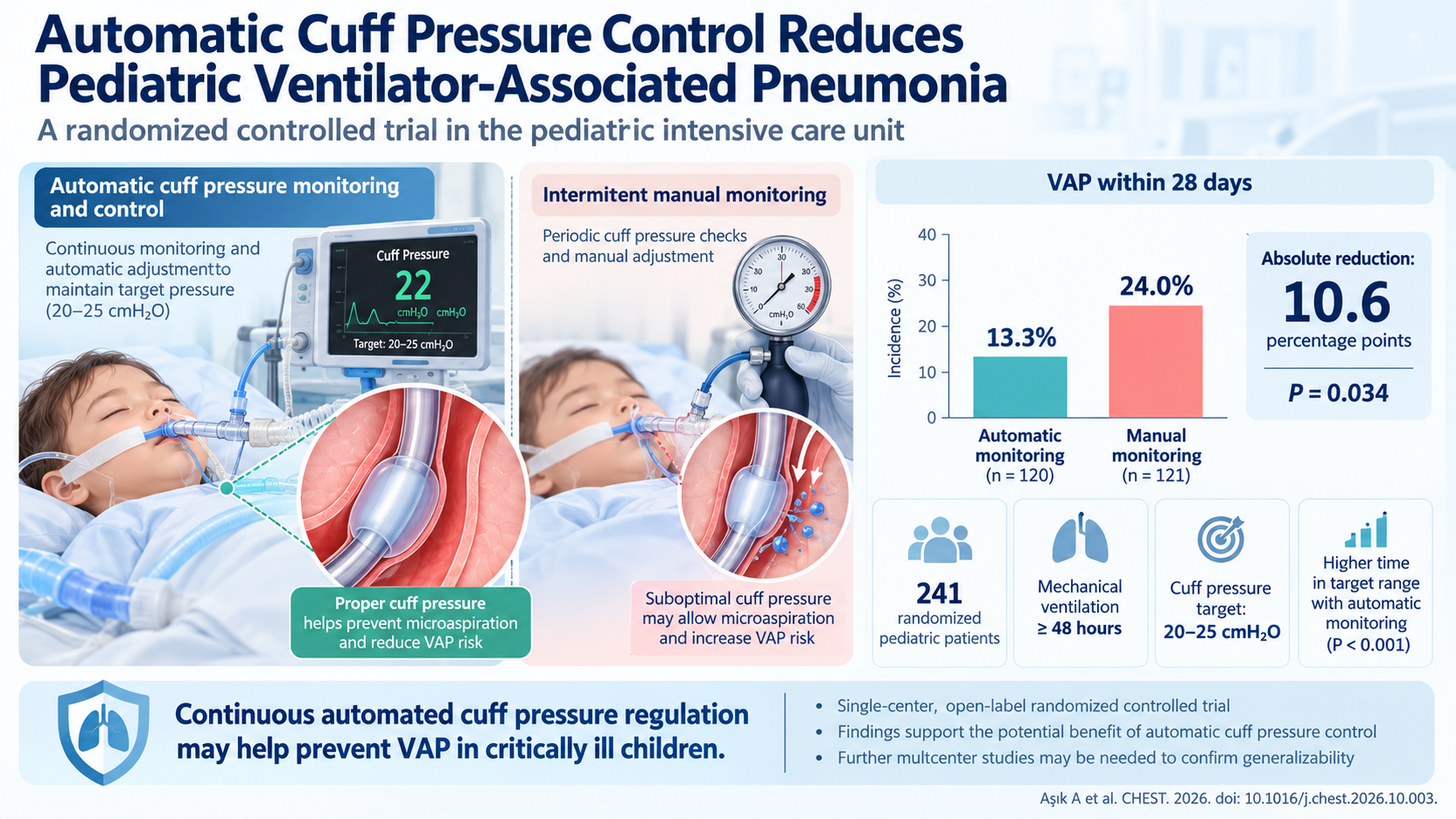
Highlight
– Continuous automatic cuff pressure monitoring (CACPM) reduces ventilator-associated pneumonia (VAP) incidence in critically ill children compared to intermittent manual monitoring.
– Precise maintenance of endotracheal cuff pressure at 20-25 cmH2O improves target pressure compliance.
– Adjusted analysis shows a significant hazard reduction for VAP with automatic monitoring.
– CACPM can be considered a valuable adjunct in pediatric VAP prevention protocols.
Study Background
Ventilator-associated pneumonia (VAP) remains one of the most common healthcare-associated infections in pediatric intensive care units (PICU) globally, contributing significantly to increased morbidity, prolonged hospital stay, and healthcare costs. The pathogenesis of VAP is closely linked to microaspiration of secretions around the endotracheal tube cuff, which can allow bacterial invasion of the lower respiratory tract during mechanical ventilation. Maintaining an optimal cuff pressure is critical to minimizing leakage and subsequent aspiration; however, manual intermittent cuff pressure measurement may be inconsistent and allow pressure fluctuations that predispose to VAP.
Despite advances in critical care, turning this preventative understanding into effective bedside practices in pediatric populations has been a challenge. This study addresses a crucial gap by evaluating whether continuous automatic cuff pressure monitoring (CACPM), which allows real-time adjustment to maintain target pressure, can reduce VAP incidence compared to the traditional intermittent manual cuff pressure monitoring (IMCPM).
Study Design
This open-label, randomized controlled trial enrolled 241 pediatric patients requiring mechanical ventilation for 48 hours or more in a PICU. Patients were randomized in a 1:1 ratio to either continuous automatic cuff pressure monitoring (CACPM) or intermittent manual cuff pressure monitoring (IMCPM). The intervention group received automatic real-time cuff pressure adjustment targeting 20-25 cmH2O, a pressure range previously associated with reduced microaspiration risk. The primary endpoint was the proportion of patients who developed VAP within 28 days of intubation, analyzed on an intention-to-treat (ITT) basis.
Secondary endpoints included time to VAP diagnosis, target cuff pressure compliance rates, and incidence density per 1,000 ventilator-days. Statistical methods employed Kaplan-Meier survival analysis and Cox proportional hazard regression adjusted for important clinical covariates.
Key Findings
The trial demonstrated a statistically and clinically significant reduction in the proportion of patients developing VAP in the CACPM arm compared to the IMCPM arm (13.3% vs 24.0%; risk difference -10.6 percentage points; 95% CI -20.3 to -0.8; P=0.034) in the ITT population. The per-protocol (PP) analysis confirmed these findings with 15.0% vs 26.6% VAP incidence (P=0.044).
Although the incidence density of VAP per 1,000 ventilator-days showed a lower rate in the CACPM group (15.7 vs 27.1), the difference did not reach statistical significance (Incidence Rate Ratio, IRR 1.73; 95% CI 0.94-3.18; P=0.080). Unadjusted time-to-event analysis with Kaplan-Meier curves indicated a nonsignificant trend toward earlier VAP diagnosis in the IMCPM group (Hazard Ratio, HR 1.80; 95% CI 0.976-3.321; P=0.060).
Importantly, after adjusting for confounders in a multivariable Cox proportional hazards model, IMCPM was associated with a significantly higher hazard of developing VAP (HR 1.90; 95% CI 1.024-3.510; P=0.042), underlining the independent protective effect of CACPM.
Target cuff pressure compliance, measured as the proportion of time cuff pressure was maintained within the optimal target range, was significantly higher in the CACPM group (P<0.001), which plausibly explains the reduction in VAP incidence by effectively minimizing microaspiration risk.
Expert Commentary
This study marks a relevant advance in pediatric critical care by rigorously testing and demonstrating that a straightforward technological intervention—automating cuff pressure control—can reduce a major complication. Maintaining cuff pressure within the narrow therapeutic window is challenging during manual intermittent checks due to fluctuations from patient movements, suctioning, and circuit changes. Automated continuous monitoring provides real-time feedback and adjustment mitigating these issues.
One limitation is the open-label design which could introduce performance bias, although the objective primary endpoint diagnosis and blinding of outcome adjudicators mitigate this risk. The single-center design may affect generalizability, but the large sample size and robust methodology offer confidence that these results are applicable in comparable PICU settings.
The conflicting non-significant incidence density finding might relate to variability in ventilator days or sample size constraints for that measure. However, the consistent and significant reduction in VAP proportion and adjusted hazard reinforce the clinical relevance.
From a mechanistic standpoint, optimal cuff pressure prevents subglottic secretions from entering the lower respiratory tract, thereby attenuating bacterial colonization and subsequent pneumonia. Automation ensures sustained compliance during prolonged ventilation, which is especially critical in pediatric populations with smaller airway and cuff sizes.
Conclusion
Continuous automatic endotracheal cuff pressure monitoring represents a significant improvement in the prevention of ventilator-associated pneumonia among critically ill children requiring prolonged mechanical ventilation. The study supports integrating CACPM into pediatric ICU protocols to enhance cuff pressure management, reduce VAP incidence, and potentially improve clinical outcomes. Future multicenter trials and cost-effectiveness analyses would further solidify CACPM’s place in standard care. Meanwhile, clinicians and PICU teams should consider adoption of this technology as part of evidence-based VAP prevention bundles.
Funding and Clinical Trials Registration
This trial was registered with ClinicalTrials.gov under identifier NCT05918172. No specific funding details were provided in the primary report.
References
Aşık A, Duyu M, Özdemir Dağhan SH, Pehlivan P, Türkmen B, Sevinç NA, Tüfekçi Y, Özyıldırım B, Sametoğlu SY, Bulut Y. Effectiveness of Continuous Automatic Endotracheal Cuff Pressure Monitoring in Preventing Ventilator-Associated Pneumonia in the Pediatric Intensive Care Unit: A Randomized Controlled Trial. Chest. 2026 Oct 10:S0012-3692(26)06801-7. doi: 10.1016/j.chest.2026.10.003. Epub ahead of print. PMID: 42858808.
This article was created using several editorial tools, including AI, as part of the process. Human editors reviewed this content before publication.