Isoflurane-Based Inhaled Sedation for Acute Hypoxemic Respiratory Failure: Insights from the SAVE-ICU Randomized Clinical Trial
Highlights
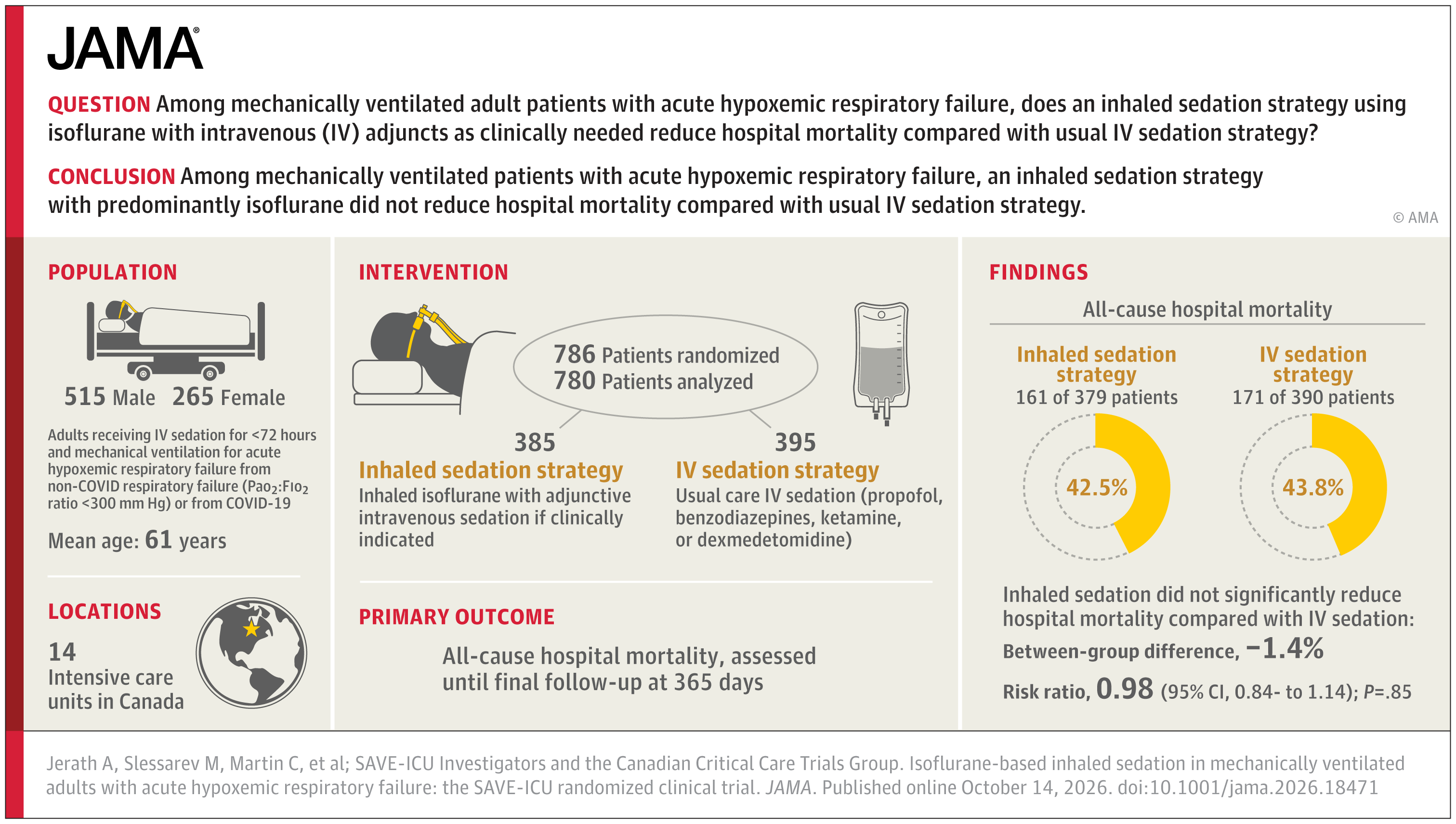
The SAVE-ICU trial is the largest pragmatic RCT evaluating isoflurane-based inhaled sedation compared to intravenous sedation in adults with acute hypoxemic respiratory failure (AHRF), including COVID and non-COVID etiologies.
Isoflurane inhaled sedation did not reduce hospital mortality or improve ventilator-, ICU-, or hospital-free days compared with standard intravenous sedation.
Patients receiving inhaled sedation received more adjunct therapies for refractory hypoxemia and had slightly fewer delirium- and coma-free days, without difference in long-term functional outcomes.
These findings temper early enthusiasm for inhaled sedation as superior in AHRF and underscore the need for refined sedation strategies tailored to patient subgroups and complementary supportive therapies.
Background
Acute hypoxemic respiratory failure (AHRF), defined by impaired oxygenation and gas exchange necessitating mechanical ventilation, remains a common and lethal critical illness syndrome. Despite advances in supportive care, mortality rates remain high, exceeding 40% in many cohorts. Sedation is integral to ventilatory management, primarily aiming to improve patient-ventilator synchrony, reduce stress and anxiety, and facilitate tolerance of endotracheal tubes and ventilators.
Traditionally, intravenous agents such as propofol, benzodiazepines, and opioids prevail, but inhaled volatile anesthetics like isoflurane offer potential advantages due to rapid titratability, bronchodilation effects, and potentially reduced systemic toxicity owing to minimal metabolism. Prior small trials and mechanistic studies hinted that inhaled sedation may shorten ventilation duration and reduce delirium risk; however, robust RCT evidence in AHRF was lacking.
Key Content
Chronological Development of Evidence on Inhaled Sedation in ICU
Early observational and small RCT data from the 2000s onwards raised interest in volatile anesthetics for long-term ICU sedation, citing faster awakening and anti-inflammatory properties. Meta-analyses up to 2020 suggested potential reductions in ICU length of stay and ventilation duration but were limited by heterogeneity, small sizes, and inclusion of mixed ICU populations.
Amidst the COVID-19 pandemic, the need for effective sedation strategies in AHRF intensified, with isoflurane inhaled sedation emerging as a feasible alternative where intravenous drug shortages occurred. Small pilot studies demonstrated safety and feasibility but could not address mortality or long-term outcomes.
The SAVE-ICU Randomized Clinical Trial (2020–2025)
Jerath and colleagues conducted a pragmatic, open-label, randomized clinical trial enrolling 786 adults with AHRF receiving mechanical ventilation across 14 Canadian ICUs. The inclusion of both COVID-19 and non-COVID respiratory failure allowed broad applicability. The intervention group received inhaled isoflurane sedation titrated to target sedation levels, with intravenous adjuncts as needed; the control group received standard intravenous sedation per ICU protocols.
Primary endpoint was all-cause hospital mortality. Secondary outcomes included ICU-, ventilator-, and hospital-free days, use of adjunctive therapies for refractory hypoxemia (e.g., prone positioning, ECMO), neurocognitive outcomes (delirium- and coma-free days), and 3-month quality of life and disability scores.
Outcomes and Interpretation
The trial found no significant difference in hospital mortality between inhaled sedation (42.5%) and intravenous sedation groups (43.8%), with a risk ratio of 0.98 (95% CI 0.84–1.14; P=0.85). Secondary outcomes also showed parity in ventilator-, ICU-, and hospital-free days. Notably, the inhaled sedation group required more adjunctive therapies for refractory hypoxemia (63.9% vs 55.0%), suggesting more severe or less responsive respiratory failure despite similar baseline severity.
A modest reduction was observed in delirium- and coma-free days among patients receiving inhaled sedation (-0.95 days), an unexpected finding contrasting earlier smaller studies which suggested a potential neurocognitive benefit. No differences emerged in 3-month patient-centered outcomes such as quality of life or disability.
Subgroup analyses for age, sex, and COVID-19 status did not reveal differential effects, indicating consistent results across diverse AHRF populations.
Safety and Practical Considerations
The study documented frequent concomitant use of intravenous sedatives alongside isoflurane, reflecting challenges in achieving adequate sedation with isoflurane alone. This combined sedation approach may dilute potential benefits of inhaled agents. Practical deployment requires specialized anesthesia delivery systems compatible with ICU ventilators, adding complexity.
There were no new safety signals regarding isoflurane toxicity, strengthening its safety profile for ICU sedation use under clinical supervision.
Expert Commentary
The SAVE-ICU trial provides the most rigorous evidence to date on inhaled isoflurane sedation in mechanically ventilated adults with AHRF and challenges prior optimistic assumptions about its superiority. Despite promising pharmacologic properties, the lack of hospital mortality benefit and increased adjunct therapy use suggests inhaled sedation may not confer major clinical advantage over established intravenous regimens.
The somewhat greater use of adjunctive therapies for refractory hypoxemia in the inhaled sedation group raises questions about potential subtle effects on ventilation-perfusion matching or inflammatory pathways. Mechanistically, while isoflurane’s bronchodilatory and anti-inflammatory effects are documented in preclinical models, translation to improved clinical outcomes remains uncertain.
The observed decrease in delirium- and coma-free days contrasts with previous findings and calls for further exploration of neurocognitive effects of volatile anesthetics during prolonged ICU sedation.
From a guidelines perspective, current critical care sedation recommendations emphasize light sedation with validated scales and minimizing benzodiazepine use. Inhaled sedation may remain appropriate in selected settings, especially where intravenous agents are contraindicated or unavailable, but routine replacement of intravenous sedation is unsupported.
Limitations of the trial include open-label design and incomplete isolation of isoflurane effects due to concomitant intravenous sedative use. Future studies might focus on subpopulations that could differentially benefit, such as those intolerant to intravenous agents or with severe bronchospasm.
Conclusion
Collectively, the SAVE-ICU randomized clinical trial defines the current clinical role for isoflurane-based inhaled sedation in AHRF: a safe and feasible alternative but not superior to intravenous sedation regarding mortality or short- and medium-term clinical outcomes. These findings underscore the complexity of sedation management in critically ill ventilated patients and emphasize individualized, multimodal approaches targeting sedation depth, respiratory mechanics, and adjunct therapies.
Research gaps remain in delineating mechanisms by which inhaled anesthetics might effect lung recovery and neurocognition, optimal sedation combinations, and integration with precision medicine strategies. Ongoing and future trials should pursue these avenues to refine sedation practice in ICU respiratory failure.
References
Jerath A, Slessarev M, Martin C, D’Aragon F, Carrier FM, Senaratne J, Meggison H, Hooper J, Cavayas YA, Goligher EC, Couture EJ, Randall IM, Hatzakorzian R, Jacka M, Wiener-Kronish J, Xie Z, Pinto R, Hussain I, Cuthbertson BH, SAVE-ICU Investigators, Canadian Critical Care Trials Group. Isoflurane-Based Inhaled Sedation in Mechanically Ventilated Adults With Acute Hypoxemic Respiratory Failure: The SAVE-ICU Randomized Clinical Trial. JAMA. 2026 Oct 14; PMID: 42872958. https://pubmed.ncbi.nlm.nih.gov/42872958/
Bellgardt M, et al. Volatile anesthetics for sedation in intensive care: a prospective randomized trial. Crit Care. 2016;20:87. PMID: 27091193.
Mesguich E, et al. Inhaled sedation in intensive care unit—a narrative review. Ann Transl Med. 2019;7(24):817. PMID: 32088737.
Kress JP, et al. Sedation and Analgesia in the ICU: The New Frontier. Ann Am Thorac Soc. 2019;16(7):847-849. PMID: 31335657.
This article was created using several editorial tools, including AI, as part of the process. Human editors reviewed this content before publication.