Highlight
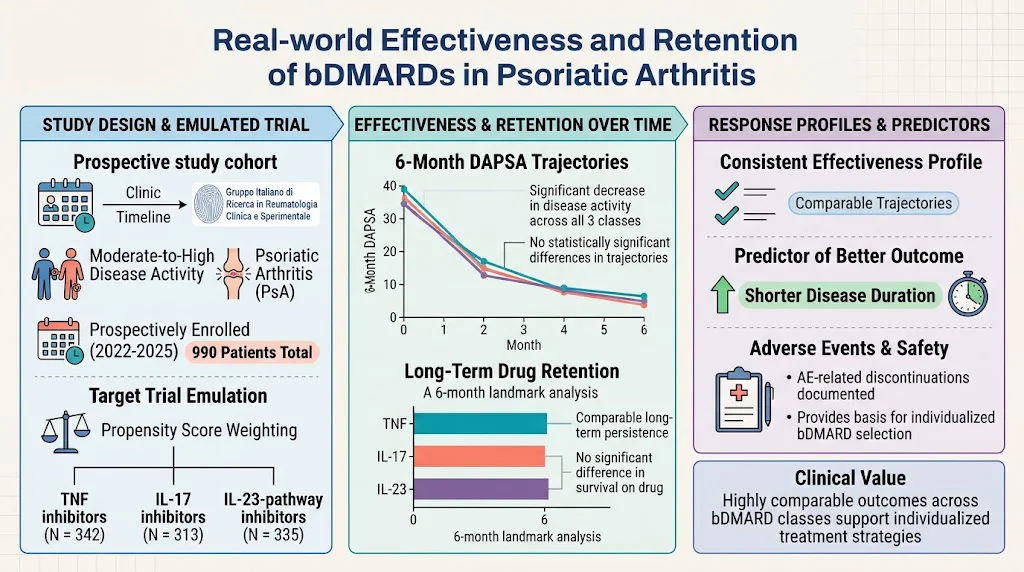
All three biologic DMARD classes—TNF inhibitors, IL-17 inhibitors, and IL-23 pathway inhibitors—demonstrated significant and comparable 6-month effectiveness in reducing PsA disease activity as measured by DAPSA.
Long-term drug retention over subsequent months showed no statistically significant differences among bDMARD classes, indicating similar persistence in clinical practice.
Shorter disease duration was consistently associated with better treatment outcomes, suggesting earlier intervention may optimize response.
Distinct, class-specific response patterns were observed, providing a basis for personalized therapeutic strategies in PsA.
Study Background
Psoriatic arthritis (PsA) is a chronic inflammatory musculoskeletal disease associated with psoriasis, characterized by heterogeneous clinical manifestations affecting peripheral joints, entheses, axial skeleton, and skin. This complexity contributes to varied responses to treatment and challenges in optimizing management. Biologic disease-modifying antirheumatic drugs (bDMARDs) targeting key inflammatory pathways—including tumor necrosis factor (TNF), interleukin-17 (IL-17), and interleukin-23 (IL-23)—have revolutionized PsA therapy by offering improved disease control. However, direct head-to-head comparisons of these agents in randomized controlled trials remain limited. Real-world evidence reflecting routine clinical practice is critical to validate effectiveness, understand long-term drug retention, and identify predictors of response that may guide personalized treatment decisions. This study addresses the unmet need for comparative effectiveness data using an innovative emulated multicentre clinical trial approach applied to prospectively collected real-world data.
Study Design
This multicentre study prospectively enrolled 990 consecutive patients with moderate-to-high PsA disease activity who initiated treatment with a bDMARD between January 2022 and June 2025 as part of the Gruppo Italiano di Ricerca in Reumatologia Clinica e Sperimentale (GIRRCS). The three biologic classes studied were TNF inhibitors (n=342), IL-17 inhibitors (n=313), and IL-23 pathway inhibitors (n=335).
Real-world data were analyzed within a target trial emulation framework, designed to approximate randomized controlled trial conditions by adjusting for confounders and improving comparability across treatment groups. Propensity score weighting balanced baseline characteristics to reduce selection bias. The primary effectiveness outcome was change in Disease Activity Index for Psoriatic Arthritis (DAPSA) over 6 months.
For long-term persistence analysis, a 6-month landmark method was applied, focusing on patients continuing the index bDMARD at month 6 to evaluate subsequent drug retention. Exploratory analyses assessed clinical factors associated with treatment response and discontinuation, including disease duration and prior bDMARD exposure. Safety data on adverse-event-related discontinuations were reported descriptively.
Key Findings
Effectiveness Over 6 Months
All three bDMARD classes yielded significant reductions in DAPSA scores over 6 months, indicating improved disease control. Adjusted analyses found no statistically significant differences in the longitudinal trajectories of DAPSA among TNF, IL-17, and IL-23 inhibitor groups. This suggests broadly comparable short-term efficacy among these biologics in real-world PsA patients.
Long-Term Drug Retention
Among patients who remained on treatment at the 6-month landmark, subsequent drug retention rates did not differ significantly between bDMARD classes. The comparable persistence implies similar tolerability, effectiveness, and patient satisfaction in clinical practice across these therapies.
Predictors of Response and Discontinuation
Shorter disease duration prior to bDMARD initiation was associated with more favorable clinical outcomes, reinforcing the importance of early therapeutic intervention. The impact of prior bDMARD exposure on treatment response was inconsistent, reflecting heterogeneity in patient experiences and clinical contexts. Exploratory, class-specific associations with response patterns were identified but require validation.
Safety and Discontinuations
Adverse-event-related discontinuations were documented but not analyzed for formal comparative safety due to study design constraints. This acknowledges the need for dedicated pharmacovigilance studies to fully characterize safety profiles among bDMARD classes.
Expert Commentary
This large, multicenter real-world study leverages a robust target trial emulation methodology, enhancing the validity of comparative effectiveness assessments beyond traditional observational designs. Its finding of comparable efficacy and persistence among TNF, IL-17, and IL-23 inhibitors supports current treatment paradigms emphasizing individualized therapy selection based on clinical features and patient preference.
The identification of shorter disease duration as a predictor of better outcomes aligns with accumulating evidence advocating early intervention to alter disease trajectory in PsA. However, inconsistent relationships regarding prior biologic failures highlight ongoing challenges in treatment sequencing.
Limitations include the observational nature inherent to real-world data, potential residual confounding, and lack of formal safety comparison. The exploratory subgroup findings warrant further mechanistic studies and randomized head-to-head trials to clarify optimal patient-bDMARD matching.
Overall, the study offers valuable insights into the real-world utility of bDMARDs in PsA and underscores the promise of personalized medicine approaches tailored to patient-specific clinical profiles.
Conclusion
In this emulated multicentre clinical trial using prospective real-world data, biologic DMARDs targeting TNF, IL-17, and IL-23 pathways demonstrated comparable short-term therapeutic effectiveness and long-term treatment persistence in patients with psoriatic arthritis. Early disease duration emerged as a key factor influencing favorable responses. These findings support the current use of all three bDMARD classes as effective options and highlight the potential to refine therapy selection through individualized assessment of response patterns and clinical characteristics. Further research should focus on validating predictors, understanding mechanistic differences among biologic classes, and integrating safety evaluations to optimize comprehensive PsA management.
Funding and Clinical Trials Registration
The study was conducted under the auspices of the Gruppo Italiano di Ricerca in Reumatologia Clinica e Sperimentale (GIRRCS). No specific funding or clinicaltrials.gov registration was reported in the source publication.
References
Ruscitti P, Masedu F, Pantano I, et al. Real‑world assessment of the effectiveness and response profiles of biologic DMARDs in psoriatic arthritis: findings from an emulated multicentre clinical trial. Ann Rheum Dis. 2026 Oct 28. PMID: 42951730. https://pubmed.ncbi.nlm.nih.gov/42951730/
Additional literature supporting early intervention in PsA and the efficacy of biologic DMARDs can be found in current EULAR and GRAPPA guidelines and recent meta-analyses on PsA therapeutics.