Centralized Expert Review Enhances Diagnostic Accuracy in Axial Spondyloarthritis: Insights from a Multicenter Telemedicine Study
Highlight
Centralized expert review of clinical and imaging data in suspected axial spondyloarthritis (axSpA) enhances diagnostic precision compared to local assessments.
Over 969 cases evaluated prospectively via a telemedicine platform demonstrated a 33.7% discrepancy when local diagnoses labeled axSpA but experts identified alternative causes.
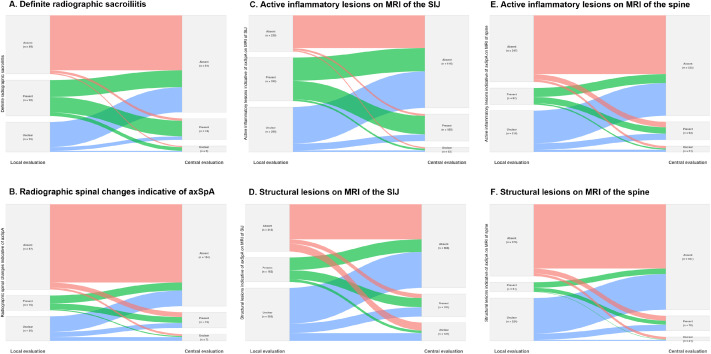
Interpretation of imaging findings, especially of sacroiliac joints and spine, was a major driver of diagnostic differences between local and central evaluations.
Telemedicine-facilitated centralized review may reduce misdiagnosis, improving targeted treatment initiation and patient outcomes in axSpA.
Background: Clinical Context and Unmet Need
Axial spondyloarthritis (axSpA) is a chronic inflammatory rheumatic disease primarily affecting the axial skeleton, notably the sacroiliac joints and spine, leading to pain, stiffness, and potential structural damage. Early diagnosis is critical to initiate disease-modifying therapies and prevent irreversible disability. However, the clinical presentation of axSpA often overlaps with other causes of chronic back pain such as degenerative and mechanical disorders, posing significant diagnostic challenges.
Imaging, particularly MRI, plays a crucial role in detecting inflammation and structural lesions consistent with axSpA. Nonetheless, variability in imaging interpretation and clinical assessments across centers may contribute to diagnostic inaccuracy, delayed treatment, and unnecessary interventions. Establishing standardized, expert-led evaluation strategies holds promise to mitigate these issues.
Study Design
This prospective multicentre study implemented a centralized telemedicine platform to collect detailed demographic, clinical, laboratory, and imaging data from patients presenting with suspected axSpA to rheumatologists and orthopaedists. The study enrolled 969 patients across multiple centers, enabling remote, blinded expert assessments of all submitted case information.
The central review involved experienced axSpA specialists conducting comprehensive evaluations of clinical histories and imaging, including MRI scans. Diagnostic conclusions regarding the presence or absence of axSpA were systematically documented. Comparisons were made between local diagnoses established by referring physicians and centralized expert assessments.
Key Findings
Among 969 patients, the local clinical teams diagnosed axSpA in 264 cases (27.2%). Following centralized expert review, 238 patients (24.6%) were classified as having axSpA, reflecting a slight reduction overall.
Detailed comparison revealed notable discrepancies:
Of the 264 locally diagnosed axSpA cases, only 142 (53.8%) were confirmed by central experts.
In 89 cases (33.7%) with local axSpA diagnosis, experts considered alternative causes of back pain more likely. Degenerative or mechanical disorders were the predominant alternative diagnoses.
Among 319 patients locally assessed as not having axSpA, 265 (83.1%) were concordant with expert evaluations.
A significant factor contributing to discordance was the interpretation of imaging findings. Central experts applied rigorous criteria to distinguish inflammatory lesions typical of axSpA from degenerative or nonspecific changes, which appeared overdiagnosed in local assessments.
This centralized review process reduced the risk of false-positive axSpA diagnoses and allowed more accurate identification of patients without inflammatory pathology, facilitating appropriate clinical management.
Expert Commentary
These findings highlight the complexity of diagnosing axSpA and the critical role of expert interpretation of imaging in this process. Discrepancies emphasize the need for enhanced training and potentially consensus reads to improve local diagnostic accuracy.
Centralized telemedicine platforms provide a scalable solution to access expert opinions without geographic constraints, supporting clinical decision-making in community and specialized settings alike. Although centralized review was more stringent, clinical context and imaging quality remain essential to optimize outcomes.
Limitations include potential referral bias as only patients with suspected axSpA were included, and the study did not assess the impact on longitudinal patient outcomes. Future research should evaluate whether centralized assessment translates to better long-term prognoses and cost-effectiveness.
Conclusion
This prospective multicentre study demonstrates that centralized evaluation of both clinical and imaging data by axSpA experts using a telemedicine platform enhances diagnostic accuracy and reduces misclassification. By addressing a major source of diagnostic variability—the radiologic interpretation of key imaging features—centralized expert review can improve patient stratification and treatment selection.
Clinical integration of such approaches could standardize axSpA diagnosis, ensuring that patients receive timely and appropriate care while avoiding overtreatment of non-inflammatory back pain conditions. Further studies are warranted to assess implementation strategies, impact on patient outcomes, and health economic implications.
Funding and Registration
The article did not provide specific details on funding sources or clinical trial registration.
References
1. Poddubnyy D, Redeker I, Kämmerer M, et al. Enhancing diagnostic accuracy in axial spondyloarthritis through centralised clinical and imaging evaluation: results from a prospective multicentre project. Ann Rheum Dis. 2026;85(10):1956-1966. doi:10.1136/annrheumdis-2025-42420061
2. Rudwaleit M, van der Heijde D, Landewe R, et al. The development of Assessment of SpondyloArthritis International Society classification criteria for axial spondyloarthritis (part II): validation and final selection. Ann Rheum Dis. 2009;68(6):777-783.
3. Maksymowych WP, Inman RD, Salonen D, et al. Spondyloarthritis Research Consortium of Canada magnetic resonance imaging index for assessment of sacroiliac joint inflammation in ankylosing spondylitis. Arthritis Rheum. 2005;53(5):703-709.
4. Sieper J, Rudwaleit M, Baraliakos X, et al. The Assessment of SpondyloArthritis international Society (ASAS) handbook: a guide to assess spondyloarthritis. Ann Rheum Dis. 2009;68 Suppl 2:ii1-44.
This article was created using several editorial tools, including AI, as part of the process. Human editors reviewed this content before publication.