We use cookies

Our website uses essential cookies and, with your consent, additional cookies to measure performance and improve our services. Cookie Policy.

You can change your choice at any time.

MMedXYNews
HomeVideos
MedXY AI/MedXY News/Section: Diabetes & Endocrinology

Optimizing Interpretation of Serial Aldosterone-to-Renin Ratio Measurements in Primary Aldosteronism Diagnosis
MedXY Editorial Team•Sep 27, 2026•Diabetes & Endocrinology
primary aldosteronismaldosterone-to-renin ratioendocrine hypertensiondiagnosis

Highlight

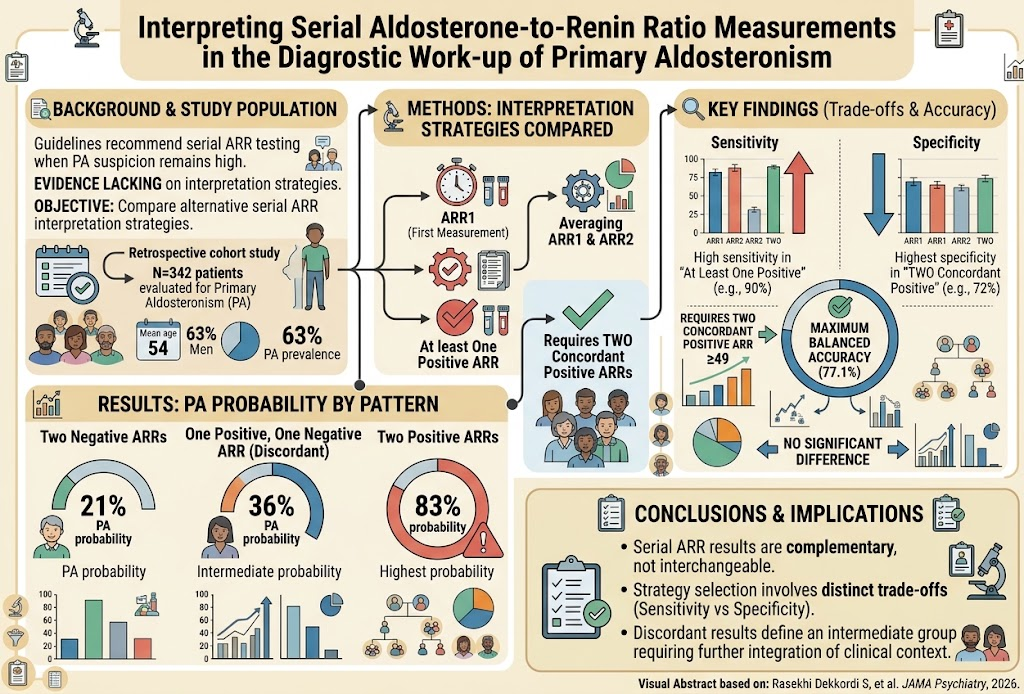
  • Serial aldosterone-to-renin ratio (ARR) measurements provide complementary data rather than interchangeable results in diagnosing primary aldosteronism (PA).
  • Requiring both ARR measurements to be positive improves balanced diagnostic accuracy, achieving 82.2% sensitivity and 71.9% specificity at a threshold of 49.
  • Patients with discordant ARR results represent an intermediate risk group, necessitating nuanced clinical integration and further evaluation.
  • Averaging two serial ARR measurements modestly improves discrimination for biochemical confirmation of PA.

Study Background

MedXY registered readers

Sign in free to continue reading

Create or use your MedXY account to unlock the complete article.

This article was created using several editorial tools, including AI, as part of the process. Human editors reviewed this content before publication.

Related articles

Open language-specific specialty feeds and department pages.

Laparoscopic Modified Davydov’s Technique for Vaginoplasty: Operative Steps and Technical PearlsA 21-year-old woman with Müllerian agenesis underwent a standardized laparoscopic modified Davydov vaginoplasty, achieving an 11 cm neovagina with intact function and no complications at 6-month follow-up.Sep 21, 2026Balancing Accuracy and Practicality: Should RAAS-Modifying Drugs Be Withdrawn in Primary Aldosteronism Diagnosis?This article examines the debate on whether RAAS-modifying antihypertensives should be stopped before testing for primary aldosteronism, weighing diagnostic accuracy against patient safety and feasibility.Sep 15, 2026Widening the Spectrum of Disease Expression due to Heterozygous Variants in EFEMP1A case series delineating a novel EFEMP1 variant, p.Arg140Trp, associated with late-onset peripheral retinal degeneration distinct from classic DHRD/ML, highlighting rod dysfunction precedes structural changes.Sep 13, 2026Early Identification of PVOD/PCH in Pulmonary Arterial Hypertension: Introducing a Novel Clinical Likelihood Score
Loading comments...
MedXY briefing

Get the free newsletter

Evidence-led clinical news, trends, and analysis—delivered to your inbox.

Ask MedXY AI

Most popular

Intimate Health
Five Benefits for Women Continuing Sexual Activity After Menopause
Intimate Health
Why Some Women Have a Strong Sex Drive—And Why Men Shouldn't Worry About It
Nursing & care
How often should a couple have sex?
General Surgery
Optimizing Postoperative Opioid Prescriptions After Intra-Abdominal Cancer Surgery: Comparing the 5x-Multiplier and 3-Tier Models
Intimate Health
Classic Intimacy Recommendations: How to Help Women Reach Orgasm and Enjoy Mutual Pleasure
© 2026 MedXY
Contact usAbout usPrivacy PolicyMedXY story
A newly developed clinical likelihood score accurately distinguishes pulmonary arterial hypertension patients with venous or capillary involvement (PVOD/PCH), enabling earlier diagnosis, tailored therapy, and timely transplant referral.
Sep 11, 2026
Cushing’s Syndrome in the Elderly: Diagnostic and Therapeutic Nuances in an Aging PopulationCushing’s syndrome in older adults requires a tailored diagnostic approach and individualized management that prioritizes functional status and quality of life over chronological age, accounting for atypical presentations and comorbidities.Sep 8, 2026
A patient with CHILD syndrome mimicking Hailey-Hailey disease: A diagnostic challengeWe present a molecularly confirmed case of CHILD syndrome mimicking Hailey-Hailey disease without classical features, highlighting diagnostic pitfalls and benefits of targeted therapy.Sep 3, 2026