Highlight
This study demonstrates that CaneStat, a novel recombinant hybrid protein, modulates the physicochemical characteristics of the acquired enamel pellicle favorably and significantly reduces early enamel erosion in vivo. Using quartz crystal microbalance with dissipation monitoring (QCM-D), CaneStat was shown to produce a pellicle layer with distinct viscoelastic properties. Furthermore, in a randomized triple-blind crossover clinical trial, CaneStat outperformed negative control and was comparable to a commercial positive control in protecting enamel against erosive challenges.
Study Background
Dental erosion, the irreversible loss of tooth enamel caused by acid challenge without bacterial involvement, represents a growing public health concern worldwide. Early enamel erosion undermines tooth integrity and can progress to hypersensitivity, aesthetic deterioration, and increased risk of caries. The acquired enamel pellicle, a proteinaceous film formed by selective adsorption of salivary proteins on enamel surfaces, plays a crucial protective role by acting as a diffusion barrier against erosive acids.
Enhancing pellicle protective properties via bioengineering approaches offers a promising preventive strategy. CaneStat, a recombinant hybrid protein designed to interact selectively with hydroxyapatite, the primary mineral of enamel, represents an innovative intervention aiming to increase pellicle robustness and resilience against acid-induced demineralization.
Study Design
This investigation comprised two complementary parts: an in vitro biophysical study employing quartz crystal microbalance with dissipation monitoring (QCM-D) to characterize the interaction between CaneStat and hydroxyapatite-coated sensors, and an in vivo randomized, triple-blind, crossover clinical trial to evaluate the preventive effect of CaneStat on early enamel erosion in healthy human volunteers.
In the QCM-D analysis, multiple concentrations of CaneStat (0.01 to 0.5 mg/mL) were applied to hydroxyapatite-coated quartz sensors, followed by exposure to saliva to facilitate pellicle formation. Frequency and dissipation shifts were recorded to quantify pellicle mass, thickness, viscosity, and elasticity parameters.
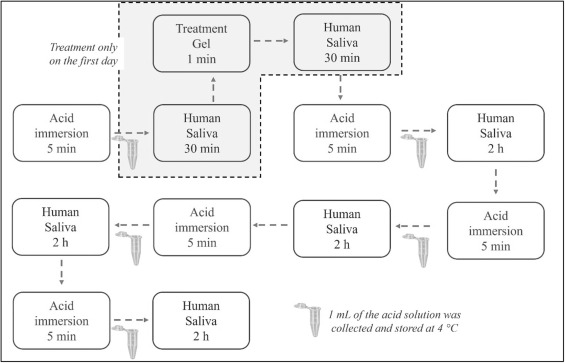
For the clinical trial, eighteen healthy adult volunteers underwent enamel prophylaxis followed by rinsing with deionized water (negative control), Elmex Erosion Protection (a fluoride-based positive control), or CaneStat (0.025 mg/mL). To model pellicle maturation, enamel surfaces were exposed to saliva for either 3 minutes or 2 hours before being subjected to an erosive challenge. The primary endpoint was change in percentage surface reflection intensity (%SRI), a sensitive measure of enamel surface integrity.
Key Findings
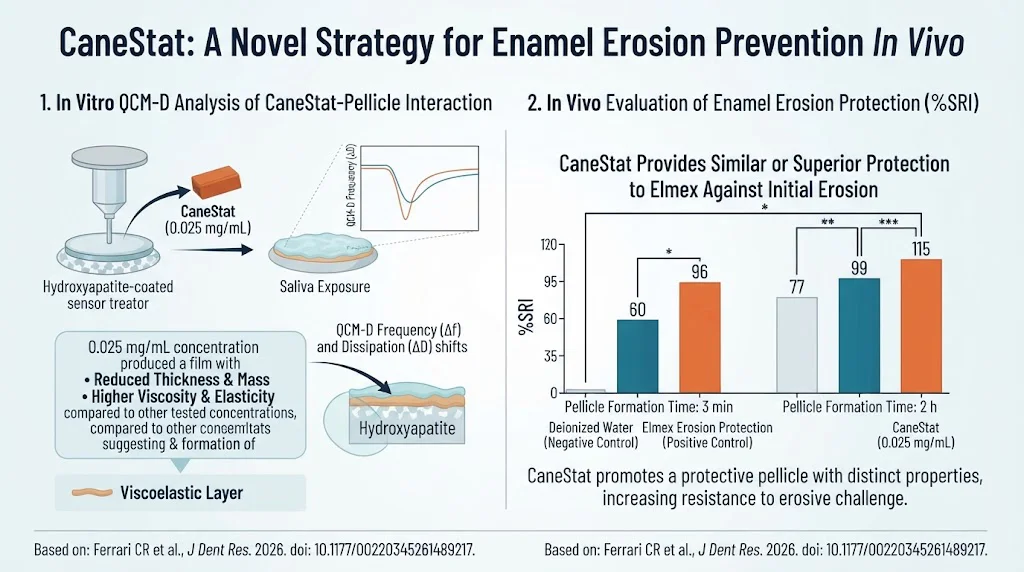
Biophysical Analysis (QCM-D): The 0.025 mg/mL concentration of CaneStat produced a pellicle film with reduced thickness and mass compared to other concentrations but exhibited significantly greater viscosity and elasticity. This indicates a more compact yet viscoelastic pellicle, hypothesized to confer enhanced mechanical stability and acid resistance. Frequency shift data confirmed robust and stable adsorption of CaneStat to hydroxyapatite even after saliva exposure and rinsing, while dissipation changes validated the formation of a viscoelastic protective layer.
Clinical Efficacy (In Vivo): Both pellicle formation time and treatment influenced enamel surface protection outcomes. At early (3-minute) pellicle formation, %SRI values for Elmex (94.2% ± 21.3%) and CaneStat (96.6% ± 19.6%) were significantly higher than for deionized water (60.1% ± 11.7%), indicating substantially better initial protection against acid challenge.
At the extended pellicle formation time (2 hours), CaneStat achieved an even higher %SRI (115.7% ± 33.7%) than Elmex (99.4% ± 21.1%) and markedly outperformed deionized water (77.5% ± 16.8%), highlighting statistically significant and clinically relevant enhanced erosion resistance. These data suggest that CaneStat not only protects enamel in the short term but may also improve pellicle durability and protective efficacy with time.
Safety and Tolerability: No adverse effects or safety concerns related to CaneStat rinsing were reported during the study, supporting its favorable safety profile for potential clinical use.
Expert Commentary
The interplay of the enamel pellicle with external agents to modulate its protective capabilities introduces a novel paradigm in dental erosion prevention. The use of recombinant hybrid proteins like CaneStat marks an advance beyond traditional fluoride-based therapies, leveraging molecular engineering to enhance the biochemical and biomechanical properties of the pellicle. This study’s integration of QCM-D biophysical assessments with rigorous clinical evaluation under randomized controlled conditions strengthens the validity of the findings.
One limitation is the relatively short-term exposure and assessment periods; future longitudinal studies are warranted to determine the durability of CaneStat’s protective effects and its influence on caries and hypersensitivity outcomes. Moreover, mechanistic elucidation of molecular interactions between CaneStat and native salivary pellicle components could inform optimization of the protein design.
Given their biocompatibility and customizable nature, recombinant proteins hold promise as next-generation preventive agents in oral health, potentially synergizing with or complementing established modalities.
Conclusion
CaneStat effectively modulates enamel pellicle composition and biophysical properties, resulting in significant protection against early enamel erosion in vivo. Its ability to form a viscoelastic pellicle layer with enhanced durability suggests a potential for improving clinical outcomes in patients at risk of dental erosion.
These findings advocate for further development and clinical evaluation of recombinant hybrid proteins as innovative tools in the preventive dentistry armamentarium. Optimizing formulations and delivery methods could pave the way for tailored, molecularly targeted strategies to mitigate erosive tooth wear and preserve dental health.
Funding and ClinicalTrials.gov
Funding sources were not detailed in the original publication. The clinical trial registration number was not provided.
References
1. Lussi A, Carvalho TS. Erosive tooth wear: a multifactorial condition of growing concern and increasing knowledge. Monogr Oral Sci. 2014;25:1-15. doi:10.1159/000360691
2. Hannig M, Balz M. Structure and function of the acquired pellicle. Monogr Oral Sci. 2001;15:14-29. doi:10.1159/000047303
3. Buzalaf MAR, et al. Fluoride and Other Protective Agents Against Dental Erosion. Monogr Oral Sci. 2018;27:102-17. doi:10.1159/000484596
4. Ferrari CR, Taira EA, Pelá VT, et al. CaneStat Modulates Pellicle Properties and Reduces Enamel Erosion In Vivo. J Dent Res. 2026 Oct 23:220345261489217. doi:10.1177/00220345261489217