We use cookies

Our website uses essential cookies and, with your consent, additional cookies to measure performance and improve our services. Cookie Policy.

You can change your choice at any time.

MMedXYNews
HomeVideos
MedXY AI/MedXY News/Section: Diabetes & Endocrinology

Bridging the Gap: Advancing Automated Insulin Delivery for Pregnant Women with Type 1 Diabetes
MedXY Editorial Team•Sep 29, 2026•Diabetes & Endocrinology
type 1 diabetesPregnancyautomated insulin deliveryGlycemic Management

Highlight

  • Pregnant women with type 1 diabetes require stringent, pregnancy-specific glycemic targets that are currently unmet by available automated insulin delivery (AID) systems.
  • FDA-approved AID devices are not designed or labeled for use during pregnancy, largely due to the exclusion of pregnant women from clinical trials.
  • Current AID systems reduce insulin delivery when glucose sensors indicate optimal fetal well-being range, which may not align with tighter pregnancy targets, risking suboptimal glucose control.
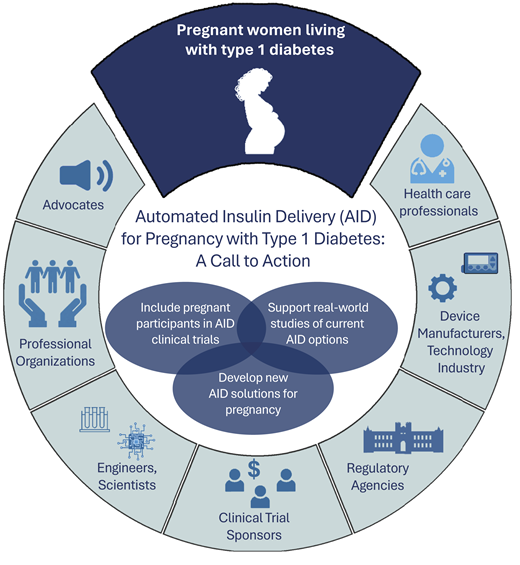
  • A coordinated call to action urges inclusion of pregnant women in AID clinical trials, the development of pregnancy-tailored AID systems, and real-world studies to improve outcomes in this vulnerable population.

Study Background: Disease Burden and Clinical Context

MedXY registered readers

Sign in free to continue reading

Create or use your MedXY account to unlock the complete article.

This article was created using several editorial tools, including AI, as part of the process. Human editors reviewed this content before publication.

Related articles

Open language-specific specialty feeds and department pages.

Precision Medicine in Type 1 Diabetes Prevention: Long-Term Delayed Onset of Stage 3 Diabetes After GAD-Alum Treatment in HLA-DR3-DQ2-Positive ChildrenGAD-alum immunotherapy significantly delays progression to stage 3 type 1 diabetes in children positive for the HLA-DR3-DQ2 haplotype, underscoring precision medicine’s role in managing autoimmunity.Oct 3, 2026Evaluating the Safety of GLP-1 Receptor Agonists and New-Generation Glucose-Lowering Agents in Pregnant Women with Type 2 Diabetes: Insights from a French Nationwide StudyA French nationwide cohort study finds first-trimester exposure to second-line glucose-lowering agents, including GLP-1 receptor agonists, is generally safe for pregnancies with type 2 diabetes, though a slight increase in cardiac malformatOct 3, 2026Challenges in Using Insulin Dose-Adjusted HbA1c to Identify Partial Remission in Pediatric Type 1 Diabetes: Insights from the SEARCH for Diabetes in Youth StudyThis study highlights the limitations of insulin dose-adjusted hemoglobin A1c (IDAA1c) ≤9 in detecting partial remission in US youth with type 1 diabetes, especially those with overweight or obesity, suggesting BMI-specific adjustments impr
Loading comments...
MedXY briefing

Get the free newsletter

Evidence-led clinical news, trends, and analysis—delivered to your inbox.

Ask MedXY AI

Most popular

Intimate Health
Five Benefits for Women Continuing Sexual Activity After Menopause
Intimate Health
Why Some Women Have a Strong Sex Drive—And Why Men Shouldn't Worry About It
Nursing & care
How often should a couple have sex?
Cardiology
Precision Medicine for Long QT Syndrome Type 2: Lumacaftor Corrects Trafficking Defects and Shortens QT Interval
General Surgery
Optimizing Postoperative Opioid Prescriptions After Intra-Abdominal Cancer Surgery: Comparing the 5x-Multiplier and 3-Tier Models
© 2026 MedXY
Contact usAbout usPrivacy PolicyMedXY story
Oct 3, 2026
Increased Risk of Obstructive Sleep Apnea and Poor Sleep Quality Among Older Adults With Type 1 Diabetes: Insights from the DCCT/EDIC CohortThis review synthesizes evidence from the DCCT/EDIC study highlighting the high prevalence and risk factors of obstructive sleep apnea and poor sleep quality in older adults with long-standing type 1 diabetes, emphasizing the clinical and mOct 3, 2026
Behavioral Interventions in Pediatric Type 1 Diabetes: Optimizing Glycemic Control Through Family-Centered, Multicomponent StrategiesUpdated meta-analysis reveals modest HbA1C improvements with behavioral interventions in youth with type 1 diabetes, highlighting the superiority of family-focused, multicomponent approaches over single-focus programs.Sep 29, 2026
Worsening Time in Range as a Predictor of Microvascular Complications in Type 1 Diabetes: Insights from a 5-Year Real-World StudyA 5-year real-world cohort study reveals that declines in CGM-derived time in range correlate with increased microvascular complications in type 1 diabetes, offering prognostic value beyond HbA1c.Sep 27, 2026