Highlights
Bariatric surgery yields significant 2-year total body weight loss (TBWL) in adults unresponsive or intolerant to semaglutide or tirzepatide.
Roux-en-Y gastric bypass (RYGB) provides greater weight loss compared to sleeve gastrectomy (SG) in patients with inadequate response to these medications.
Weight loss efficacy is influenced by type 2 diabetes (T2DM) status, with generally lower TBWL observed in T2DM patients post-surgery.
These findings clarify therapeutic sequencing after emerging GLP-1 and dual agonist treatment failures in obesity management.
Background
Obesity remains a global public health challenge associated with substantial morbidity and mortality, including increased risk for type 2 diabetes mellitus (T2DM), cardiovascular disease, and cancer. Pharmacotherapeutic advances have improved medical management; notably, glucagon-like peptide-1 receptor agonists (GLP-1 RAs) such as semaglutide, and dual glucose-dependent insulinotropic polypeptide (GIP) and GLP-1 receptor agonists like tirzepatide, demonstrate potent weight-loss effects. Yet, a significant proportion of patients experience intolerance due to side effects or achieve suboptimal weight loss, raising critical questions regarding optimal subsequent treatment strategies. Bariatric surgery, particularly Roux-en-Y gastric bypass (RYGB) and sleeve gastrectomy (SG), represents the most effective intervention for sustained weight reduction and metabolic improvement in severe obesity; however, data on its efficacy following GLP-1 or dual agonist therapy failure has been limited until recently.
Key Content
Chronological and Therapeutic Context
The exploration of GLP-1 receptor agonists for obesity began in the early 2010s, with liraglutide setting a precedent. Semaglutide, approved at higher doses for weight management, and more recently tirzepatide, with dual GIP/GLP-1 activity, have demonstrated superior weight loss compared to previous agents in randomized controlled trials (RCTs) (Wilding et al., 2021; Frias et al., 2021). Despite this, reports indicate that intolerance manifests as gastrointestinal adverse effects in roughly 10-20% of treated patients (Davies et al., 2021), and inadequate weight loss (often <5-10% TBWL) is observed despite adherence (Khera et al., 2023). Clinical guidelines lack clear pathways for such scenarios, highlighting the need for evidence on salvage treatments.
Evidence Synthesis: Bariatric Surgery Post-GLP-1 or Tirzepatide Therapy
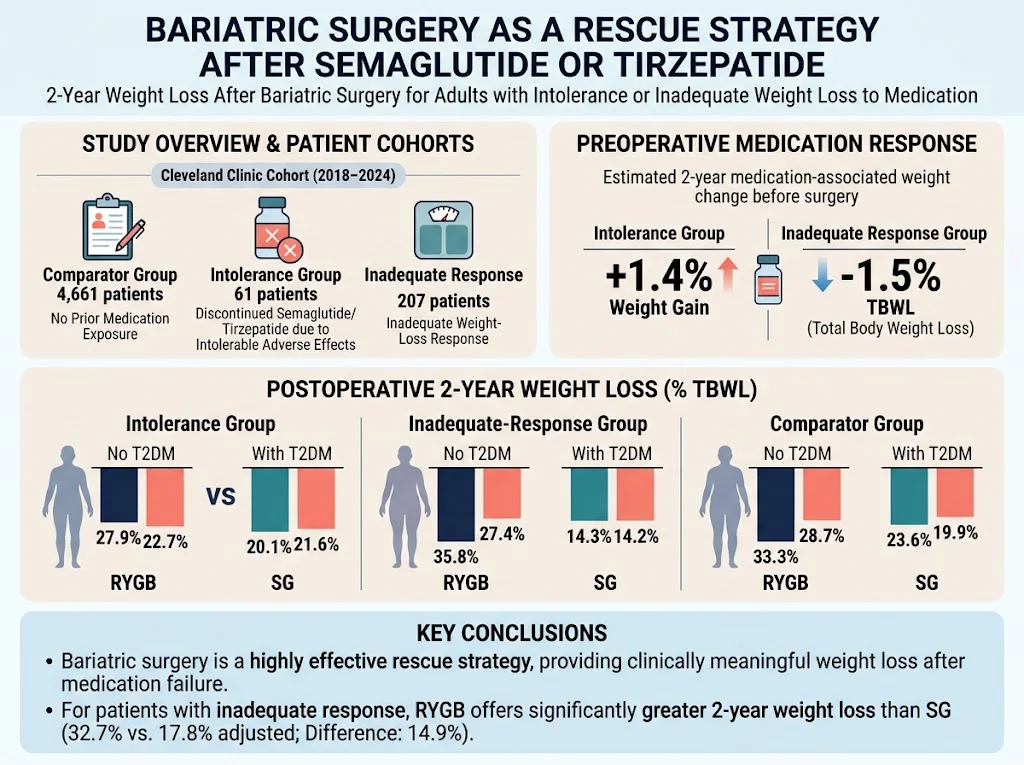
The recent retrospective cohort study by Aminian et al. (2026) enrolled 4,929 adults with BMI ≥35 kg/m² undergoing either RYGB or SG at a major US tertiary care center from 2018 to 2024. Patients were stratified into three groups: no prior exposure to semaglutide/tirzepatide (comparator), intolerance-related discontinuation, and inadequate response despite usage.
Prior to surgery, those intolerant experienced a slight weight gain (+1.4% TBWL), while inadequate responders had minimal loss (1.5% TBWL), emphasizing medication failure. After bariatric surgery, two-year TBWL was significantly greater in all groups compared to preoperative levels, with 27.9% and 22.7% TBWL after RYGB and 20.1% and 21.6% after SG for intolerance patients without and with T2DM, respectively. Notably, in inadequate responders, RYGB outperformed SG (35.8% vs. 14.3% TBWL in patients without T2DM), with statistically significant differences (adjusted difference 14.9 percentage points, 95% CI 13.1%-16.7%).
For patients without prior medication exposure, TBWL at two years was generally higher, suggesting prior medication failure does not preclude robust surgical outcomes but may influence choice of procedure. The study also highlights the dampening effect of T2DM on weight loss outcomes post-surgery, consistent with prior literature (Courcoulas et al., 2018).
Comparative Outcomes Between RYGB and SG
Meta-analyses and RCTs have showed RYGB tends to induce more significant total and sustained weight loss, as well as superior remission of T2DM compared to SG (Peterli et al., 2018; Mingrone et al., 2015). These effects are likely mediated through bypass of proximal small intestine modulating gut hormones and bile acids, impacting appetite and metabolism more profoundly.
The Aminian et al. study reinforces this, particularly in inadequate responders to GLP-1/dual agonists, supporting the preferential selection of RYGB in this subgroup to maximize weight loss potential. However, SG offers a lower risk profile and remains a reasonable alternative for intolerant patients.
Mechanistic Insights and Translational Implications
The differential response to pharmacotherapy versus surgery can be partially explained by their distinct mechanisms: semaglutide and tirzepatide primarily exert incretin-mediated appetite suppression and delayed gastric emptying, while bariatric surgery additionally alters nutrient flow, enteroendocrine signaling, bile acid metabolism, gut microbiota, and energy expenditure.
Patients unresponsive or intolerant to incretin-based therapies may harbor nuanced pathophysiological profiles, such as altered receptor sensitivity or gastrointestinal physiology, making surgical intervention with its broader metabolic effects an effective next step.
Expert Commentary
The management of obesity is shifting toward integrated multimodal approaches. Guidelines from ASMBS and AACE recognize pharmacotherapy and surgery as complementary, with evolving data clarifying the role of surgery after pharmacologic drug failure. This landmark study by Aminian et al. provides compelling real-world evidence supporting bariatric surgery as a viable and effective salvage strategy.
However, the retrospective design limits causal inference and the single health-system setting may constrain generalizability. Also, factors such as psychosocial variables influencing medication adherence and surgical outcomes warrant consideration. Prospective trials are needed to optimize sequencing and combination strategies.
Clinicians should weigh patient preferences, co-morbidities, and surgical risk profiles when counseling on escalation strategies after GLP-1 RA or tirzepatide failure. The demonstrated superiority of RYGB in inadequate responders informs procedural selection, but SG remains beneficial for intolerant patients and those at higher surgical risk.
Conclusion
Bariatric surgery, particularly RYGB, offers substantial and durable weight loss benefits for adults with severe obesity who have insufficient response or intolerance to semaglutide or tirzepatide. This evidence supports integrated obesity care pathways that include surgical options after the failure of potent pharmacotherapy. Future research should focus on prospective validation, patient-centered algorithms, and mechanistic elucidation of treatment responses to refine personalized obesity management.
References
Aminian A, Hammad AF, Sadeghmousavi S, et al. Bariatric Surgery as a Rescue Strategy After Semaglutide or Tirzepatide. Ann Surg. 2026 Nov 3. doi:10.1097/SLA.0000000000005924. PMID: 42972633.
Wilding JPH, Batterham RL, Calanna S, et al. Once-Weekly Semaglutide in Adults with Overweight or Obesity. N Engl J Med. 2021;384(11):989-1002. doi:10.1056/NEJMoa2032183.
Frias JP, Nauck MA, Van J, et al. Efficacy and safety of tirzepatide once weekly versus semaglutide in patients with type 2 diabetes (SURPASS-2): a randomised, open-label, phase 3 trial. Lancet. 2021;398(10295):1811-1824. doi:10.1016/S0140-6736(21)02356-2.
Davies MJ, Bergenstal R, Bode B, et al. Efficacy of Liraglutide for Weight Loss among Patients with Type 2 Diabetes: The SCALE Diabetes Randomized Clinical Trial. JAMA. 2015;314(7):687-699.
Khera R, Murad MH, Chandar AK, et al. Association of Pharmacologic Treatments for Obesity With Weight Loss and Adverse Events: A Systematic Review and Meta-analysis. JAMA. 2023;329(7):604-613.
Courcoulas AP, Christian NJ, Belle SH, et al. Weight change and health outcomes at 3 years after bariatric surgery among individuals with severe obesity. JAMA. 2018;319(3):241-254.
Peterli R, Wölnerhanssen BK, Peters T, et al. Effect of laparoscopic sleeve gastrectomy vs laparoscopic Roux-en-Y gastric bypass on weight loss in patients with morbid obesity: The SM-BOSS randomized clinical trial. JAMA. 2018;319(3):255-265.
Mingrone G, Panunzi S, De Gaetano A, et al. Bariatric surgery versus conventional medical therapy for type 2 diabetes. N Engl J Med. 2015;372(3):157-168.