We use cookies

Our website uses essential cookies and, with your consent, additional cookies to measure performance and improve our services. Cookie Policy.

You can change your choice at any time.

MMedXYNews
HomeVideos
MedXY AI/MedXY News/Section: news

Balancing Risks: The Impact of Bilateral Salpingo-Oophorectomy Timing on Ovarian Cancer Risk in BRCA1 and BRCA2 Mutation Carriers
MedXY Editorial Team•Sep 28, 2026•news
BRCA mutationsbilateral salpingo-oophorectomyovarian cancercancer prevention

Highlight

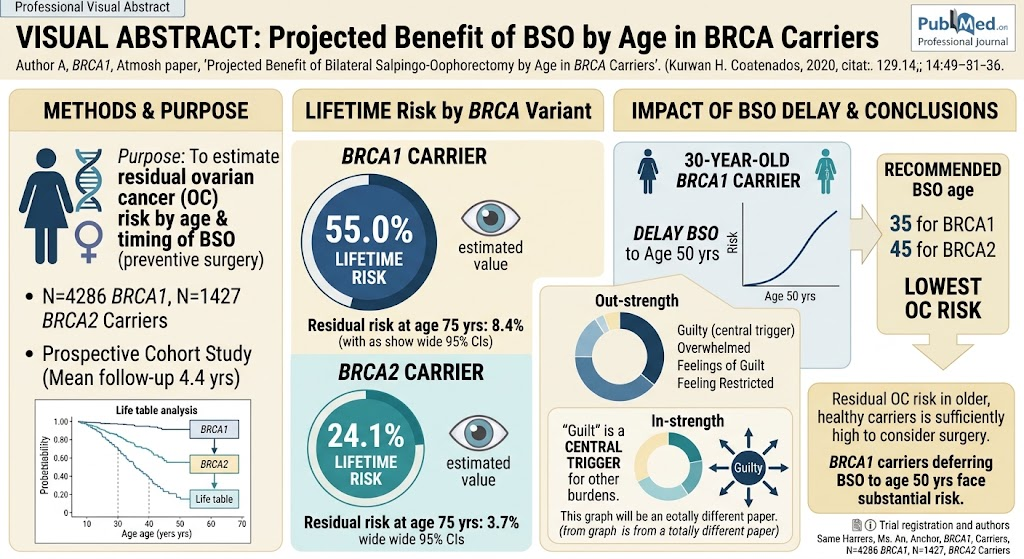
– Women with BRCA1/2 mutations face significantly elevated lifetime risks of ovarian cancer.
– Bilateral salpingo-oophorectomy (BSO) reduces ovarian cancer risk but the optimal timing varies by mutation type.
– Early BSO is strongly recommended (age 35 for BRCA1, 45 for BRCA2), yet some women delay surgery, increasing residual risk.
– Even at older ages, residual ovarian cancer risk remains sufficiently high to support consideration of preventive BSO in healthy women.

Study Background

MedXY registered readers

Sign in free to continue reading

Create or use your MedXY account to unlock the complete article.

This article was created using several editorial tools, including AI, as part of the process. Human editors reviewed this content before publication.

Related articles

Open language-specific specialty feeds and department pages.

Disparities in Ovarian Cancer Clinical Trial Access Linked to Social Vulnerability: A U.S. County-Level AnalysisCounty-level social vulnerability significantly limits ovarian cancer clinical trial availability, underscoring structural inequities and the need for targeted strategies to improve trial access in vulnerable communities.Sep 25, 2026Harnessing Artificial Intelligence for Early Detection of Ovarian Cancer: Development and Validation of a Predictive Risk ModelA novel AI-driven risk prediction model for ovarian cancer demonstrates high accuracy and potential to improve early detection in screening settings.Aug 31, 2026Oral Anticoagulation Significantly Lowers Venous Thromboembolism Rates in Ovarian Cancer Patients on First-Line Chemotherapy: Insights from a Quality Improvement ProjectA quality improvement initiative integrating oral anticoagulants reduced venous thromboembolism incidence in ovarian cancer patients undergoing first-line chemotherapy without increasing bleeding risks.Aug 24, 2026
Loading comments...
MedXY briefing

Get the free newsletter

Evidence-led clinical news, trends, and analysis—delivered to your inbox.

Ask MedXY AI

Most popular

Intimate Health
Five Benefits for Women Continuing Sexual Activity After Menopause
Intimate Health
Why Some Women Have a Strong Sex Drive—And Why Men Shouldn't Worry About It
Nursing & care
How often should a couple have sex?
Cardiology
Precision Medicine for Long QT Syndrome Type 2: Lumacaftor Corrects Trafficking Defects and Shortens QT Interval
General Surgery
Optimizing Postoperative Opioid Prescriptions After Intra-Abdominal Cancer Surgery: Comparing the 5x-Multiplier and 3-Tier Models
© 2026 MedXY
Contact usAbout usPrivacy PolicyMedXY story
Trends in Incidence, Mortality, and Survival of Endometrial, Ovarian, and Cervical Cancers in Young Nordic Women: Insights from 40 Years of Registry Data
This article analyzes 40-year trends in incidence, mortality, and survival of endometrial, ovarian, and cervical cancers among Nordic women aged 0-49, highlighting evolving epidemiology and implications for age-specific prevention.
Aug 22, 2026
Niraparib Versus Platinum-Taxane Chemotherapy as Neoadjuvant Treatment in Advanced HR-Deficient Ovarian Cancer: Insights from the OPAL Phase 2 TrialThe OPAL phase 2 trial compared neoadjuvant niraparib to standard platinum-taxane chemotherapy in newly diagnosed HR-deficient advanced ovarian cancer, showing inferior response rates with niraparib and a safety profile consistent with PARPAug 21, 2026
Evaluating CT-Based Models to Predict Residual Disease and Surgical Extent in Interval Debulking Surgery for Ovarian CancerThis study assesses the predictive accuracy of the MSKCC CT-based model for residual disease after neoadjuvant chemotherapy in advanced ovarian cancer, showing limited discrimination that improves with optimized clinical parameters. CT findAug 19, 2026