We use cookies

Our website uses essential cookies and, with your consent, additional cookies to measure performance and improve our services. Cookie Policy.

You can change your choice at any time.

MMedXYNews
HomeVideos
MedXY AI/MedXY News/Section: Cardiology

Atrial Mechanical Dysfunction as a Predictor of Stroke Risk in Transthyretin Amyloid Cardiomyopathy Patients in Sinus Rhythm
MedXY Editorial Team•Sep 25, 2026•Cardiology
Atrial mechanical contractionCerebrovascular riskStroke predictionSinus rhythmtransthyretin amyloid cardiomyopathy

Highlight

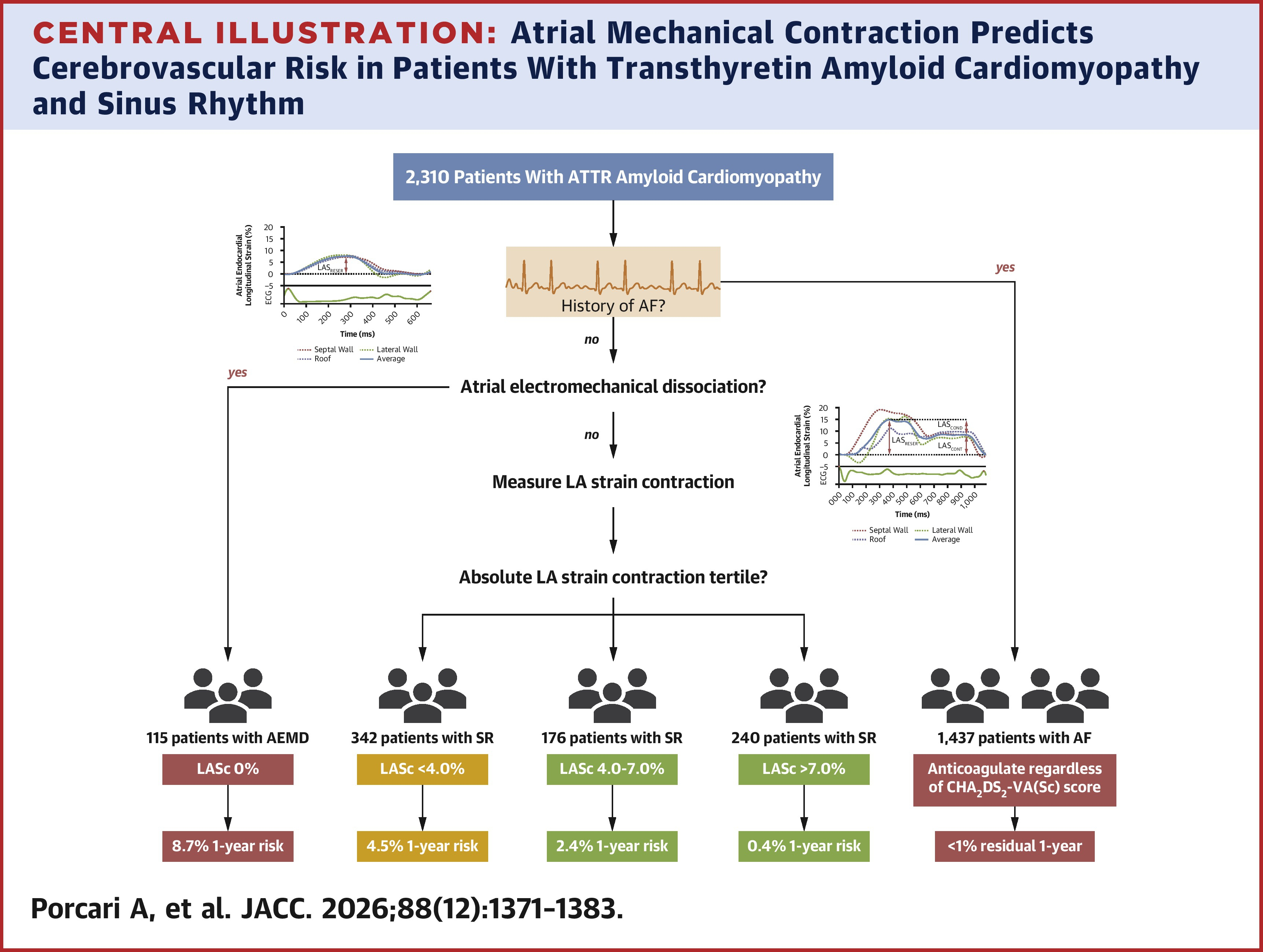
This study identifies atrial mechanical dysfunction, specifically atrial electromechanical dissociation (AEMD) and severely reduced left atrial strain contraction (LASc), as strong independent predictors of cerebrovascular events in transthyretin amyloid cardiomyopathy (ATTR-CM) patients who remain in sinus rhythm. Incorporating LASc measurements into stroke risk prediction models improves risk stratification beyond CHA2DS2-VASc scores, offering a potential clinical tool for targeting anticoagulation therapy and enhanced rhythm monitoring.

Study Background

MedXY registered readers

Sign in free to continue reading

Create or use your MedXY account to unlock the complete article.

This article was created using several editorial tools, including AI, as part of the process. Human editors reviewed this content before publication.

Related articles

Open language-specific specialty feeds and department pages.

Unveiling Arrhythmic Burden in Cardiac Amyloidosis: Insights from the EXCALIBUR Implantable Loop Recorder StudyThe EXCALIBUR study reveals significant arrhythmia incidence in cardiac amyloidosis (CA), highlighting subtype-specific arrhythmic profiles linked to myocardial amyloid burden, guiding risk stratification and management.Sep 25, 2026Rethinking Disease Progression in Transthyretin Amyloid Cardiomyopathy: Toward Mechanism-Specific Monitoring and Therapeutic Response AssessmentThis article explores a novel, biologically informed framework for monitoring transthyretin amyloid cardiomyopathy progression and treatment, emphasizing mechanism-specific strategies aimed at personalized care.Aug 13, 2026Acoramidis Significantly Improves Heart Failure-Related Quality of Life in Transthyretin Amyloid Cardiomyopathy: Insights from the ATTRibute-CM TrialAcoramidis demonstrates substantial benefits in heart failure-related health status among ATTR-CM patients, significantly improving patient-reported outcomes and supporting its role in modifying disease trajectory.Aug 4, 2026
Loading comments...
MedXY briefing

Get the free newsletter

Evidence-led clinical news, trends, and analysis—delivered to your inbox.

Ask MedXY AI

Most popular

Intimate Health
Five Benefits for Women Continuing Sexual Activity After Menopause
Intimate Health
Why Some Women Have a Strong Sex Drive—And Why Men Shouldn't Worry About It
Nursing & care
How often should a couple have sex?
General Surgery
Optimizing Postoperative Opioid Prescriptions After Intra-Abdominal Cancer Surgery: Comparing the 5x-Multiplier and 3-Tier Models
Intimate Health
Classic Intimacy Recommendations: How to Help Women Reach Orgasm and Enjoy Mutual Pleasure
© 2026 MedXY
Contact usAbout usPrivacy PolicyMedXY story
Acoramidis and Kidney Function in Transthyretin Amyloid Cardiomyopathy: Clinical Implications and Hemodynamic Insights
Acoramidis stabilizes transthyretin and shows kidney-protective effects in transthyretin amyloid cardiomyopathy by reducing eGFR decline and albuminuria, with an initial reversible dip in kidney function associated with improved clinical ou
Jul 3, 2026
Rationale and Design of CARDIO-TTRansform: A Phase 3 Trial of Eplontersen for Transthyretin Amyloid CardiomyopathyCARDIO-TTRansform is a global Phase 3 trial evaluating eplontersen’s efficacy and safety in reducing cardiovascular events in transthyretin amyloid cardiomyopathy patients receiving standard care, including TTR stabilizers. With 1,432May 10, 2026
Acoramidis Shows Consistent Benefit in Wild‑Type and Variant Transthyretin Amyloid Cardiomyopathy — Signal Extends Through 42 MonthsIn ATTRibute‑CM and its open‑label extension, acoramidis (712 mg twice daily) produced consistent reductions in all‑cause mortality and cardiovascular hospitalizations in both wild‑type and variant ATTR cardiomyopathy, including p.Val142IleNov 18, 2025