We use cookies

Our website uses essential cookies and, with your consent, additional cookies to measure performance and improve our services. Cookie Policy.

You can change your choice at any time.

MMedXYNews
HomeVideos
MedXY AI/MedXY News/Section: news

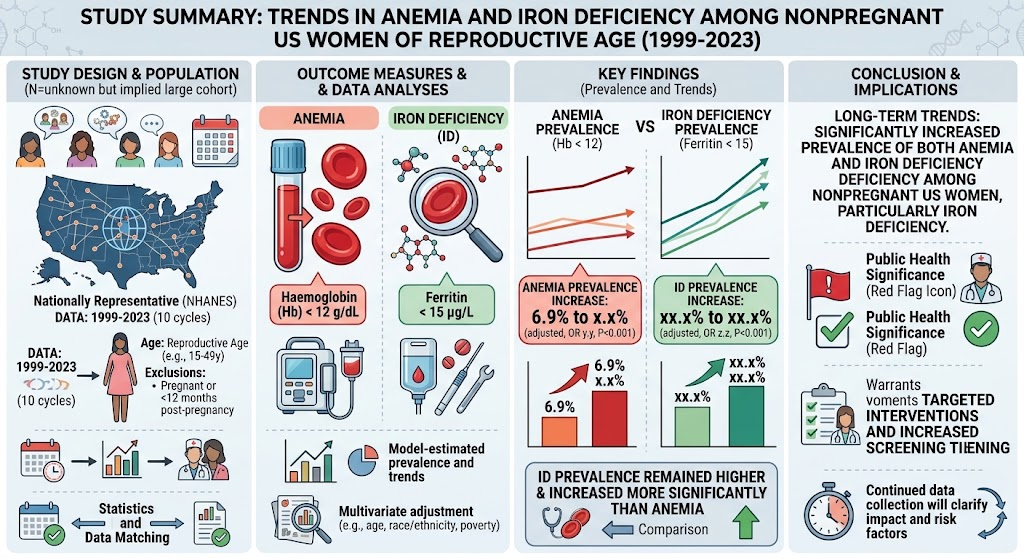
Rising Burden of Anemia and Iron Deficiency Among U.S. Nonpregnant Women of Reproductive Age: Insights from NHANES 1999–2023
MedXY Editorial Team•Aug 18, 2026•news
anemiawomen's healthiron deficiencyThiếu máu do thiếu sắt

Highlight

  • From 1999 to 2023, the prevalence of anemia among nonpregnant U.S. women aged 20–45 increased markedly from 8.0% to 14.2%, corresponding to over 3 million affected individuals.
  • Iron deficiency anemia (IDA) prevalence more than doubled in the same period, rising from 4.3% to 9.1%, indicating a growing public health concern.
  • Despite the rise in anemia and IDA, the prevalence of iron deficiency alone remained high yet relatively stable around 17–19%.
  • Adjusted analysis shows an 8% increase per NHANES cycle in the odds of anemia and IDA, underscoring a persistent worsening trend over the last two decades.

Study Background

MedXY registered readers

Sign in free to continue reading

Create or use your MedXY account to unlock the complete article.

This article was created using several editorial tools, including AI, as part of the process. Human editors reviewed this content before publication.

Related articles

Open language-specific specialty feeds and department pages.

KDIGO 2026 on Anemia in CKD: Key Recommendations and Practical Guidance for CliniciansKDIGO 2026 updates anemia care in CKD: evidence-based thresholds for iron therapy, preference for IV iron on hemodialysis, ESA-first approach over HIF-PHIs, individualized Hb initiation, and an ESA maintenance upper Hb target <11.5 g/dL.Sep 18, 2026Hemoglobin Levels and Mortality Risk: Insights from a Large UK Cohort StudyA UK prospective cohort study reveals a U-shaped association between hemoglobin concentration and mortality, with both low and high levels linked to increased death risk across age and sex groups.Sep 13, 2026From PCOS to PMOS: Transforming Understanding and Care in Women’s Reproductive HealthPMOS reframes polycystic ovary syndrome as a systemic endocrine-metabolic disorder with lifelong implications, emphasizing the need for comprehensive obstetric and gynecologic care to improve diagnosis, pregnancy outcomes, and long-term heaAug 31, 2026Low-Normal Hemoglobin Concentrations and Clinical Outcomes in Heart Failure: Rethinking WHO Anemia Thresholds
Loading comments...
MedXY briefing

Get the free newsletter

Evidence-led clinical news, trends, and analysis—delivered to your inbox.

Ask MedXY AI

Most popular

Intimate Health
Five Benefits for Women Continuing Sexual Activity After Menopause
Intimate Health
Why Some Women Have a Strong Sex Drive—And Why Men Shouldn't Worry About It
Nursing & care
How often should a couple have sex?
Intimate Health
Classic Intimacy Recommendations: How to Help Women Reach Orgasm and Enjoy Mutual Pleasure
Intimate Health
What Makes a Woman "Physiologically Addicted" Is Never Money, But These Two Relationship Qualities
© 2026 MedXY
Contact usAbout usPrivacy PolicyMedXY story
This review synthesizes current evidence on hemoglobin thresholds in heart failure, highlighting that optimal prognosis is associated with hemoglobin levels higher than WHO anemia cutoffs, with clinical implications for management and iron
Aug 29, 2026
Air Pollution and Its Impact on Age at Natural Menopause: Insights from the SWAN StudyHigh exposure to ambient NO2 and O3 air pollutants is associated with approximately one year earlier natural menopause, highlighting environmental risks to women’s reproductive aging.Aug 24, 2026
Renin-Angiotensin-Aldosterone System Inhibitors Worsen Anemia in Sickle Cell Disease: Clinical and Mechanistic InsightsRAAS inhibitors, used for kidney protection in sickle cell disease, may significantly exacerbate anemia by impairing erythropoiesis, warranting close hemoglobin monitoring in this vulnerable population.Aug 10, 2026