Combining Anatomical and Histologic Response Predicts Recurrence After Surgery for Colorectal Liver Metastases
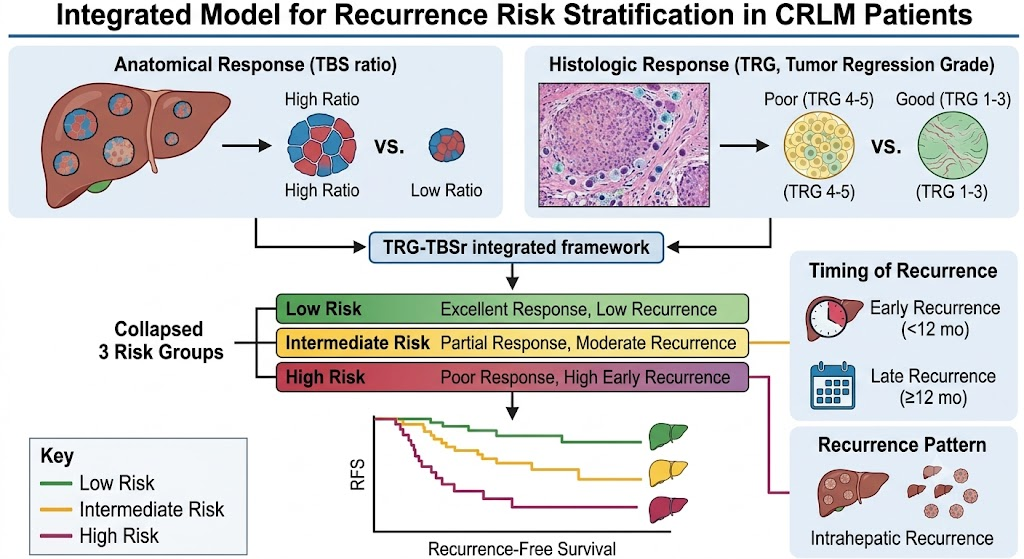
For patients with colorectal liver metastases (CRLM) undergoing surgery after neoadjuvant therapy, accurately predicting recurrence remains a clinical challenge. A new multi-institutional observational cohort study published in Annals of Surgery suggests that combining macroscopic and histologic measures of treatment response may provide a more complete picture of recurrence risk than either approach alone.
In 483 patients who underwent hepatectomy for CRLM after neoadjuvant therapy, both the Tumor Burden Score ratio (TBSr, macroscopic) and Tumor Regression Grade (TRG, histologic) were independently associated with recurrence-free survival and early recurrence.
The integrated TRG-TBSr classification identified three risk groups with significantly different recurrence patterns.
Early recurrence (<12 months) occurred in 36.9% of patients; intrahepatic recurrence occurred in 25.1%.
Combined assessment offers a simple, interpretable framework to stratify recurrence risk after surgery.
Study Snapshot
Design: Multi-institutional retrospective observational cohort study (2004–2022)
Patients: 483 adults with CRLM undergoing curative-intent hepatectomy after neoadjuvant therapy
Exposures: Macroscopic response via TBSr (data-driven and prespecified cutoffs); histologic response via TRG (good: 1–3; poor: 4–5)
Primary outcomes: Recurrence-free survival, timing of recurrence (early <12 mo vs late ≥12 mo), liver-limited recurrence
Key findings: Both TBSr (aHR 1.30, 95% CI 1.12–1.52) and TRG (aHR 1.22, 95% CI 1.12–1.33) independently associated with worse RFS; combined risk categories strongly associated with all recurrence outcomes (all P<0.001)
Limitations: Retrospective design, potential selection bias, unmeasured confounders, lack of external validation cohort
Why This Study Matters
Neoadjuvant therapy is increasingly used for CRLM to downsize tumors and improve resectability, but response assessment remains imprecise. Radiologic response (macroscopic) and pathologic response (histologic) are often evaluated separately, and their combined prognostic value has not been well characterized. This study addresses that gap by integrating TBSr—a quantitative measure of tumor burden change on imaging—with TRG, a standard histologic grading system, to predict recurrence patterns.
How the Study Was Conducted
Data were drawn from an international, multi-institutional database of patients who underwent curative-intent hepatectomy for CRLM after neoadjuvant therapy between 2004 and 2022. Macroscopic response was quantified using the Tumor Burden Score ratio (TBSr), calculated as the ratio of post-treatment to pre-treatment tumor burden scores, with cutoffs determined both by data-driven methods and prespecified criteria. Histologic response was categorized using TRG (1–5), with scores 1–3 considered good response and 4–5 poor response.
Six combined TRG-TBSr patterns were collapsed into three risk groups using maximally selected log-rank statistics. The primary outcomes were recurrence-free survival (RFS) and timing of recurrence (early <12 months; late ≥12 months). Liver-limited (intrahepatic) recurrence was a secondary outcome. Multivariable models adjusted for relevant covariates, including synchronous disease, to assess independent associations.
What the Researchers Found
Among 483 patients, median RFS was 15.87 months. Both TRG (adjusted hazard ratio [aHR] 1.22, 95% CI 1.12–1.33, P<0.001) and TBSr (aHR 1.30, 95% CI 1.12–1.52, P<0.001) were independently associated with worse RFS. Early recurrence (<12 months) occurred in 36.9% of patients and was independently associated with TRG (odds ratio [OR] 1.34, 95% CI 1.15–1.57, P<0.001), TBSr (OR 1.35, 95% CI 1.03–1.80, P=0.0036), and synchronous disease (OR 1.85, 95% CI 1.21–2.87, P=0.005).
Intrahepatic recurrence occurred in 25.1% of patients and was predicted by both TRG (HR 1.36, 95% CI 1.15–1.61) and TBSr (HR 1.59, 95% CI 1.31–1.93) (both P<0.001). The integrated TRG-TBSr risk categories were strongly associated with RFS, early recurrence, and intrahepatic recurrence (all P<0.001), suggesting that the combined approach captures complementary prognostic information.
What the Findings May Mean
The study provides evidence that macroscopic and histologic response assessments are not interchangeable but rather offer distinct insights into tumor biology. Combining them may allow clinicians to better identify patients at highest risk for early or liver-limited recurrence, potentially guiding surveillance intensity, adjuvant therapy decisions, or selection for clinical trials. However, the authors caution that these results are retrospective and require prospective validation before routine clinical implementation.
Strengths and Limitations
Strengths include the multi-institutional cohort, use of standardized and widely available assessment tools (TBSr and TRG), and robust statistical methodology with data-driven risk categorization. Limitations include the retrospective design with inherent potential for selection bias, missing data on some covariates, and the lack of an external validation cohort. Association should not be interpreted as causation, and unmeasured confounders such as differences in chemotherapy regimens or surgical technique may influence outcomes. Furthermore, generalizability may be limited to high-volume centers with standardized pathologic assessment.
Implications for Practice and Research
If validated, the combined TRG-TBSr framework could be integrated into routine pathologic reporting and risk stratification after hepatectomy for CRLM. Future prospective studies should evaluate whether this integrated classification improves clinical decision-making compared with either measure alone, and whether it can be used to tailor postoperative management. The simplicity and interpretability of the approach are notable advantages for translation into practice.
Funding, Disclosures, and Registration
As reported in the original article, this was a multi-institutional study; specific funding sources were not detailed in the abstract. The authors declared no conflicts of interest (based on the abstract). No trial registration was noted due to the retrospective observational design.
References
Baldo A, Akabane M, Elemosho A, et al. Anatomical and Histologic Response to Neoadjuvant Therapy: Recurrence Patterns Among Poor Responders. A Multi-institutional Observational Cohort Study. Ann Surg. 2026. PMID: 42473131.
This article was created using several editorial tools, including AI, as part of the process. Human editors reviewed this content before publication.