We use cookies

Our website uses essential cookies and, with your consent, additional cookies to measure performance and improve our services. Cookie Policy.

You can change your choice at any time.

MMedXYNews
HomeVideos
MedXY AI/MedXY News/Section: news

Optimizing Management of Conjunctival Melanocytic Lesions: A Sequential Multimodal Treatment Framework

MedXY Editorial Team•Sep 27, 2026•news
ocular oncologymelanocytic intraepithelial lesionsMultimodal TreatmentConjunctival melanomaRecurrence Risk
Highlight

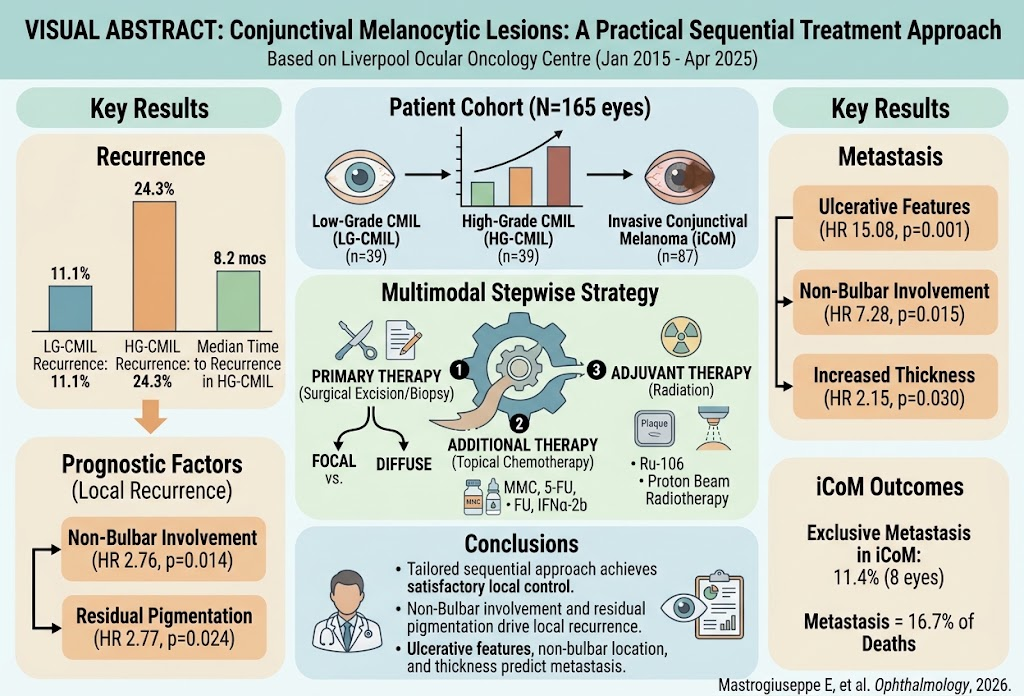
This study presents a practical stepwise treatment algorithm for conjunctival melanocytic lesions from low-grade intraepithelial lesions (LG-CMIL) to invasive melanoma (iCoM). Key findings include the identification of non-bulbar involvement and residual pigmentation as independent risk factors for local recurrence and ulcerative features as a strong predictor of metastatic spread. The multimodal approach incorporating surgery, topical chemotherapy, and radiotherapy demonstrates promising local disease control outcomes.

Study Background

MedXY registered readers

Sign in free to continue reading

Create or use your MedXY account to unlock the complete article.

This article was created using several editorial tools, including AI, as part of the process. Human editors reviewed this content before publication.

Related articles

Open language-specific specialty feeds and department pages.

Recurrent Severe Hypertensive Disorders in Pregnancy: Evaluating Risks and Outcomes for Future PregnanciesThis study delineates the significant recurrence risk of severe hypertensive disorders of pregnancy, especially early-onset cases, highlighting implications for patient counseling and management in subsequent pregnancies.Aug 21, 2026Combining Anatomical and Histologic Response Predicts Recurrence After Surgery for Colorectal Liver MetastasesA multi-institutional study of 483 patients shows that combining macroscopic (TBSr) and histologic (TRG) response to neoadjuvant therapy better stratifies recurrence risk after hepatectomy for colorectal liver metastases than either measure alone.Jul 29, 2026Recurrent Venous Thromboembolism After Isolated Distal DVT: Insights from the RIDTS TrialThis article reviews the incidence and predictors of recurrent VTE following anticoagulation for isolated distal deep vein thrombosis, highlighting key risk factors and implications for treatment duration and patient management.Jul 7, 2026
Loading comments...
MedXY briefing

Get the free newsletter

Evidence-led clinical news, trends, and analysis—delivered to your inbox.

Ask MedXY AI

Most popular

Intimate Health
Five Benefits for Women Continuing Sexual Activity After Menopause
Intimate Health
Why Some Women Have a Strong Sex Drive—And Why Men Shouldn't Worry About It
Nursing & care
How often should a couple have sex?
General Surgery
Optimizing Postoperative Opioid Prescriptions After Intra-Abdominal Cancer Surgery: Comparing the 5x-Multiplier and 3-Tier Models
Intimate Health
Classic Intimacy Recommendations: How to Help Women Reach Orgasm and Enjoy Mutual Pleasure
© 2026 MedXY
Contact usAbout usPrivacy PolicyMedXY story
RETREAT Score Stratifies Long-Term Hepatocellular Carcinoma Recurrence Risk After Liver Transplantation in Real-World Practice
A single-center validation study shows the RETREAT score reliably predicts long-term HCC recurrence after liver transplantation and identifies patients with markedly different recurrence-free and overall survival trajectories.
Jun 7, 2026
Calcitonin Doubling Rate Sharpens Postoperative Recurrence Risk Stratification in Medullary Thyroid Carcinoma With Biochemical Persistent DiseaseIn medullary thyroid carcinoma with biochemical persistent disease after surgery, an early postoperative calcitonin doubling rate of at least 0.3/year strongly identified patients at higher recurrence risk and may help tailor surveillance iMay 4, 2026
Beyond Nodal Status: A New Risk Score Predicts Recurrence in Lymph Node-Negative Pancreatic Neuroendocrine TumorsA multi-center study in JAMA Surgery introduces a validated 13-point risk score to identify recurrence risk in LN-negative PanNET patients, revealing that tumor size, grade, and lymphovascular invasion are critical prognostic drivers even wDec 22, 2025