We use cookies

Our website uses essential cookies and, with your consent, additional cookies to measure performance and improve our services. Cookie Policy.

You can change your choice at any time.

MMedXYNews
HomeVideos
MedXY AI/MedXY News/Section: Neurology

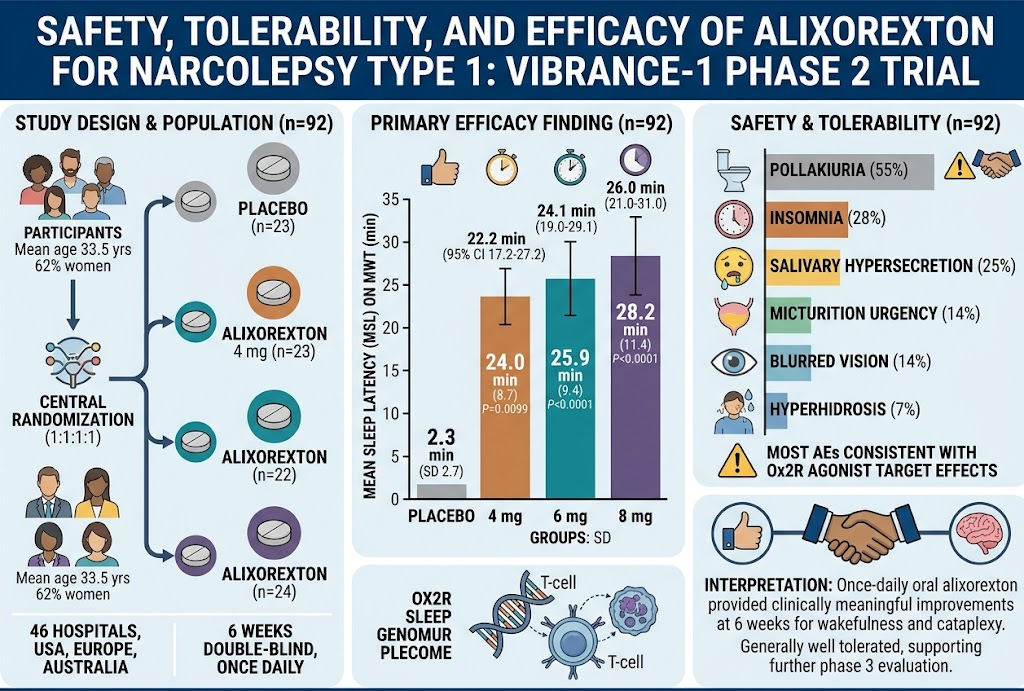
Alixorexton, a Novel Oral Orexin 2 Receptor Agonist, Shows Promising Safety and Efficacy in Narcolepsy Type 1: Insights from the Vibrance-1 Phase 2 Trial
MedXY Editorial Team•Aug 26, 2026•Neurology
alixorextonorexin 2 receptor agonistwakefulnesscataplexynarcolepsy type 1

Highlight

  • Alixorexton, a selective oral orexin 2 receptor agonist, significantly improves wakefulness in patients with narcolepsy type 1 compared to placebo, as evidenced by increased mean sleep latency on the Maintenance of Wakefulness Test.
  • Clinically meaningful reduction in excessive daytime sleepiness and cataplexy symptoms was observed after six weeks of daily dosing across multiple doses (4 mg, 6 mg, 8 mg).
  • The safety profile of alixorexton was generally acceptable; adverse events aligned with known on-target OX2R agonist effects and were manageable.
  • Vibrance-1 trial results strongly support advancing alixorexton into phase 3 studies, offering a promising new therapeutic option for narcolepsy type 1 patients.

Study Background

MedXY registered readers

Sign in free to continue reading

Create or use your MedXY account to unlock the complete article.

This article was created using several editorial tools, including AI, as part of the process. Human editors reviewed this content before publication.

Related articles

Open language-specific specialty feeds and department pages.

Distinct Molecular and Clinical Profiles of USH2A-Associated Retinitis Pigmentosa in Korean Patients: Implications for Targeted TherapyThis study elucidates the unique East Asian-specific genetic variants and clinical progression of USH2A-associated retinitis pigmentosa in Koreans, highlighting the potential for exon 13-targeted treatments.Sep 19, 2026Cystoid Macular Edema Following Cultured Human Corneal Endothelial Cell Injection: Incidence, Risk Factors, and Visual PrognosisThis review synthesizes current evidence on the frequency and risk factors of cystoid macular edema (CME) after cultured human corneal endothelial cell (cHCEC) injection, highlighting prostaglandin analog use as a key associated factor andSep 19, 2026Post-Tonsillectomy Hemorrhage in Lebanon: Prevalence, Risks, and Implications for Adult PatientsA retrospective Lebanese study finds a 2.65% prevalence of post-tonsillectomy hemorrhage, predominantly secondary bleeding, with adult age as the key independent risk factor, underscoring tailored postoperative care.Sep 19, 2026
Loading comments...
MedXY briefing

Get the free newsletter

Evidence-led clinical news, trends, and analysis—delivered to your inbox.

Ask MedXY AI

Most popular

Intimate Health
Five Benefits for Women Continuing Sexual Activity After Menopause
Intimate Health
Why Some Women Have a Strong Sex Drive—And Why Men Shouldn't Worry About It
Nursing & care
How often should a couple have sex?
Intimate Health
Classic Intimacy Recommendations: How to Help Women Reach Orgasm and Enjoy Mutual Pleasure
Intimate Health
What Makes a Woman "Physiologically Addicted" Is Never Money, But These Two Relationship Qualities
© 2026 MedXY
Contact usAbout usPrivacy PolicyMedXY story
Beta-Trace Protein Quantification: A Novel Diagnostic Tool for Early Detection of CSF Leak Post-Endoscopic Endonasal Sellar Tumor Surgery
Quantitative measurement of beta-trace protein in nasal sponge extracts accurately identifies postoperative cerebrospinal fluid leaks after endoscopic endonasal surgery for sellar tumors, enabling early diagnosis and targeted intervention.
Sep 19, 2026
Colovac Device vs Diverting Loop Ileostomy: A Prospective Pooled Analysis in Rectal Cancer SurgeryThis pooled analysis evaluates the safety and effectiveness of the Colovac Anastomosis Protection Device compared to standard diverting loop ileostomy following low anterior resection for rectal cancer, showing comparable major complicationSep 19, 2026
Out-of-Hours Liver Transplantation: Identifying High-Risk Timeframes and Implications for Patient OutcomesA Swedish national retrospective study reveals that liver transplantations initiated between 17:00 and 05:59 are linked to significantly increased postoperative complications and healthcare costs, highlighting the need for optimized schedulSep 19, 2026