We use cookies

Our website uses essential cookies and, with your consent, additional cookies to measure performance and improve our services. Cookie Policy.

You can change your choice at any time.

MMedXYNews
HomeVideos
MedXY AI/MedXY News/Section: news

Air Pollution and Its Impact on Age at Natural Menopause: Insights from the SWAN Study
MedXY Editorial Team•Aug 24, 2026•news
natural menopauseO3women's healthNO2air pollution

Highlight

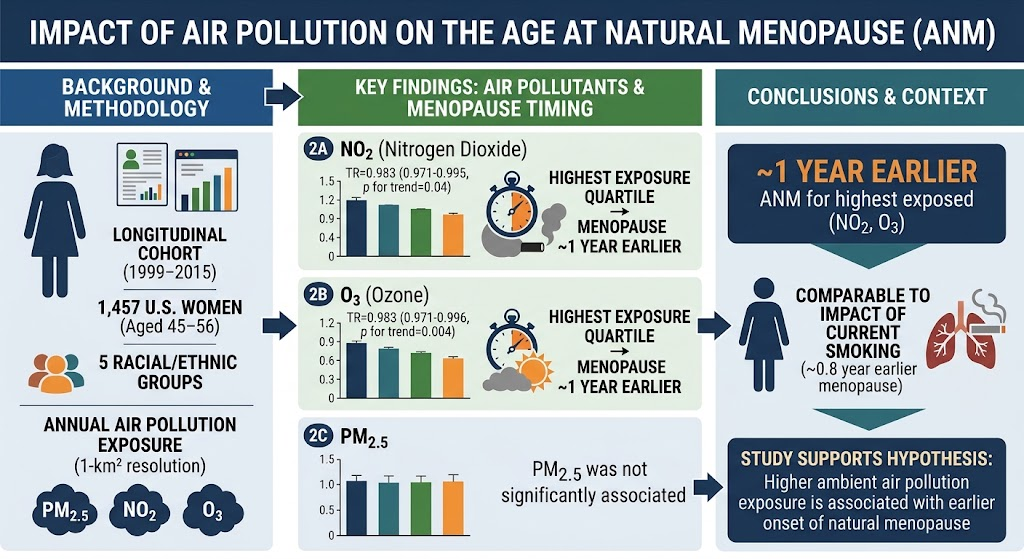
This longitudinal study from the Study of Women’s Health Across the Nation (SWAN) demonstrates that women with the highest exposure to ambient nitrogen dioxide (NO2) and ozone (O3) experience natural menopause approximately one year earlier compared to those with the lowest exposure. The study found no significant association between particulate matter (PM2.5) and age at natural menopause (ANM). The magnitude of earlier menopause linked to air pollution exposure mirrors the effect observed with smoking, with implications for women’s reproductive and overall health.

Study Background

MedXY registered readers

Sign in free to continue reading

Create or use your MedXY account to unlock the complete article.

This article was created using several editorial tools, including AI, as part of the process. Human editors reviewed this content before publication.

Related articles

Open language-specific specialty feeds and department pages.

Unveiling the Cardiovascular Toll of Long-Term Wildfire Smoke PM2.5 Exposure in Older AmericansLong-term cumulative exposure to wildfire smoke PM2.5 significantly increases cardiovascular hospitalizations among U.S. older adults, with notable risks in ischemic heart disease and arrhythmias, highlighting the need for targeted public hSep 15, 2026Linking Air Pollution to Heart Health: Chronic PM2.5 Exposure and Coronary Endothelial DysfunctionChronic exposure to fine particulate matter (PM2.5) is linked to epicardial coronary endothelial dysfunction, an early marker of coronary artery disease, as demonstrated by invasive coronary vasoreactivity testing.Sep 11, 2026From PCOS to PMOS: Transforming Understanding and Care in Women’s Reproductive HealthPMOS reframes polycystic ovary syndrome as a systemic endocrine-metabolic disorder with lifelong implications, emphasizing the need for comprehensive obstetric and gynecologic care to improve diagnosis, pregnancy outcomes, and long-term heaAug 31, 2026Rising Burden of Anemia and Iron Deficiency Among U.S. Nonpregnant Women of Reproductive Age: Insights from NHANES 1999–2023
Loading comments...
MedXY briefing

Get the free newsletter

Evidence-led clinical news, trends, and analysis—delivered to your inbox.

Ask MedXY AI

Most popular

Intimate Health
Five Benefits for Women Continuing Sexual Activity After Menopause
Intimate Health
Why Some Women Have a Strong Sex Drive—And Why Men Shouldn't Worry About It
Nursing & care
How often should a couple have sex?
Intimate Health
Classic Intimacy Recommendations: How to Help Women Reach Orgasm and Enjoy Mutual Pleasure
Intimate Health
What Makes a Woman "Physiologically Addicted" Is Never Money, But These Two Relationship Qualities
© 2026 MedXY
Contact usAbout usPrivacy PolicyMedXY story
Analysis of NHANES data reveals increasing anemia and iron deficiency anemia rates among nonpregnant U.S. women aged 20-45 from 1999 to 2023, with persistently high iron deficiency prevalence.
Aug 18, 2026
Linking Endometriosis Subtypes to Increased Risk of Type 2 Diabetes: Insights from the ARCHES StudyThe ARCHES retrospective cohort study reveals that endometriosis significantly elevates the risk of type 2 diabetes, particularly in specific subtypes and among premenopausal women with lower BMI, highlighting the importance of subtype-specAug 18, 2026
Air Pollution and Built Environment Linked to Prediabetes Incidence and Remission in KORA StudyLong-term exposure to particulate matter and lack of green space were associated with increased risk of prediabetes, especially impaired glucose tolerance phenotypes, and reduced remission of isolated impaired fasting glucose.Jul 28, 2026