Highlight
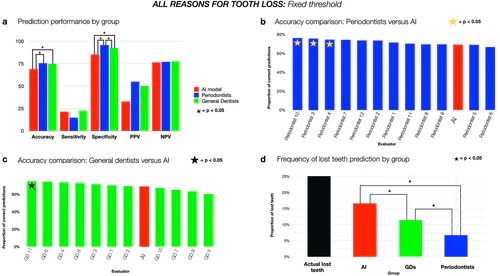
Clinicians demonstrated higher overall accuracy than AI in predicting 10-year tooth survival using a fixed threshold.
AI performance improved and was comparable to clinicians when group-specific optimal thresholds were applied.
AI showed worse calibration compared to clinicians, indicating less reliable probability estimates.
Individual AI performance overlapped with several clinicians, suggesting potential as an adjunct diagnostic tool.
Study Background
Periodontal disease remains a leading cause of tooth loss worldwide, imposing significant clinical and economic burdens. Effective long-term prognosis of periodontal outcomes is critical for personalized patient management, informing treatment decisions and resource allocation. Traditional prognosis relies heavily on clinician expertise, integrating diverse clinical and radiographic data over time. In recent years, artificial intelligence (AI) has emerged as a promising tool in clinical dentistry, with potential to augment diagnostic accuracy and prognostic assessment through data-driven modeling. However, evidence evaluating whether AI can match or surpass experienced clinicians in long-term periodontal prognosis is limited. This study addresses this gap by directly comparing AI to periodontists and general dentists in predicting tooth loss over a decade, thereby informing the potential role of AI in periodontal practice.
Study Design
This study utilized a comparative accuracy design involving a trained AI model and practicing clinicians. The AI model was developed using structured clinical and radiographic data from a cohort with known 10-year periodontal outcomes. Twelve experienced periodontists and eleven general dentists (GDs) independently assigned prognostic scores to 300 teeth, each categorized on a 0-10 scale predicting tooth survival. The primary endpoint was accuracy of tooth loss prediction over 10 years.
Comparisons between AI and clinician performance were based on two evaluation approaches: a fixed prognostic threshold (score >5 indicating expected survival) and group-specific optimal thresholds derived for each evaluator. Metrics used included accuracy, sensitivity, specificity, predictive values, area under the receiver operating characteristic curve (AUC), and calibration performance measured by the Brier score.
Key Findings
When applying the fixed threshold, both groups of clinicians significantly outperformed AI in overall accuracy: periodontists achieved 75.6%, general dentists 74.9%, whereas AI achieved 69.2% (p < 0.05). Sensitivity — the ability to correctly identify teeth lost — was low and comparable across all groups (14.7%–22.7%), reflecting challenges in predicting tooth loss accurately.
Upon adjusting to group-specific optimal thresholds, AI’s accuracy improved significantly to 67.5% for all-cause tooth loss prediction, nearly matching general dentists for periodontitis-related tooth loss (76.2% vs. 76.3%). These findings demonstrate that AI’s predictive accuracy is sensitive to threshold calibration, and it can achieve parity with human evaluators when thresholds are optimized.
Despite comparable accuracy under optimized conditions, AI exhibited markedly worse calibration (Brier score 0.247) compared to periodontists and general dentists (0.171 and 0.170 respectively), indicating that AI’s probability estimations were less well aligned with actual outcomes. Calibration is clinically relevant for tailoring individualized treatment decisions.
Individual AI performance overlapped with several clinicians, indicating variability in human expert prognostic ability and highlighting AI’s potential as an adjunct rather than replacement tool.
Expert Commentary
This landmark comparative study provides critical insights into AI’s role in periodontal prognosis. While AI does not yet surpass clinicians in a standard threshold setting, its comparable performance using individualized thresholds suggests AI could support clinical decision-making as an adjunct, especially in general practice settings where specialist expertise may be limited. Experts note that the modest sensitivity across all evaluators underscores intrinsic challenges in long-term tooth loss prediction, reflecting complex multifactorial disease progression and variable patient adherence.
The study’s strength lies in its real-world clinical data foundation and inclusion of both periodontists and general dentists, enhancing relevance. Limitations include the use of a single AI model and retrospective outcome data, which may affect generalizability. Further prospective validation and integration of additional data modalities such as longitudinal behavioral and systemic health factors could improve AI prognostic capabilities.
From the mechanistic perspective, AI models primarily leveraging structured clinical measures may miss subtle biological and environmental cues that experienced clinicians intuitively incorporate. Future AI enhancements incorporating advanced image analysis and multi-omics data could potentially elevate predictive accuracy beyond human capacity.
Conclusion
This study demonstrates that AI, while not outperforming periodontists or general dentists under a fixed prognostic threshold, can achieve comparable accuracy when optimal thresholds are applied. Despite modest overall predictive ability and poorer calibration, AI’s performance overlaps with several clinicians, positioning it as a promising supplementary tool in periodontal prognosis. These findings support the cautious integration of AI into clinical workflows to support, rather than replace, clinician judgment in long-term tooth loss prediction. Ongoing development and prospective validation of AI prognostic models remain imperative to enhance individualized periodontal care.
Funding and ClinicalTrials.gov
The study did not report specific funding sources or clinical trial registration.
References
López-Galindo PA, Troiano G, Serroni M, et al. Can Artificial Intelligence Match Human Expertise in Long-Term Periodontal Prognosis? A Comparative Accuracy Study. J Clin Periodontol. 2026;53(11):1712-1721. PMID: 42629146.
Tonetti MS, Jepsen S, Jin L, Otomo-Corgel J. Impact of the global burden of periodontal diseases on health, nutrition, and wellbeing of mankind: A call for global action. J Clin Periodontol. 2017;44(5):456-462.
Devlin H, Kelly MP, Halpin M, et al. Clinical utility of AI in periodontology: current status and future prospects. Periodontol 2000. 2023;92(1):245-259.