Highlight
The autotaxin/lysophosphatidic acid (ATX/LPA) axis expression is elevated in periodontitis and correlates with disease severity.
Macrophage-specific autotaxin knockout mice exhibit reduced inflammation and bone resorption during periodontitis.
The ATX/LPA axis promotes osteoclastogenesis and inflammatory responses synergistically via activation of inflammation-related pathways.
Pharmacological inhibition of ATX with PF8380 mitigates alveolar bone loss and modulates macrophage osteoclast differentiation in experimental periodontitis.
Study Background
Periodontitis is a chronic inflammatory disease characterized by destruction of periodontal supporting tissues, including alveolar bone loss, that ultimately leads to tooth loss. It affects a significant proportion of the adult population worldwide, imposing a substantial public health burden. The pathogenesis of periodontitis involves complex interactions between bacterial biofilms, immune responses, and bone remodeling processes, notably osteoclast-mediated bone resorption. Understanding molecular regulators that influence both inflammatory and osteoclastic pathways is essential for developing targeted therapies to prevent tissue destruction and preserve oral health.
Autotaxin (ATX) is an enzyme that generates lysophosphatidic acid (LPA), a lipid mediator involved in various biological functions including cell proliferation, migration, and immune modulation. Emerging evidence suggests that the ATX/LPA axis may regulate inflammatory diseases and bone metabolism, but its role in periodontitis has remained unclear prior to this study.
Study Design
This study investigated the role of the ATX/LPA axis in human periodontitis and preclinical murine models through a combination of clinical sample analysis, genetic mouse models, cell culture experiments, and pharmacological interventions.
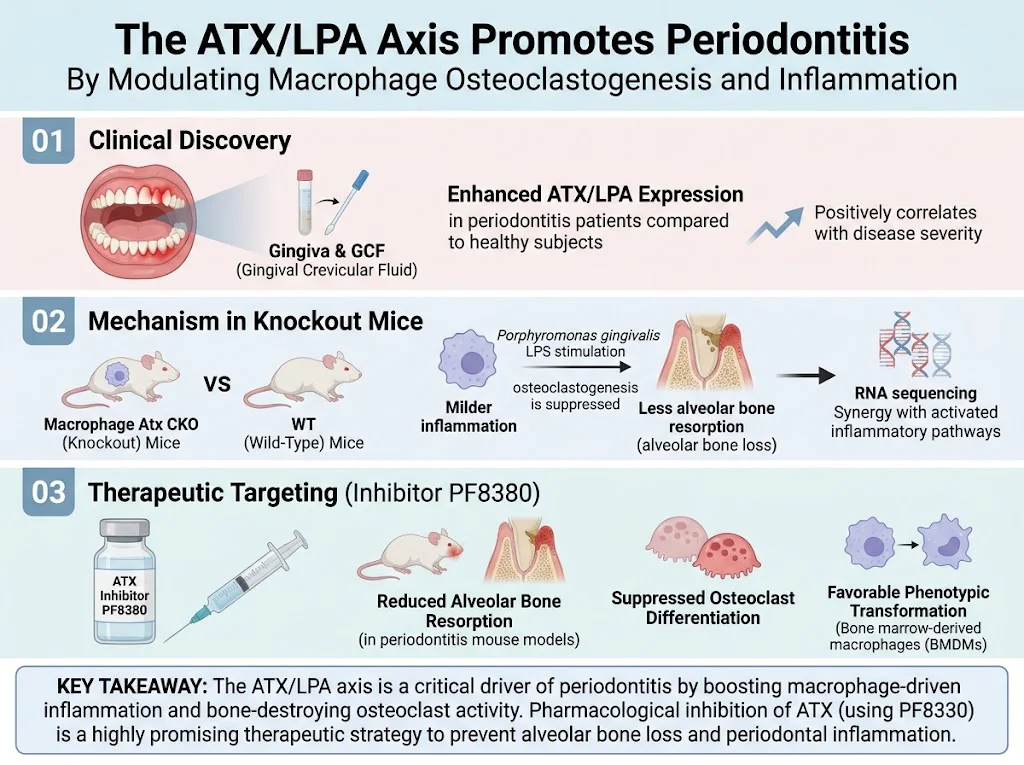
Clinical samples: Gingiva and gingival crevicular fluid were collected from patients diagnosed with periodontitis and from healthy controls to analyze ATX/LPA expression levels and correlate them with disease severity.
Genetic model: Macrophage-specific Atx knockout (CKO) mice were generated to study the cell-specific contribution of ATX to periodontitis development. These mice were compared with wild-type (WT) controls in a periodontitis model induced by Porphyromonas gingivalis lipopolysaccharide (LPS).
In vitro studies: Bone marrow-derived macrophages (BMDMs) from CKO and WT mice were cultured and stimulated with LPS to assess osteoclastogenesis and inflammatory gene expression.
Pharmacological intervention: The ATX inhibitor PF8380 was administered in vivo and in vitro to evaluate its therapeutic potential for mitigating periodontitis-associated bone loss and inflammation.
Analytical methods: A combination of histomorphology, RNA sequencing, quantitative PCR, immunostaining, enzyme-linked immunosorbent assay, micro-CT imaging, tartrate-resistant acid phosphatase (TRAP) staining, actin filament staining, pit resorption assays, and flow cytometry were employed.
Key Findings
Elevated ATX/LPA axis expression correlates with periodontitis severity: Clinical analyses revealed that ATX and LPA expression were significantly increased in the gingival tissues and fluids of periodontitis patients compared to healthy controls. Moreover, the degree of expression positively correlated with clinical measures of periodontal destruction, indicating a potential pathogenic role.
Macrophage-specific ATX deficiency reduces periodontitis severity: In vivo, CKO mice showed markedly less alveolar bone resorption and reduced inflammatory infiltrates following P. gingivalis LPS challenge compared to WT mice. This establishes macrophage-derived ATX as a critical mediator in disease progression.
ATX/LPA axis promotes osteoclastogenesis and inflammation synergistically: In vitro experiments demonstrated that BMDMs lacking ATX exhibited significant impairment in osteoclast differentiation and lower production of pro-inflammatory cytokines upon LPS stimulation. RNA sequencing data indicated that ATX/LPA signaling activates multiple inflammation-related pathways that synergize with osteoclastogenesis mechanisms, amplifying tissue destruction.
Pharmacological inhibition of ATX offers therapeutic benefits: Treatment with PF8380 significantly alleviated alveolar bone loss and suppressed osteoclast formation in periodontitis mouse models. Additionally, PF8380 modulated the phenotypic transformation of macrophages, indicating its capacity to target both inflammatory and bone-resorptive components simultaneously.
Expert Commentary
This study provides compelling evidence that the ATX/LPA axis is a key molecular driver linking macrophage-mediated inflammation with osteoclastogenesis in periodontitis. The use of macrophage-specific knockout models elegantly defines the cellular source of pathogenic ATX. The synergistic activation of inflammatory and bone resorption pathways by ATX/LPA further substantiates its central role in periodontal tissue breakdown.
From a translational viewpoint, these findings highlight the ATX/LPA axis as a promising therapeutic target. PF8380’s efficacy in reducing bone loss and modulating immune cells suggests it could complement existing periodontal treatments by addressing the underlying pathophysiology more directly. However, clinical validation is required to assess safety, dosing, and long-term outcomes in humans.
Limitations of the study include the use of a single animal model and the need to clarify how ATX expression is regulated in human periodontitis at molecular and environmental levels. Additionally, the broader immunological consequences of systemic ATX inhibition warrant careful evaluation.
Conclusion
The autotaxin/lysophosphatidic acid axis plays a pivotal role in driving macrophage-dependent osteoclastogenesis and inflammation in periodontitis. Its expression correlates with disease severity and contributes mechanistically to alveolar bone resorption and local inflammation. Targeting this axis using inhibitors such as PF8380 represents a novel and promising therapeutic strategy to prevent periodontal tissue destruction. Further clinical research is essential to translate these preclinical findings into effective treatment modalities that could improve outcomes for patients suffering from chronic periodontitis.
Funding and Clinical Trials
The study by Liu et al. (2026) was conducted without disclosed external funding. No clinical trials related to ATX inhibitors in periodontitis have been registered to date, underscoring the need for future translational research in this area.
References
Liu E, Ding J, Jiang Y, et al. Autotaxin/Lysophosphatidic Acid Axis Promotes Periodontitis by Modulating Macrophage Osteoclastogenesis and Inflammation. Journal of clinical periodontology. 2026;53(11):1735-1747. PMID: 42596745.
Xu Y, Fang X, et al. Lysophosphatidic Acid: Its Role in Immune and Bone Pathophysiology. Immunology Letters. 2023;254:35-42.
Reed KR et al. Targeting Autotaxin in Inflammation and Bone Diseases: Prospects and Challenges. Bone Research. 2024;12:19.