We use cookies

Our website uses essential cookies and, with your consent, additional cookies to measure performance and improve our services. Cookie Policy.

You can change your choice at any time.

MMedXYNews
HomeVideos
MedXY AI/MedXY News/Section: AI

AI-Driven 3D Liver Modeling Enhances Prediction of Liver Resection Complexity from Preoperative CT Scans
MedXY Editorial Team•Oct 7, 2026•AI
3D Modelingartificial intelligenceliver resectionSurgical Planning

Highlight

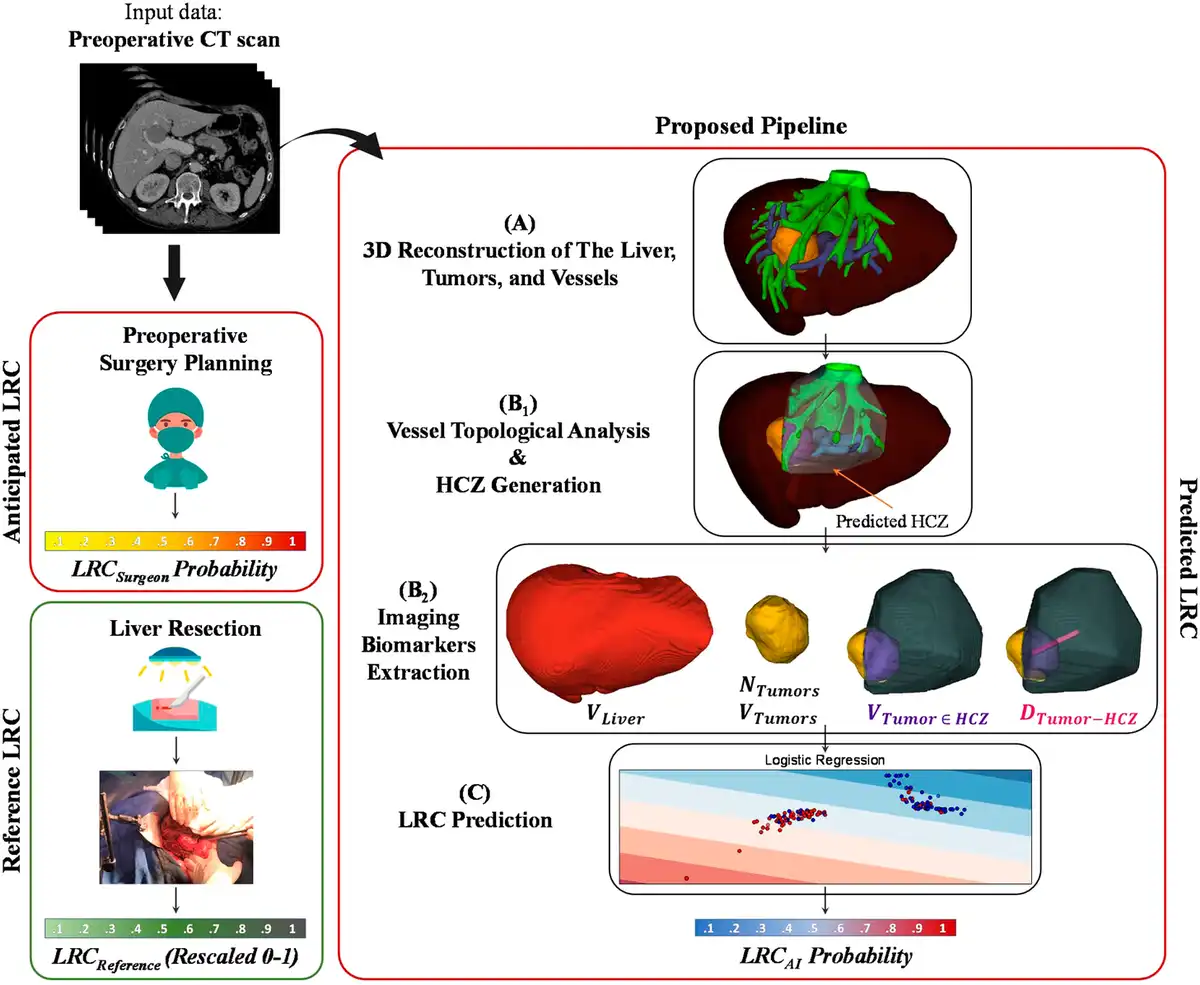
– Development of an AI-based automatic 3D liver modeling pipeline that integrates organ, tumor, and blood vessel segmentation from preoperative CT scans.
– Introduction of the Hepatic Central Zone (HCZ) as a novel anatomic frame of reference for assessing liver resection complexity.
– The AI model predicts intraoperative liver resection complexity (LRC) with higher accuracy and AUC than experienced surgeons relying solely on CT imaging.
– This novel AI tool holds promise for enhancing surgical planning, optimizing patient referral, and potentially reducing morbidity and mortality in liver cancer surgery.

Study Background

MedXY registered readers

Sign in free to continue reading

Create or use your MedXY account to unlock the complete article.

This article was created using several editorial tools, including AI, as part of the process. Human editors reviewed this content before publication.

Related articles

Open language-specific specialty feeds and department pages.

Evaluating Conversational AI in Urgent Primary Care: A Prospective Feasibility Study of the Articulate Medical Intelligence ExplorerThis study assesses the safety, quality, and user acceptance of a conversational AI system aiding urgent primary care by engaging patients before appointments, demonstrating promising feasibility for clinical integration.Oct 18, 2026Navigating the Landscape of FDA-Approved Surgical AI Devices: Innovation, Evidence, and Regulatory ChallengesThis article analyzes FDA-approved surgical AI devices, highlighting trends in technology, evidence quality, regulatory pathways, and implications for clinical adoption.Oct 16, 2026The Role of Medical Interpreters in Enhancing Resilience and the Challenges for Artificial Intelligence IntegrationThis review synthesizes evidence on medical interpreters’ critical roles in supporting resilience for non-English language preference patients during ambulatory diagnostic care, highlighting gaps and implications for AI interpretationOct 15, 2026
Loading comments...
MedXY briefing

Get the free newsletter

Evidence-led clinical news, trends, and analysis—delivered to your inbox.

Ask MedXY AI

Most popular

Intimate Health
Five Benefits for Women Continuing Sexual Activity After Menopause
Intimate Health
Why Some Women Have a Strong Sex Drive—And Why Men Shouldn't Worry About It
Nursing & care
How often should a couple have sex?
Cardiology
Precision Medicine for Long QT Syndrome Type 2: Lumacaftor Corrects Trafficking Defects and Shortens QT Interval
General Surgery
Optimizing Postoperative Opioid Prescriptions After Intra-Abdominal Cancer Surgery: Comparing the 5x-Multiplier and 3-Tier Models
© 2026 MedXY
Contact usAbout usPrivacy PolicyMedXY story
AI-Assisted Video Monitoring Revolutionizes Care for Tracheostomy-Dependent Infants: A Proof-of-Concept Evaluation
This study demonstrates promising accuracy of a patient-personalized AI system in detecting tracheostomy tube status and infant distress via video monitoring, highlighting potential for enhanced, continuous surveillance in high-risk infants
Oct 14, 2026
Clinical AI Competence in Obstetrics and Gynecology: Balancing Innovation with Patient Safety and AccountabilityThe integration of artificial intelligence in obstetrics and gynecology necessitates clinical competence to ensure patient safety, verify outputs, and maintain physician accountability. Structured training and evaluation are essential for rOct 6, 2026
Harnessing No-Code AI for Thyroid Nodule Ultrasound Malignancy Classification: A Leap Toward Accessible and Reproducible Medical AIA no-code, agentic AI workflow successfully developed and externally validated a calibrated thyroid nodule malignancy classifier, demonstrating strong diagnostic performance across multiple cancer histologies and enhancing accessibility in Oct 4, 2026