Agency-Level Variability in Futility Determinations and Termination of Resuscitation for Pediatric Out-of-Hospital Cardiac Arrest
Highlight
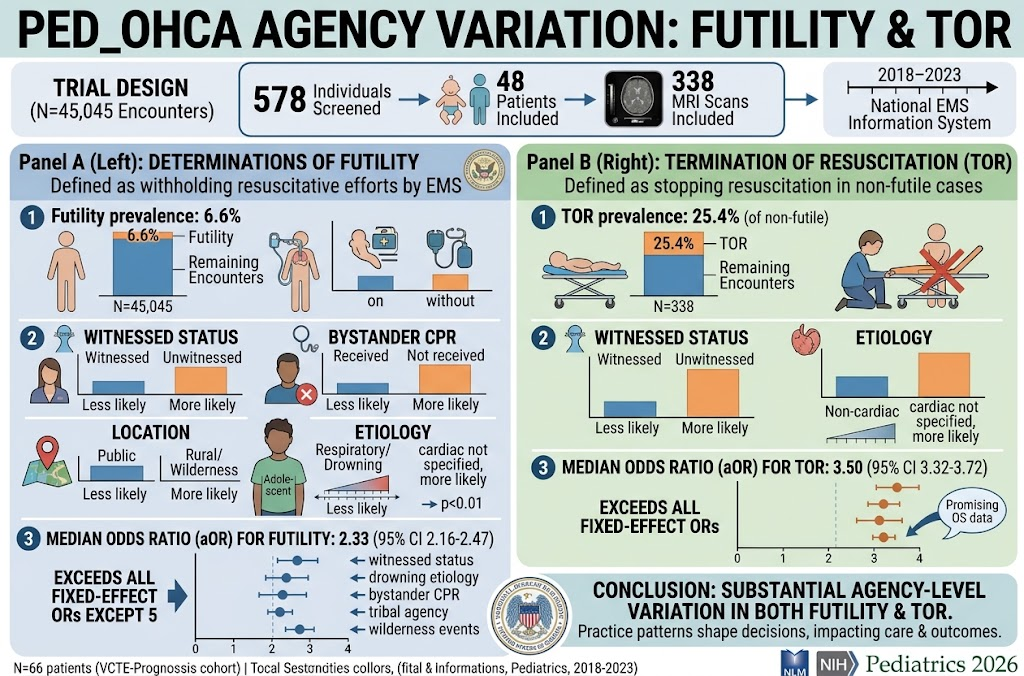
- Substantial variation exists among EMS agencies regarding futility assessments and termination of resuscitation (TOR) decisions in pediatric out-of-hospital cardiac arrest (OHCA) cases.
- Futility determinations were less likely in witnessed arrests, events with bystander CPR, public settings, and specific etiologies such as respiratory/asphyxia or drowning, but more common in rural/wilderness locations and among adolescents.
- The magnitude of interagency variability exceeded many clinical factors, underscoring local EMS practice patterns as strong drivers of resuscitation decisions.
- These findings have important implications for resource utilization, clinical outcomes, and efforts to standardize pediatric resuscitation protocols.
Study Background
Pediatric out-of-hospital cardiac arrest (OHCA) presents a complex clinical challenge, marked by generally low survival rates despite intensive efforts. Decisions regarding the initiation, continuation, or termination of resuscitation by emergency medical services (EMS) critically impact patient outcomes, resource allocation, and family experiences. However, the criteria that EMS agencies use to judge resuscitation as futile or to terminate efforts prematurely remain poorly standardized, especially in pediatric populations. Given the sensitive nature and ethical considerations inherent to pediatric resuscitation, understanding variability across agencies in these decisions is essential for optimizing care quality and equity. This study addresses a pressing unmet need by quantifying interagency differences and identifying factors influencing futility and TOR determinations in children experiencing nontraumatic OHCA.
Study Design
This retrospective cross-sectional investigation analyzed EMS activations for pediatric patients under 18 years old who experienced nontraumatic OHCA between 2018 and 2023. Data were extracted from the National EMS Information System, encompassing 45,045 encounters managed by 6,550 EMS agencies nationwide. The primary outcomes were twofold: (1) determinations of futility, operationalized as EMS decisions to withhold resuscitation efforts upon patient contact; and (2) termination of resuscitation (TOR) after resuscitative attempts had been initiated.
To dissect factors influencing these decisions, mixed-effects logistic regression models incorporated both patient-level covariates (age group, arrest witnessed status, bystander CPR, etiology, location type) and agency-level characteristics. The magnitude of variation between agencies was quantified using median odds ratios (MOR), a statistical measure expressing the likelihood that two random agencies would differ in their threshold to declare futility or perform TOR.
Key Findings
Among pediatric OHCA cases, resuscitation was deemed futile in 6.6% of instances, while TOR occurred in 25.4% of cases where resuscitation was attempted. Analysis revealed several clinical and contextual factors influencing these decisions:
- Futility Determination: Less likely in witnessed arrests, incidents with bystander CPR, public locations, and cases with respiratory/asphyxia or drowning causes. Conversely, more likely in adolescents and in rural or wilderness settings.
- Termination of Resuscitation: Less likely in witnessed arrests and in noncardiac etiologies, suggesting reluctance to cease efforts when potential reversibility exists.
Importantly, the median odds ratio (MOR) for futility determination was 2.33 (95% CI: 2.16-2.47), indicating that the odds of declaring futility could more than double depending solely on which EMS agency managed the case. This variation exceeded the influence of most fixed-effects variables except some critical clinical/contextual factors including arrest witnessed status, drowning etiology, bystander CPR, tribal EMS agency type, and wilderness events.
Regarding TOR, the MOR was even higher at 3.50 (95% CI: 3.32-3.72), meaning that interagency differences outweighed every patient-level variable’s effect on termination decisions. These findings strongly suggest that local EMS protocols and culture heavily shape resuscitation practices beyond patient characteristics.
Clinical Implications
The demonstrated variability has profound implications. First, it raises concerns about consistency and equity in pediatric resuscitation outcomes across geographical and organizational boundaries. Agencies with more conservative or aggressive TOR criteria may respectively underutilize resources or expose patients to protracted futile attempts. Second, it underscores the need for enhanced evidence-based guidelines specifically tailored to children to harmonize EMS responses and improve survival chances.
Expert Commentary
Current guidelines from organizations such as the American Heart Association provide general TOR recommendations, but pediatric-specific criteria remain less refined, often relying on adult data extrapolation. This study highlights a gap between guideline intent and field implementation, where local practice variability supersedes patient factors. Experts emphasize that future research should focus on identifying reliable prognostic markers in pediatric OHCA and integrating them into pragmatic protocols to support EMS decision-making.
Additionally, understanding the ethical framework underpinning futility judgments, especially in pediatrics, is crucial. Transparency, communication with families, and training in shared decision-making could help mitigate variability and improve care quality.
Conclusion
This nationally representative analysis reveals significant agency-level variation in EMS determinations of resuscitation futility and termination for pediatric out-of-hospital cardiac arrest. While clinical factors influence decisions, local EMS culture and protocols exert an even more powerful effect. These insights stress the urgent need to develop, validate, and implement standardized pediatric-specific resuscitation guidelines. Achieving consistency in resuscitation practices is vital for optimizing outcomes, rationalizing resource use, and providing equitable emergency care for children susceptible to cardiac arrest.
Funding and Registration
The study was supported by institutional research funds; no clinical trials registration applies as this is a retrospective observational study.
References
1. Ramgopal S, Loftus K, Amagasa S, et al. Futility and termination of resuscitation variation for pediatric out-of-hospital cardiac arrest. Pediatrics. 2026. doi:10.1542/peds.2026-076981. PMID:42580740.
2. Meaney PA, Bobrow BJ, Mancini ME, et al. Cardiopulmonary resuscitation quality: improving cardiac resuscitation outcomes both inside and outside the hospital. Circulation. 2013;128(4):417-435. doi:10.1161/CIRCULATIONAHA.112.128728.
3. Atkins DL, Everson-Stewart S, Sears GK, et al. Epidemiology and Outcomes from Out-of-Hospital Cardiac Arrest in Children: The Resuscitation Outcomes Consortium Epistry-Cardiac Arrest. Circulation. 2009;119(11):1484-1491. doi:10.1161/CIRCULATIONAHA.108.804945.
4. American Heart Association. Pediatric Advanced Life Support Provider Manual. 2020.
5. Morrison LJ, Visentin LM, Kiss A, et al. Incidence and outcomes of out-of-hospital cardiac arrest stratified by neighborhood socioeconomic position: A retrospective cohort study. Can J Cardiol. 2019;35(7):853-860. doi:10.1016/j.cjca.2019.02.027.
This article was created using several editorial tools, including AI, as part of the process. Human editors reviewed this content before publication.