Advancing Laryngeal Examination: Real-Time Functional Behavior Classification via Vocal Fold Kinematics
Background: Addressing Challenges in Laryngeal Functional Assessment
Laryngeal disorders encompass a range of conditions affecting phonation, airway protection, and swallowing, significantly impacting quality of life. Clinical evaluation often employs videolaryngoscopy to visualize vocal fold movements. However, manual analysis of laryngeal function during examinations is labor-intensive, subjective, and prone to variability. Automated real-time classification of laryngeal behaviors could improve diagnostic accuracy, streamline clinical workflows, and enable scalable data capture for research and treatment monitoring.
Study Design and Methods
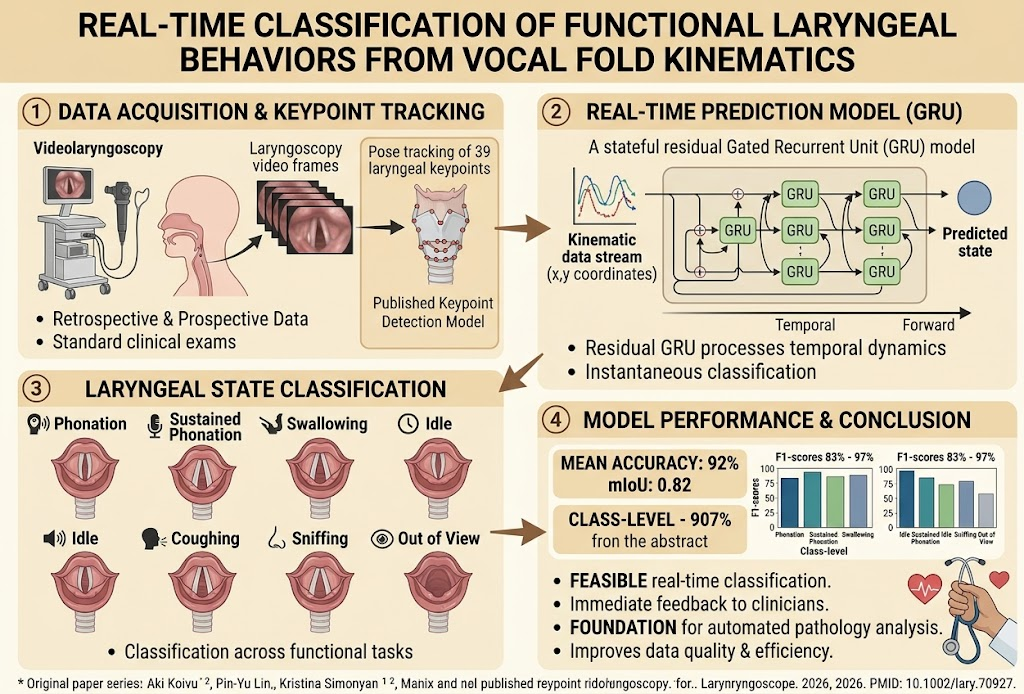
The study by Koivu et al. introduces a cutting-edge machine learning approach leveraging vocal fold kinematics captured by videolaryngoscopy. Researchers developed a stateful residual Gated Recurrent Unit (GRU) neural network that processes tracking data from 39 keypoints on the larynx. These keypoints were detected via a previously published model specialized in laryngeal landmark identification. The GRU model classified functional states including phonation, sustained phonation, swallowing, idle (rest), coughing, sniffing, and out-of-view segments.
The training dataset comprised 916 annotated state segments consisting of 222,065 frames from 72 laryngoscopy videos. An independent test dataset with 123 segments and 49,770 frames from 8 additional videos evaluated model generalizability. Performance was quantified with standard classification metrics (accuracy, F1-score) and temporal agreement measured by mean Intersection over Union (mIoU).
Key Findings and Interpretation
The study demonstrated that real-time classification of laryngeal behaviors from vocal fold kinematics is both feasible and highly accurate. The model achieved an overall accuracy of 92% on the independent test set, with an mIoU of 0.82 indicating strong temporal alignment between predicted and manual annotations.
Per-class F1-scores indicated robust performance across states: phonation reached 83%, sniffing 97%, and sustained phonation, swallowing, idle, and out-of-view also exhibited favorable classification metrics. The lowest F1-score was for coughing at 82%, but confidence intervals suggested reasonable stability. This variation likely reflects the temporal complexity and variability of cough behaviors.
The high accuracy and temporal precision open opportunities for integrating such models into clinical endoscopy sessions, providing instantaneous feedback to clinicians about patient laryngeal behavior and potentially triggering prompts or interventions during examinations.
Expert Commentary and Clinical Implications
Automated interpretation of vocal fold motion could revolutionize the otolaryngology field by standardizing laryngeal functional assessments and minimizing subjectivity. The use of a stateful GRU that captures temporal dependencies aligns well with the dynamic nature of laryngeal activities.
Challenges remain, including the variability in anatomic and pathological presentations that may affect tracking accuracy and classification consistency. Future work should explore larger multicenter datasets, incorporate pathological states, and evaluate real-world clinical integration impact on outcomes.
Moreover, this methodology sets the stage for downstream automated pathology detection, severity grading, and longitudinal monitoring, all critical for personalized voice disorder management.
Conclusion and Future Directions
This study establishes a promising foundation for real-time, automated classification of functional laryngeal behaviors using sophisticated machine learning on videolaryngoscopy-derived vocal fold kinematics. It offers a scalable approach to enhance clinical data quality and workflow efficiency.
Continued development and validation of such models can expand their utility beyond research into routine clinical practice, enabling objective, rapid, and reproducible assessments for better diagnosis and treatment of laryngeal pathologies.
Funding and Disclosures
The original investigation by Koivu et al. did not specify funding sources or clinical trial registration within the abstract. Further detailed disclosures should be sought in the full article to appraise potential conflicts of interest.
References
- Koivu A, Lin PY, Simonyan K, Naunheim MR. Real-Time Classification of Functional Laryngeal Behaviors From Vocal Fold Kinematics. The Laryngoscope. 2026 Sep 18. PMID: 42760595.
- Roy N, Merrill RM, Gray SD, Smith EM. Voice Disorders in the General Population: Prevalence, Risk Factors, and Occupational Impact. Laryngoscope. 2005 Apr;115(4):757-64.
- Simonyan K, Zisserman A. Very Deep Convolutional Networks for Large-Scale Image Recognition. arXiv preprint arXiv:1409.1556. 2014.
This article was created using several editorial tools, including AI, as part of the process. Human editors reviewed this content before publication.