Abbott initiates real-world TriClip postmarket study as Edwards prepares Pascal U.S. launch
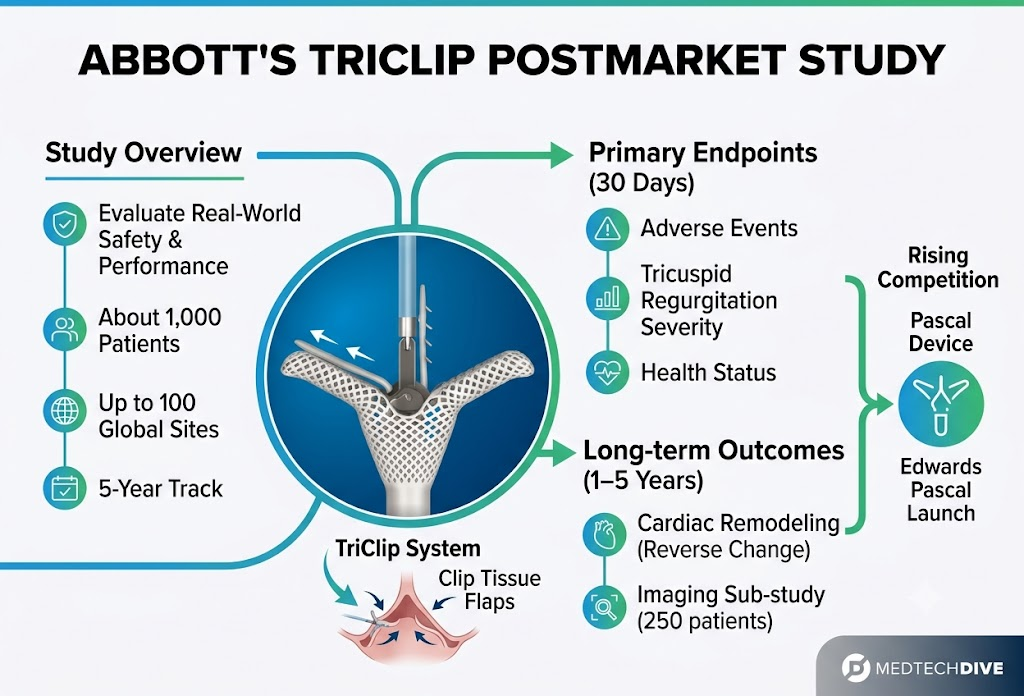
Abbott announced Tuesday that it has initiated a postmarket study to evaluate the real-world safety and performance of its TriClip tricuspid valve repair system, collecting data from approximately 1,000 patients over five years. The move strengthens Abbott’s evidence base as Edwards Lifesciences prepares to launch its competing Pascal device in the U.S. later this year.
Abbott begins a prospective, multicenter real-world study of TriClip with a target of 1,000 patients across up to 100 sites globally.
Primary endpoints assess adverse events, tricuspid regurgitation severity, and health status 30 days post-treatment; five-year follow-up will capture longer-term outcomes and cardiac remodeling.
The imaging sub-study in 250 patients will evaluate whether TriClip reverses structural changes in the heart over 12 months.
Edwards Lifesciences expects U.S. launch of its Pascal tricuspid system in Q4 2026, citing advantages in independent grasping features.
Abbott CEO Robert Ford noted that TriClip growth is offsetting headwinds in the mitral business due to increased competitive intensity.
TriClip background and technology
The U.S. Food and Drug Administration approved TriClip in 2024 based on pivotal trial results showing reduced severity of tricuspid regurgitation and improved quality of life. Tricuspid regurgitation (TR) occurs when the tricuspid valve fails to close properly, allowing blood to flow backward into the right atrium and forcing the heart to work harder. TriClip is a transcatheter edge-to-edge repair device that clips together leaflets of the valve to restore proper function.
Real-world study design
Abbott’s new postmarket study will track patients treated in contemporary clinical practice. The three primary endpoints focus on safety (adverse events), efficacy (TR severity), and patient-reported health status 30 days after the procedure. Beyond the primary endpoint window, five-year follow-up will capture longer-term outcomes, including effects on cardiac structure. An imaging sub-study of 250 patients will use echocardiography or similar methods to assess whether TriClip reverses cardiac remodeling—structural changes in the heart caused by injury or overload—within 12 months of treatment.
Competitive landscape and Edwards’ Pascal
The study launch comes as Edwards Lifesciences expects to introduce its Pascal transcatheter tricuspid repair system in the United States in the fourth quarter of 2026. Pascal already competes with TriClip in Europe. On Edwards’ recent earnings call, Daveen Chopra, corporate vice president of transcatheter mitral and tricuspid therapies, highlighted Pascal’s independent grasping capability, stating that the feature “really make a difference” in tricuspid patients and that physicians “want to use Pascal more and more often” in Europe.
Abbott CEO Robert Ford, speaking on the company’s earnings call this month, said that TriClip is “showing good growth in tricuspid,” which is helping offset challenges in the mitral valve business. Ford acknowledged that Abbott has “got to do a better job” in mitral repair following an increase in “competitive intensity” in the U.S.
Outlook
The real-world study will generate additional evidence that may support Abbott’s market position as Edwards enters the U.S. tricuspid space. The five-year follow-up and remodeling sub-study could provide differentiation if positive outcomes emerge. However, the study is observational and non-randomized, limiting direct comparisons. Clinicians and investors will watch enrollment pace and early safety signals as competition intensifies.
References:
Abbott announcement, July 29, 2026; Edwards Lifesciences earnings call, July 2026; Abbott earnings call, July 2026.
https://clinicaltrials.gov/study/NCT04483089?cond=TriClip%20&viewType=Card&rank=3