We use cookies

Our website uses essential cookies and, with your consent, additional cookies to measure performance and improve our services. Cookie Policy.

You can change your choice at any time.

MMedXYNews
HomeVideos
MedXY AI/MedXY News/Section: Gastroenterology

Xenotransplantation in Acute Liver Failure: Bridging the Organ Gap with Genetically Modified Porcine Livers
MedXY Editorial Team•Sep 21, 2026•Gastroenterology
xenotransplantationgenetically modified pigsorgan shortageAcute liver failure

Highlight

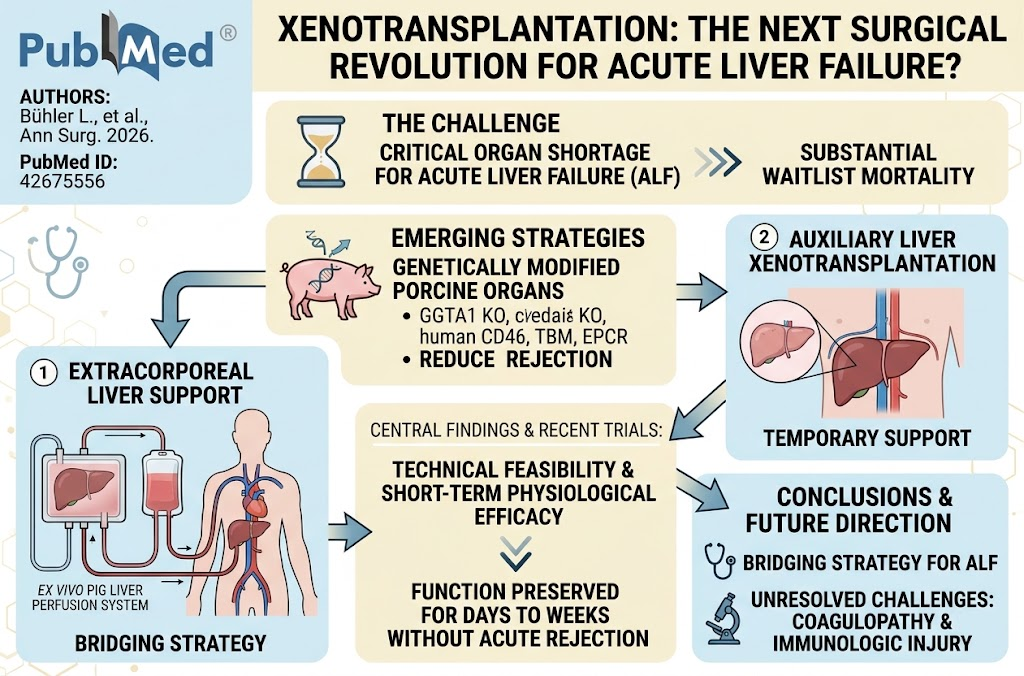
  • Xenotransplantation with genetically modified porcine livers offers a promising bridge therapy for patients with acute liver failure, addressing the critical organ shortage.
  • Recent early clinical cases demonstrate technical feasibility and short-term viability of porcine liver grafts in extracorporeal support and auxiliary transplantation.
  • Challenges remain, notably coagulopathy and immune-mediated injury, necessitating further genetic and immunologic refinements.
  • Advances in gene editing, organ preservation, and machine perfusion technology underpin these translational breakthroughs.

Study Background

MedXY registered readers

Sign in free to continue reading

Create or use your MedXY account to unlock the complete article.

This article was created using several editorial tools, including AI, as part of the process. Human editors reviewed this content before publication.

Related articles

Open language-specific specialty feeds and department pages.

Therapeutic Implications of MARS Therapy-Induced Piperacillin Clearance in Critical Liver Failure PatientsMARS therapy significantly reduces total plasma piperacillin levels by approximately one-third per session in critically ill liver failure patients, underscoring the need for therapeutic drug monitoring and individualized antibiotic dosing.Jun 30, 2026SLA-DR–Deleted Donor Pigs Show Durable Kidney Xenograft Function and a Favorable Safety Profile in Rhesus MonkeysCRISPR-engineered GGTA1/B4GALNT2/SLA-DR knockout pigs remained healthy, screened negative for 55 zoonotic pathogens, and supported long-term renal xenograft function in rhesus monkeys when preformed anti-SLA antibodies were absent.Jun 6, 2026Sự viêm vi mạch bẩm sinh sớm và kích hoạt nội mô xác định đặc điểm miễn dịch chủng khác sau ghép tim lợn sang ngườiPhân tích đa chế độ của hai quả tim lợn đã được chỉnh sửa gen 10 gen được ghép vào người đã chết não cho thấy sự viêm vi mạch bẩm sinh sớm với kích hoạt nội mô và hồ sơ phân tử phù hợp với tổn thương do kháng thể mặc dù không có C4d trong mDec 3, 2025
Loading comments...
MedXY briefing

Get the free newsletter

Evidence-led clinical news, trends, and analysis—delivered to your inbox.

Ask MedXY AI

Most popular

Intimate Health
Five Benefits for Women Continuing Sexual Activity After Menopause
Intimate Health
Why Some Women Have a Strong Sex Drive—And Why Men Shouldn't Worry About It
Nursing & care
How often should a couple have sex?
General Surgery
Optimizing Postoperative Opioid Prescriptions After Intra-Abdominal Cancer Surgery: Comparing the 5x-Multiplier and 3-Tier Models
Intimate Health
Classic Intimacy Recommendations: How to Help Women Reach Orgasm and Enjoy Mutual Pleasure
© 2026 MedXY
Contact usAbout usPrivacy PolicyMedXY story
Early Innate Microvascular Inflammation and Endothelial Activation Define the Xenoimmune Signature After Pig-to-Human Heart Transplantation
Multimodal analysis of two 10-gene–edited pig hearts transplanted into brain-dead human recipients revealed early innate microvascular inflammation with endothelial activation and a molecular profile consistent with antibody-mediated injury
Dec 2, 2025
Therapeutic Plasma Exchange May Improve Transplant-Free Survival in Severe Amatoxin-Associated Acute Liver FailureA multinational retrospective cohort found adjunctive plasma exchange was associated with higher 28‑day transplant-free survival in amatoxin-related ALF patients with grade ≥2 hepatic encephalopathy.Nov 6, 2025
Innovative Extracorporeal Therapy Combining HLA-Depleted Liver Organoids and Granulocyte-Monocyte Apheresis for Reversal of Acute Liver FailureThe UTOpiA system, integrating HLA-depleted iPSC-derived liver organoids with granulocyte-monocyte apheresis, significantly improves survival and liver regeneration in acute-on-chronic and acute liver failure rat models, representing a promOct 28, 2025