We use cookies

Our website uses essential cookies and, with your consent, additional cookies to measure performance and improve our services. Cookie Policy.

You can change your choice at any time.

MMedXYNews
HomeVideos
MedXY AI/MedXY News/Section: Clinical Updates

Whole-Grain Consumption and Cardiometabolic Risk: Evidence from Meta-Analyses of Randomized Controlled Trials
MedXY Editorial Team•Sep 23, 2026•Clinical Updates
whole grainscardiometabolic riskmeta-analysisrandomized trials

Highlights

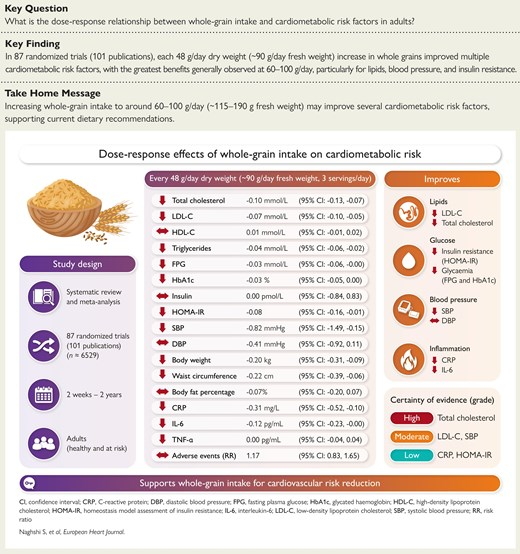
  • Comprehensive meta-analysis of 87 randomized trials demonstrates that each 48 g/day increase in whole-grain intake reduces multiple cardiometabolic risk factors including weight, waist circumference, total and LDL cholesterol, triglycerides, fasting glucose, systolic blood pressure, and inflammatory marker interleukin-6.
  • High-certainty evidence supports reductions in adiposity, total cholesterol, and inflammation, while moderate-certainty evidence supports improvements in LDL cholesterol, triglycerides, glucose, and systolic blood pressure.
  • Non-linear dose-response analysis indicates maximal benefits commonly occur at whole-grain intakes of 60–100 g/day, with limited data to clarify effects beyond this range.
  • Evidence extends to prospective cohort data suggesting that specific whole-grain foods, such as cold breakfast cereals and bran, may reduce ischemic stroke risk, though results for overall stroke risk are inconclusive.

Background

MedXY registered readers

Sign in free to continue reading

Create or use your MedXY account to unlock the complete article.

This article was created using several editorial tools, including AI, as part of the process. Human editors reviewed this content before publication.

Related articles

Open language-specific specialty feeds and department pages.

Whole-grain Consumption and Cardiometabolic Risk: A Meta-analysis of Randomized TrialsThis meta-analysis of 87 randomized trials finds that increasing whole-grain intake is associated with improved cardiometabolic risk factors including reduced body weight, cholesterol, and blood pressure, particularly at daily intakes of 60Sep 21, 2026Intracoronary Imaging-Guided PCI: Updated Meta-Analysis Validates Cardiovascular Outcome BenefitsThis updated meta-analysis of 28 RCTs reveals significant reductions in cardiovascular events and mortality with intracoronary imaging-guided PCI versus angiography-guided PCI, highlighting the importance of lesion and geographic factors inSep 19, 2026Genetic Influences on Macronutrient Preferences and Their Impact on Childhood Food Intake and Metabolic HealthThis cohort study links polygenic scores for macronutrient intake with specific food choices in children and adolescents, highlighting genetic pathways involving hypothalamic appetite regulation but limited effects on cardiometabolic outcomSep 12, 2026
Loading comments...
MedXY briefing

Get the free newsletter

Evidence-led clinical news, trends, and analysis—delivered to your inbox.

Ask MedXY AI

Most popular

Intimate Health
Five Benefits for Women Continuing Sexual Activity After Menopause
Intimate Health
Why Some Women Have a Strong Sex Drive—And Why Men Shouldn't Worry About It
Nursing & care
How often should a couple have sex?
General Surgery
Optimizing Postoperative Opioid Prescriptions After Intra-Abdominal Cancer Surgery: Comparing the 5x-Multiplier and 3-Tier Models
Intimate Health
Classic Intimacy Recommendations: How to Help Women Reach Orgasm and Enjoy Mutual Pleasure
© 2026 MedXY
Contact usAbout usPrivacy PolicyMedXY story
Genetic Insights into Childhood Blood Pressure and Heart Rate: Implications for Adult Cardiometabolic Health
Large-scale GWAS highlight novel genetic loci influencing childhood blood pressure and heart rate, with polygenic risk scores predicting adult cardiometabolic outcomes, underscoring the importance of early-life genetic determinants in cardi
Sep 5, 2026
Randomized Quality Improvement Trials: Enhancing Healthcare Safety with Ethical OversightRandomized Quality Improvement (RQI) trials offer robust evidence for healthcare interventions but raise ethical and regulatory challenges. A proposed framework provides streamlined oversight enabling safer, evidence-based care improvementsAug 24, 2026
Gut Microbiota-Derived Imidazole Propionate as a Predictor of Cardiometabolic Risk in Coronary Artery Disease: Evidence and Clinical ImplicationsEmerging evidence identifies circulating imidazole propionate, a gut microbiota-derived metabolite, as an independent predictor of major adverse cardiovascular events in patients with coronary artery disease, offering novel insights into peAug 18, 2026