Transcription Factor NFE2: A Crucial Regulator of Redox Balance and Chemotherapy Resistance in Acute Myeloid Leukemia
Highlight
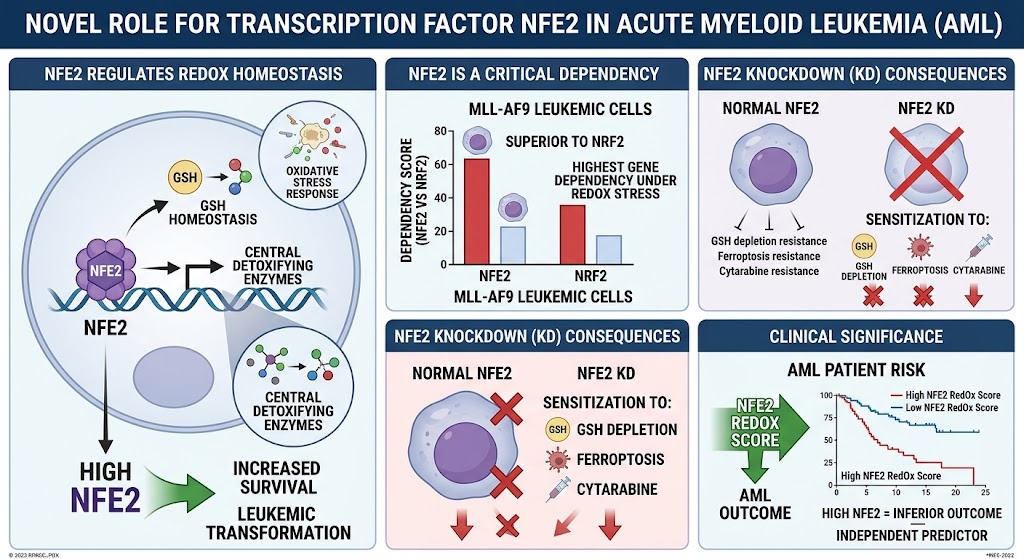
- NFE2 overactivity alone can drive leukemic transformation independent of classical drivers in AML.
- NFE2 is a pivotal regulator of oxidative stress response through controlling glutathione homeostasis and detoxifying enzymes.
- NFE2 dependency in MLL-AF9 AML cells under oxidative stress surpasses that of NRF2, a canonical redox regulator.
- Knockdown of NFE2 sensitizes AML cells to glutathione depletion, ferroptosis induction, and cytarabine chemotherapy, correlating with improved patient prognosis when NFE2 activity is low.
Study Background
Acute myeloid leukemia (AML) is a heterogeneous hematologic malignancy characterized by clonal proliferation of myeloid precursor cells. Despite advances in understanding genetic drivers and the introduction of novel targeted therapies, the prognosis of AML remains poor, especially in subsets resistant to standard chemotherapy such as cytarabine. Redox dysregulation and oxidative stress adaptation are increasingly recognized as critical contributors to leukemic cell survival and chemoresistance. The nuclear factor erythroid 2 (NFE2) transcription factor has recently emerged as a candidate oncogenic driver in AML, but its mechanistic role remains unclear. This study addresses important clinical challenges by investigating the role of NFE2 in oxidative stress regulation and resistance to chemotherapy in AML, specifically in MLL-AF9-transformed leukemic cells, a model for aggressive AML.
Study Design
This research employed a multi-layered molecular approach combining genomic occupancy analysis, chromatin accessibility assays, transcriptomics, and functional dependency screening in primary leukemic cells transformed by the MLL-AF9 fusion oncogene. Key experimental interventions included NFE2 knockdown and assessment under conditions of redox stress, glutathione depletion, ferroptosis induction, and cytarabine treatment. The primary endpoints included leukemic cell viability, gene expression of redox and detoxification pathways, and correlation of an NFE2 activity-derived RedOx score with clinical outcomes in AML patient cohorts.
Key Findings
NFE2 Drives Leukemic Transformation and Regulates Redox Homeostasis
NFE2 activity alone was sufficient to induce leukemic transformation in the absence of classical leukemic genetic drivers, indicating a powerful oncogenic role. Chromatin immunoprecipitation sequencing revealed extensive NFE2 binding to genomic regions controlling genes involved in glutathione synthesis, recycling, and usage, as well as central detoxifying enzymes critical in counteracting oxidative damage.
Superiority of NFE2 Dependency Over NRF2 Under Redox Stress
A genome-wide dependency screening highlighted that MLL-AF9 AML cells rely more heavily on NFE2 for survival under oxidative stress than on NRF2, which is conventionally seen as a chief oxidative stress regulator. This finding underscores a unique and non-redundant role of NFE2 in maintaining glutathione homeostasis in leukemic cells.
Increased Sensitivity to Therapeutic Stressors Upon NFE2 Knockdown
Silencing NFE2 significantly heightened AML cells’ vulnerability to glutathione depletion and ferroptosis, a form of programmed cell death driven by iron-dependent lipid peroxidation. Moreover, NFE2 knockdown enhanced cytarabine cytotoxicity, suggesting that NFE2 mediates chemotherapy resistance by protecting against oxidative damage.
NFE2 RedOx Score as an Independent Predictor of AML Outcome
Applying an NFE2 RedOx activity score to patient data showed that high NFE2 activity at diagnosis independently predicted inferior overall survival and response rates, supporting the clinical relevance of NFE2 as a prognostic biomarker and potential therapeutic target.
Expert Commentary
This seminal study reveals a previously underappreciated role of NFE2 as a master regulator of redox balance in AML, distinct from the classical NRF2 pathway. Its ability to drive leukemogenesis alone and regulate glutathione-dependent detoxification pathways represents a paradigm shift in understanding AML biology. Clinically, the findings implicate NFE2 as a critical determinant of chemotherapy resistance, particularly relevant for cytarabine-based regimens. Targeting NFE2 or its downstream redox network may overcome therapeutic resistance and improve patient outcomes.
From a mechanistic perspective, the involvement of ferroptosis sensitization offers a rationale for combination strategies incorporating ferroptosis inducers with standard chemotherapy. However, the study mainly focuses on MLL-AF9 AML models, and further research is needed to elucidate NFE2’s role across other AML subtypes and in vivo systems.
Conclusion
The discovery of NFE2 as a key regulator of oxidative stress response and chemotherapy resistance in AML highlights a novel therapeutic axis. NFE2’s modulation of glutathione homeostasis and detoxification pathways promotes leukemic cell survival under oxidative and chemotherapeutic stresses. Clinically, an NFE2-based RedOx activity score predicts patient prognosis at diagnosis. These findings warrant the development of targeted interventions against NFE2 or its downstream effectors to enhance AML treatment responses.
Funding and Clinical Trials
The study was funded by the contributing institutions and relevant hematology research grants. No clinical trial registration is directly associated with this research paper.
References
Staehle AM, Perner F, Staehle HF, et al. A novel role for transcription factor NFE2 in redox regulation and chemotherapy resistance in acute myeloid leukemia. Leukemia. 2026 Aug 19. PMID: 42618699.
Additional references on AML redox biology and therapy resistance:
1. Trachootham D, Lu W, Ogasawara MA, et al. Redox regulation of cell survival. Antioxid Redox Signal. 2008;10(8):1343-74.
2. Drgona L, Kumi-Diaka J. Nrf2 and oxidative stress in cancer therapy. Front Pharmacol. 2021;12:831087.
3. Yang WS, Stockwell BR. Ferroptosis: Death by Lipid Peroxidation. Trends Cell Biol. 2016;26(3):165-76.
4. Pollyea DA, Gutman JA, Gore L. Novel therapies in AML. Blood Rev. 2020;41:100660.
This article was created using several editorial tools, including AI, as part of the process. Human editors reviewed this content before publication.