We use cookies

Our website uses essential cookies and, with your consent, additional cookies to measure performance and improve our services. Cookie Policy.

You can change your choice at any time.

MMedXYNews
HomeVideos
MedXY AI/MedXY News/Section: Allergy & Immunology

Trajectory of Exacerbations in Biologic-Eligible Severe Asthma: Insights from UK Nationwide Data
MedXY Editorial Team•Oct 11, 2026•Allergy & Immunology
biologic eligibilityblood eosinophilsexacerbation trajectories重症喘息

Highlight

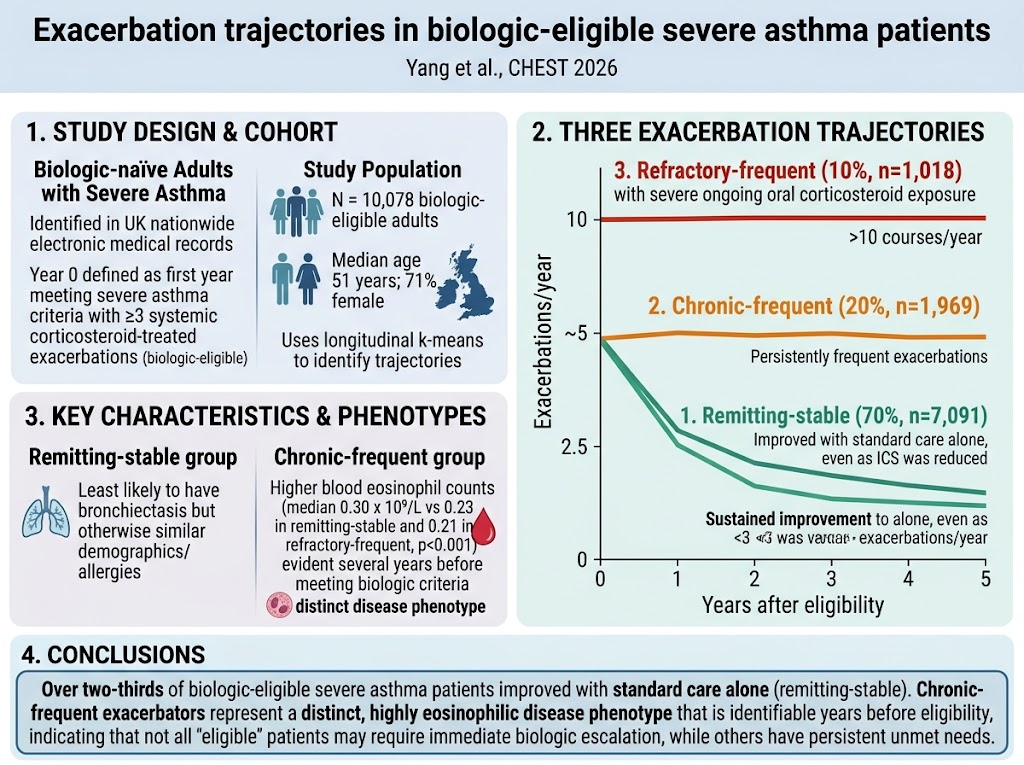
This nationwide UK study of severe asthma patients eligible for biologic therapy identified three distinct exacerbation trajectories over time: a majority experienced remitting-stable courses with reduced exacerbations under standard care; a smaller subset had persistent frequent exacerbations associated with higher eosinophil counts, indicative of a distinct inflammatory phenotype; and a refractory group endured high corticosteroid exposure. These findings challenge assumptions that biologics are universally needed immediately upon eligibility and emphasize the heterogeneity of severe asthma progression.

Study Background

MedXY registered readers

Sign in free to continue reading

Create or use your MedXY account to unlock the complete article.

This article was created using several editorial tools, including AI, as part of the process. Human editors reviewed this content before publication.

Related articles

Open language-specific specialty feeds and department pages.

2026 Global Initiative for Asthma (GINA) Strategy Report: Executive Summary and Key ChangesA concise, practice-focused summary of the 2026 GINA Strategy Report, highlighting new recommendations on inhaled corticosteroid–formoterol (AIR) strategies, severe asthma biologic guidance, and acute care updates.Oct 15, 2026Biologic Outcomes in Severe Asthma by Smoking Status: Insights from the SHARP European RegistrySHARP registry data reveal that biologic therapies improve clinical outcomes equally in severe asthma patients irrespective of smoking status, challenging prevailing prescribing hesitancy and advocating inclusive treatment approaches.Sep 26, 2026Early Biologic Initiation in Severe Asthma: Enhancing Remission and Clinical Outcomes from Global Real-World CohortsEarlier initiation of biologic therapies in severe asthma improves clinical remission rates, reduces exacerbations, preserves lung function, and decreases corticosteroid dependence, supporting a shift from reserving to preserving treatmentSep 15, 2026
Loading comments...
MedXY briefing

Get the free newsletter

Evidence-led clinical news, trends, and analysis—delivered to your inbox.

Ask MedXY AI

Most popular

Intimate Health
Five Benefits for Women Continuing Sexual Activity After Menopause
Intimate Health
Why Some Women Have a Strong Sex Drive—And Why Men Shouldn't Worry About It
Nursing & care
How often should a couple have sex?
Cardiology
Precision Medicine for Long QT Syndrome Type 2: Lumacaftor Corrects Trafficking Defects and Shortens QT Interval
General Surgery
Optimizing Postoperative Opioid Prescriptions After Intra-Abdominal Cancer Surgery: Comparing the 5x-Multiplier and 3-Tier Models
© 2026 MedXY
Contact usAbout usPrivacy PolicyMedXY story
Tezepelumab Demonstrates Robust Efficacy and Safety Across Diverse Severe Asthma Phenotypes: Insights from the Phase 4 PASSAGE Study
The PASSAGE phase 4 study reveals tezepelumab significantly reduces exacerbation rates and improves lung function and quality of life in a broad US severe asthma population, including underrepresented groups and varied phenotypes.
Sep 12, 2026
Mepolizumab and Blood Eosinophil Variability in COPD: A New Dimension in Targeted TherapyThis article reviews mepolizumab efficacy in COPD patients with variable blood eosinophil counts, showing benefits even with intermittent eosinophilia, expanding treatable phenotypes beyond persistent elevation.Jun 13, 2026
Tezepelumab Enables Complete Oral Corticosteroid Discontinuation in 50% of Patients with Severe, Uncontrolled Asthma: Results from the WAYFINDER Phase 3b TrialThe WAYFINDER study reveals that tezepelumab significantly reduces OCS dependence in severe asthma, with over half of patients achieving complete discontinuation by week 52 while maintaining asthma control, regardless of baseline inflammatoFeb 19, 2026