We use cookies

Our website uses essential cookies and, with your consent, additional cookies to measure performance and improve our services. Cookie Policy.

You can change your choice at any time.

MMedXYNews
HomeVideos
MedXY AI/MedXY News/Section: Clinical Updates

Biologic Outcomes in Severe Asthma by Smoking Status: Insights from the SHARP European Registry
MedXY Editorial Team•Sep 27, 2026•Clinical Updates
real‑world evidencebiologicssmoking status重症喘息

Highlights

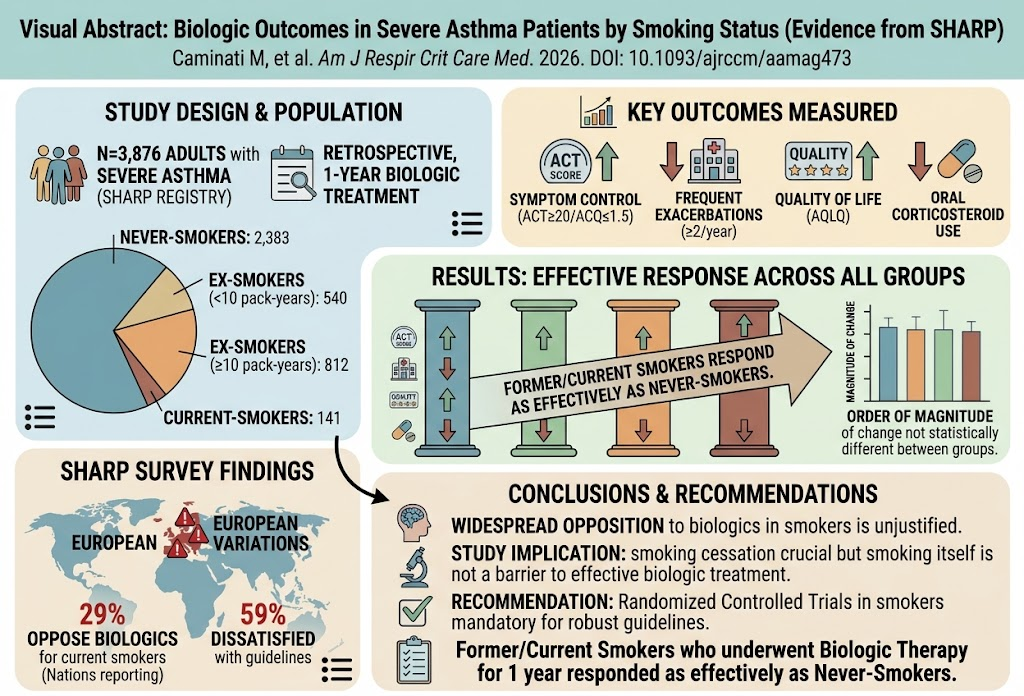
  • The SHARP registry demonstrates comparable efficacy of biologic therapies in severe asthma patients across never-smokers, ex-smokers, and current smokers.
  • Improvements in symptom control, asthma-related quality of life, exacerbation frequency, and oral corticosteroid use were consistent regardless of smoking pack-year history.
  • Despite evidence, a notable proportion of European clinicians remain reluctant to prescribe biologics to current smokers, reflecting gaps between guidelines and practice.
  • The findings emphasize the necessity of targeted randomized controlled trials involving smokers to refine asthma treatment guidelines inclusively.

Background

MedXY registered readers

Sign in free to continue reading

Create or use your MedXY account to unlock the complete article.

This article was created using several editorial tools, including AI, as part of the process. Human editors reviewed this content before publication.

Related articles

Open language-specific specialty feeds and department pages.

Empagliflozin Demonstrates Uniform Cardiovascular Benefits Across Diverse Patient Subgroups in Type 2 Diabetes: Insights from the EMPRISE Real-World StudyEmpagliflozin consistently reduces major cardiovascular events, heart failure hospitalizations, and mortality across diverse sociodemographic and cardiovascular risk groups in older adults with type 2 diabetes, with especially pronounced abSep 23, 2026Early Biologic Initiation in Severe Asthma: Enhancing Remission and Clinical Outcomes from Global Real-World CohortsEarlier initiation of biologic therapies in severe asthma improves clinical remission rates, reduces exacerbations, preserves lung function, and decreases corticosteroid dependence, supporting a shift from reserving to preserving treatmentSep 17, 2026From Mild-to-Moderate to Severe Asthma: Risk Factors and Patient Profiles from the NORDSTAR Cohort and Advances in Severe Asthma ManagementThis review summarizes the progression risk from mild-to-moderate to severe asthma based on the NORDSTAR cohort and integrates emerging evidence on biologic therapies that improve severe asthma outcomes across diverse patient profiles.Sep 17, 2026
Loading comments...
MedXY briefing

Get the free newsletter

Evidence-led clinical news, trends, and analysis—delivered to your inbox.

Ask MedXY AI

Most popular

Intimate Health
Five Benefits for Women Continuing Sexual Activity After Menopause
Intimate Health
Why Some Women Have a Strong Sex Drive—And Why Men Shouldn't Worry About It
Nursing & care
How often should a couple have sex?
General Surgery
Optimizing Postoperative Opioid Prescriptions After Intra-Abdominal Cancer Surgery: Comparing the 5x-Multiplier and 3-Tier Models
Intimate Health
Classic Intimacy Recommendations: How to Help Women Reach Orgasm and Enjoy Mutual Pleasure
© 2026 MedXY
Contact usAbout usPrivacy PolicyMedXY story
Tezepelumab Demonstrates Robust Efficacy and Safety Across Diverse Severe Asthma Phenotypes: Insights from the Phase 4 PASSAGE StudyThe PASSAGE phase 4 study reveals tezepelumab significantly reduces exacerbation rates and improves lung function and quality of life in a broad US severe asthma population, including underrepresented groups and varied phenotypes.Sep 12, 2026
Real-World Eligibility of Diabetic Macular Edema Patients for Anti-VEGF Trials: Implications for Clinical Practice and Health EquityA significant proportion of real-world diabetic macular edema patients are excluded from clinical trials of anti-VEGF therapy due to stringent systemic criteria, disproportionately affecting racial minorities. This study highlights the needSep 11, 2026
Response Kinetics Following CAR T-Cell Therapy for Large B-Cell Lymphoma: Insights from the LYSA DESCAR-T RegistryThis review synthesizes real-world data from the DESCAR-T registry on CAR T-cell therapy response kinetics in large B-cell lymphoma, highlighting the prognostic impact of early response patterns and factors influencing conversion from partiAug 24, 2026