Three-Year Clinical Evaluation of Universal Adhesive Performance Using Optical Coherence Tomography
Highlights
Scotchbond™ Universal Adhesive (SBU) in selective enamel-etch (SEE) mode demonstrated superior bond durability and marginal adaptation over 36 months compared to self-etch mode and a reference adhesive.
Optical coherence tomography (OCT) effectively detected adhesive interface defects early and correlated with clinical restoration failure outcomes.
Adhesive defects were substrate-specific, with fewer defects in enamel and dentin interfaces when using SBU-SEE, suggesting mode-dependent performance differences.
Longitudinal OCT monitoring provides a non-invasive method to predict restoration prognosis and supports clinical decision-making for adhesive selection.
Study Background
Non-carious cervical lesions (NCCLs) represent a common clinical challenge in restorative dentistry due to multifactorial etiology including abrasion, erosion, and occlusal stress. Durable adhesion between resin composites and tooth substrates—enamel and dentin—is critical for long-term restoration success. Universal adhesives that can be used in different etching modes promise simplified clinical protocols but require rigorous evaluation especially under extended clinical service. This study addresses an important healthcare need by comparing the three-year performance of a universal adhesive in different application modes and a well-established reference adhesive, providing insights into bond longevity and failure mechanisms through combined clinical evaluation and optical coherence tomography (OCT).
Study Design
This prospective, randomized clinical trial enrolled 55 patients, each presenting with three NCCLs. These lesions were restored using Filtek™ Supreme XTE composite and one of three adhesive protocols:
Scotchbond™ Universal Adhesive (SBU) applied in self-etch mode (SE)
Scotchbond™ Universal Adhesive applied in selective enamel-etch mode (SEE)
OptiBond™ FL (OFL), a reference adhesive with etch-and-rinse protocol.
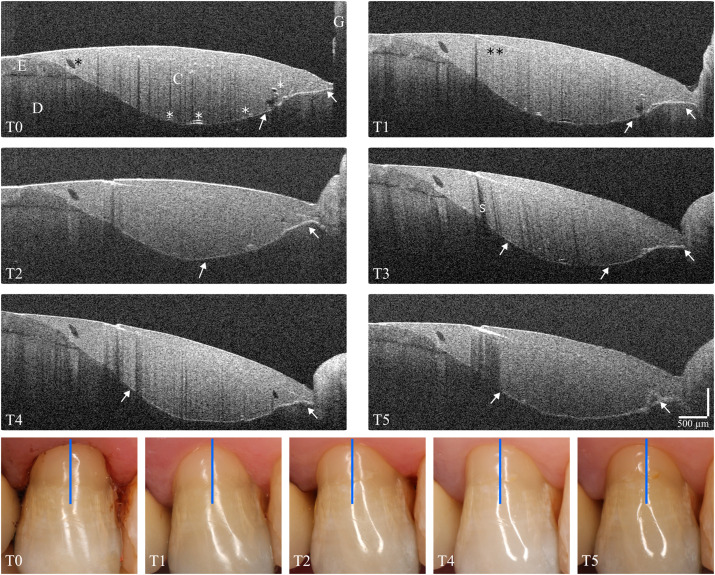
Restorations were placed and evaluated immediately (T0) and followed clinically at 6, 12, 24, and 36 months according to FDI criteria. Simultaneously, OCT imaging was conducted at the same time points to quantify interfacial adhesive defects (ADs) at enamel and dentin/cementum interfaces. Cumulative failure rates (CFRs) and mean adhesive defect measures were statistically analyzed to determine differences among groups.
Key Findings
The cumulative failure rates between 6 and 36 months showed statistically significant advantages for both SBU groups compared to the OFL reference (p ≤ 0.004). Among the SBU modalities, selective enamel-etch (SEE) significantly reduced marginal staining and improved marginal adaptation starting from 12 months onward (p ranging 0.002 to 0.727 for staining, and 0.001 to 0.629 for adaptation), compared to self-etch (SE) mode and OFL.
OCT assessments revealed substrate-specific adhesive defects. On enamel, SBU-SE exhibited increased adhesive defects relative to SBU-SEE and OFL from baseline through 36 months (p ≤ 0.001 to 0.048). On dentin/cement interfaces, SBU-SEE demonstrated fewer defects compared to SBU-SE (p ≤ 0.0115 from 6 months) and OFL (p ≤ 0.0115 at baseline and thereafter). Furthermore, SBU-SE had fewer defects than OFL on dentin (p ≤ 0.001 at baseline and follow-ups). Notably, adhesive defects at the dentin/cement interface increased significantly prior to restoration loss (p ≤ 0.05), suggesting OCT’s predictive value for impending failure.
Both clinical scores and OCT evaluations were congruent, reinforcing the reliability of OCT to non-invasively track adhesive integrity over time.
Expert Commentary
This trial underscores the clinical relevance of substrate-specific bonding strategies. The superior performance of Scotchbond™ Universal Adhesive in SEE mode is consistent with the understanding that phosphoric acid etching of enamel enhances micromechanical retention without compromising dentin integrity, compared to a purely self-etch approach. OCT’s ability to detect early interfacial defects provides an objective, quantifiable biomarker for restoration prognosis that surpasses traditional clinical scoring alone.
However, the study’s limitations include the sample size and lesion type focus on NCCLs, which may restrict generalizability to other lesion morphologies and patients. Future studies should validate findings in diverse clinical scenarios and explore adjunctive protocols to optimize dentin bonding further.
Conclusion
This three-year clinical trial demonstrates that Scotchbond™ Universal Adhesive in selective enamel-etch mode delivers the most favorable outcomes in NCCL restorations, exhibiting lower failure rates, reduced marginal staining, and better marginal adaptation compared to self-etch mode and a conventional etch-and-rinse adhesive. The adjunctive use of OCT enables early detection of adhesive interface defects that correspond with clinical failure, supporting OCT’s integration into routine dental restoration assessment. These findings advocate for tailored adhesive application strategies and endorse OCT as a valuable tool in predictive adhesive dentistry.
Funding and ClinicalTrials.gov Registration
This study was registered under trial number DRKS00011084 (http://www.drks.de/DRKS00011084) on 30 September 2016. Funding sources were not disclosed in the publication.
References
Haak R, Häfer M, Schulz-Kornas E, Meißner T, Schneider H. OCT for Evaluation of a Universal Adhesive in a Three-Year Clinical Trial. J Dent. 2026 Oct 15;107106. doi: 10.1016/j.jdent.2026.107106. PMID: 42880480.
This article was created using several editorial tools, including AI, as part of the process. Human editors reviewed this content before publication.