Highlight
Withdrawal of implementation support was associated with sustained and increased delivery of brief behavioral treatment for insomnia (BBTI) in VA Primary Care Mental Health Integration (PCMHI) clinics.
Total behavioral insomnia care, encompassing BBTI and cognitive behavioral therapy for insomnia (CBT-I), improved significantly during the sustainment phase.
Increased access to behavioral insomnia interventions correlated with a modest but statistically significant reduction in sleep medication prescriptions in primary care.
Study Background
Insomnia disorder affects a substantial portion of the population and is linked to significant adverse effects on health, daily functioning, and quality of life. Cognitive Behavioral Therapy for Insomnia (CBT-I) is a frontline evidence-based behavioral intervention recommended by clinical guidelines. However, barriers related to accessibility, provider training, and system-level implementation limit widespread delivery. The Department of Veterans Affairs (VA) has prioritized integrating behavioral health services into primary care settings via Primary Care Mental Health Integration (PCMHI) clinics to enhance access. Brief Behavioral Treatment for Insomnia (BBTI), a condensed, pragmatic form of CBT-I, offers a feasible option to extend insomnia care in such settings. Understanding how behavioral insomnia care delivery is sustained after the cessation of active implementation support is critical for health system integration and long-term improvement.
Study Design
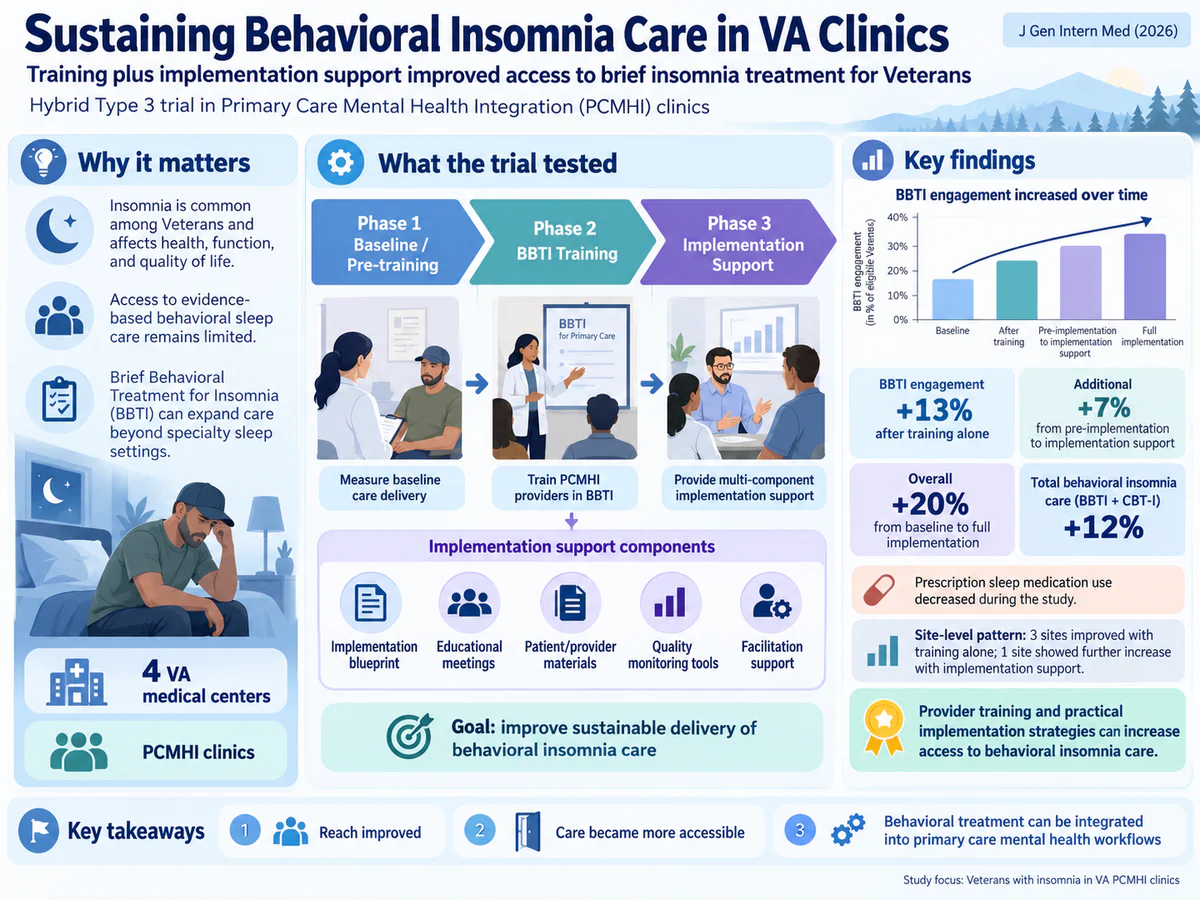
This investigation examined the sustainment phase outcomes of a stepped wedge hybrid type 3 trial conducted across four VA Medical Centers (VAMCs). The study population included veterans receiving care within PCMHI and primary care clinics at these sites. The intervention involved trained clinicians delivering BBTI, supported initially by structured implementation strategies such as training, consultations, and ongoing facilitation to enhance care adoption.
The primary measure was the delivery rate of BBTI and CBT-I within PCMHI clinics. Secondary measures included total behavioral insomnia care (combined BBTI and CBT-I) and the prescription rates of sleep medications in primary care settings. The key period contrasted outcomes between phase 3 (active implementation) and phase 4 (sustainment phase following withdrawal of implementation support).
Key Findings
Analysis revealed that after formal implementation support was withdrawn, BBTI delivery among veterans with insomnia increased significantly across the four VAMCs—from 20.2% during the implementation phase to 32.7% in the sustainment phase, representing an adjusted odds ratio (OR) of 1.9 (p < 0.001). This counters the common concern that cessation of support leads to declines in intervention delivery.
CBT-I delivery rates remained stable (p = 0.8), indicating consistent care levels for this more intensive therapy. When considering the combined total behavioral insomnia care (BBTI plus CBT-I), delivery increased from 25.5% to 37.9% (OR 1.8, p < 0.001), demonstrating sustained and even improved engagement in evidence-based behavioral treatments for insomnia.
Concurrently, prescription of sleep medications in primary care clinics modestly declined by 0.8% (n = 2158; OR 0.9, p < 0.001), suggesting an association between enhanced behavioral care access and reduced reliance on pharmacologic sleep aids.
These data collectively support that clinician training plus initial implementation support can produce durable changes in insomnia care practices within integrated primary care settings.
Expert Commentary
The observed sustainment of BBTI delivery, despite withdrawal of formal implementation strategies, highlights the potential for ingrained clinical practice changes when adequate training and initial support mechanisms are in place. The stable CBT-I delivery suggests that with established workflow integration, complex behavioral interventions can be maintained effectively.
A reduction in sleep medication prescribing aligns with best practice guidelines emphasizing non-pharmacologic management of insomnia to avoid medication side effects such as dependence and cognitive impairment. These findings reinforce the benefits of incorporating brief, scalable behavioral therapies within PCMHI models.
Limitations include the observational design during the sustainment phase and potential confounding factors influencing care delivery or medication prescribing unrelated to the withdrawal of support. Generalizability may be confined to integrated care settings with similar resources and veteran populations.
The mechanistic plausibility lies in continued clinician competency and clinic-level adaptations promoting BBTI delivery, as well as increased patient awareness and preference for behavioral approaches following initial exposure.
Conclusion
This multi-site VA study demonstrates that behavioral insomnia care, particularly BBTI, can be successfully sustained and even increased in primary care mental health integration clinics after structured implementation support is withdrawn. These findings support the value of initial training and implementation strategies to embed evidence-based insomnia treatments into routine care. The parallel reduction in sleep medication use further illustrates clinical impact and adherence to updated VA/DoD insomnia practice guidelines.
Future research should explore long-term patient outcomes, strategies to maintain fidelity, and methods to generalize these findings to diverse health systems. Health systems aiming to improve insomnia care should prioritize building sustainable clinician capacity and infrastructure to support behavioral interventions.
Funding and ClinicalTrials.gov
This trial was registered on ClinicalTrials.gov (NCT04350866) on April 14, 2020. No specific funding details were provided in the abstract.
References
1. Bramoweth AD, Ulmer CS, Klingaman EA, et al. Delivery of Behavioral Insomnia Care in VA Primary Care Mental Health Integration Clinics: Sustainment Outcomes of a Hybrid Type 3 Trial. J Gen Intern Med. 2026 Oct 23. PMID: 42920076.
2. Morin CM, Benca R. Chronic insomnia. Lancet. 2012;379(9821):1129-41.
3. Trauer JM, Qian MY, Doyle JS, Rajaratnam SMW, Cunnington D. Cognitive Behavioral Therapy for Chronic Insomnia: A Systematic Review and Meta-analysis. Ann Intern Med. 2015;163(3):191-204.
4. Koffel E, Bramoweth AD, Ulmer CS. Behavioral treatments for insomnia in adults with comorbid conditions: A systematic review. J Clin Sleep Med. 2018;14(2):175-202.
5. Department of Veterans Affairs and Department of Defense. VA/DoD Clinical Practice Guideline for the Management of Chronic Insomnia Disorder and Obstructive Sleep Apnea in Adults. VA/DOD; 2020.