Structural Brain Changes and Long-Term Outcomes in NMDA Receptor Encephalitis: Insights from a German Cross-Sectional Study
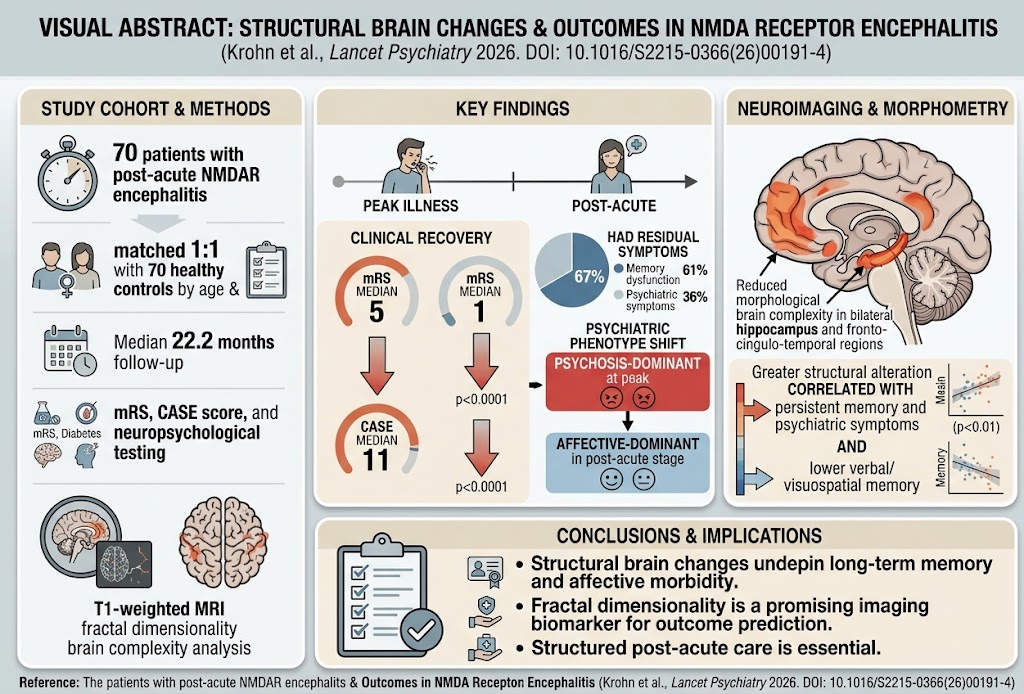
Highlight
- Post-acute NMDA receptor encephalitis exhibits distinct reductions in brain morphological complexity, especially in the hippocampus and fronto-cingulo-temporal areas.
- Patients experience a phenotypic shift in psychiatric symptoms from psychosis-dominant at peak illness to affective symptoms in the post-acute phase.
- Persistent memory dysfunction and psychiatric symptoms correlate strongly with imaging-detected structural brain alterations.
- Fractal dimensionality emerges as a sensitive neuroimaging marker linked to long-term clinical outcomes after immunotherapy.
Study Background
N-methyl-D-aspartate receptor (NMDAR) encephalitis is a severe autoimmune disorder characterized by an immune-mediated attack on neuronal NMDA receptors. It often leads to substantial neuropsychiatric disturbances, including psychosis, memory deficits, and behavioral changes, particularly affecting young adults and women. Despite advances in immunotherapy, many patients do not achieve full neurological or psychiatric recovery, with persistent symptoms impacting quality of life. However, the neuroanatomical underpinnings of these chronic sequelae remain inadequately understood. Conventional neuroimaging techniques have limitations in detecting subtle brain structural changes associated with enduring symptoms. Recently, morphological complexity analysis using fractal dimensionality has gained attention as a sensitive tool to assess brain structural intricacies in neuropsychiatric disorders but has not been applied extensively in autoimmune encephalitis.
Study Design
This cross-sectional study was conducted at Charité-Universitätsmedizin Berlin, Germany, enrolling 70 patients diagnosed with post-acute NMDA receptor encephalitis. Participants were assessed a median of 22.2 months following disease onset, ensuring evaluation in the post-acute recovery phase. Each patient was matched on age and sex with a healthy control using logistic regression propensity scores and nearest-neighbor matching, resulting in 70 matched controls. Comprehensive clinical evaluations included the modified Rankin Scale (mRS) and Clinical Assessment Scale for Autoimmune Encephalitis (CASE), along with psychiatric phenotyping and neuropsychological tests focusing on memory domains.
Structural brain morphology was quantified using fractal dimensionality measurements from T1-weighted structural MRI scans. Normative modeling techniques were employed to relate regional morphological alterations to post-acute clinical outcomes. Patient self-reports regarding persistent symptoms informed study measures and design.
Key Findings
Patients during the peak illness phase exhibited severe neurological impairment (median mRS = 5; median CASE = 11), but substantial improvements were documented in the post-acute phase (median mRS = 1; median CASE = 1; both p < 0.0001). Despite clinically significant recovery, 67% of patients demonstrated lingering CASE symptoms. The most prevalent residual complaints were memory dysfunction (61%) and psychiatric symptoms (36%). Notably, psychiatric features evolved from a predominantly psychotic profile at peak illness to affective symptomatology in the post-acute stage.
MRI analyses revealed pronounced reductions in morphological complexity involving bilateral hippocampi and a fronto-cingulo-temporal grey and white matter cluster. These structural signatures were significantly worse in patients with persistent symptoms compared to those fully recovered. Specifically, normative modeling showed
– Greater brain morphology alteration in patients with psychiatric symptoms (t = -2.65, p = 0.0100),
– Even stronger changes in those with persistent memory dysfunction (t = -3.98, p = 0.0002),
– The most pronounced deviations observed in patients exhibiting both symptom domains versus symptom-free individuals (t = -5.46, p < 0.0001).
Furthermore, morphometric abnormalities correlated with neuropsychological testing deficits, including visuospatial and verbal memory impairments (all false-discovery rate adjusted p-values < 0.015). Such associations underline the clinical relevance of fractal dimensionality as a biomarker for ongoing brain dysfunction.
Expert Commentary
This study advances our understanding of the long-term neuroanatomical sequelae of NMDA receptor encephalitis, demonstrating that structural brain changes persist well beyond acute immunotherapy. The focus on fractal dimensionality analysis addresses a critical gap by providing a more sensitive measure of subtle cortical and subcortical alterations compared with volumetric assessments alone. The observed phenotypic shift in psychiatric symptoms reflects dynamic underlying neuropathology and may inform tailored therapeutic strategies.
Limitations include the cross-sectional design, which precludes inference on temporal causality, and a lack of detailed ethnicity data that could influence generalizability. Longitudinal studies correlating imaging markers with clinical trajectories would be valuable. Moreover, it remains to be explored whether interventions targeting these neuroanatomical alterations can mitigate chronic symptoms.
Conclusion
NMDA receptor encephalitis patients exhibit significant, persistent brain morphological complexity reductions, particularly in the hippocampus and fronto-cingulo-temporal network, associated with residual memory and psychiatric impairments. Fractal dimensionality emerges as a promising marker for evaluating disease burden and guiding post-acute management. The evolving clinical phenotype underscores the importance of comprehensive, structured long-term care focusing on affective and cognitive rehabilitation. Incorporating advanced neuroimaging into routine follow-up may improve prognostication and personalized therapy in autoimmune encephalitis.
Funding and ClinicalTrials.Gov
This study was funded by the German Research Foundation and the German Ministry of Education and Research. There was no clinicaltrials.gov identifier provided for this cross-sectional study.
References
1. Dalmau J, Armangué T, Planagumà J, et al. An update on anti-NMDA receptor encephalitis for neurologists and psychiatrists: mechanisms and models. Lancet Neurol. 2019;18(11):1045-1057.
2. Krohn S, Cammà G, Zhao W, et al. Structural brain changes and clinical outcomes of patients with NMDA receptor encephalitis in Germany: a cross-sectional study. Lancet Psychiatry. 2026 Sep;13(9):734-746.
3. Boonzaier JR, Saeed N, Rohani Rankouhi S, et al. Using fractal analysis to understand brain structural complexity in neuropsychiatric conditions. Neuroimage Clin. 2022;33:102933.
4. Finke C, Prüss H. Molecular pathophysiology of autoimmune encephalitis. Int J Mol Sci. 2021;22(9):4993.
This article was created using several editorial tools, including AI, as part of the process. Human editors reviewed this content before publication.