We use cookies

Our website uses essential cookies and, with your consent, additional cookies to measure performance and improve our services. Cookie Policy.

You can change your choice at any time.

MMedXYNews
HomeVideos
MedXY AI/MedXY News/Section: Neurology

Skin Denervation as a Biomarker Linked to Cognitive Decline and Brain Atrophy in Parkinson Disease
MedXY Editorial Team•Oct 5, 2026•Neurology
Brain Atrophycognitive impairmentParkinson diseasesmall fiber neuropathy

Highlight

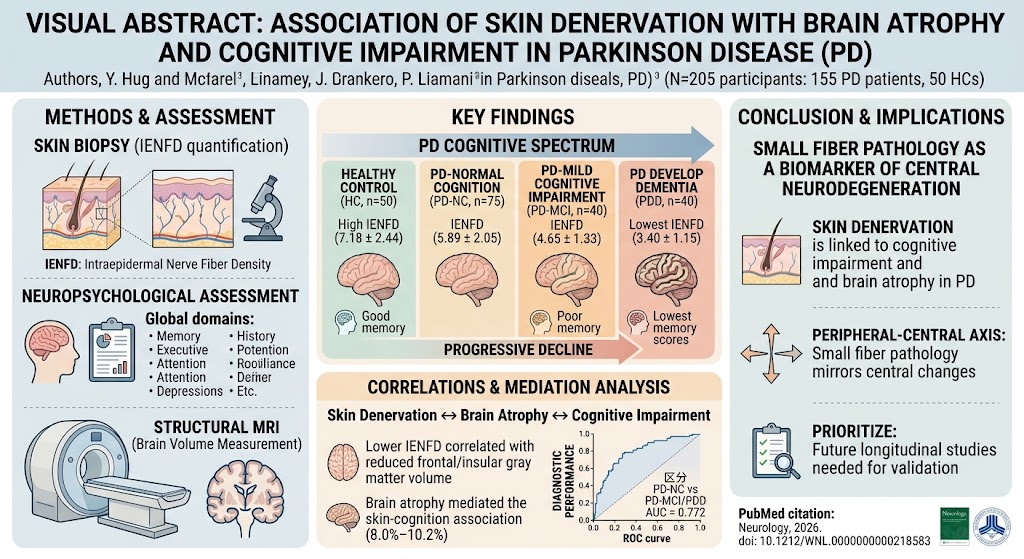
– Progressive reduction in intraepidermal nerve fiber density (IENFD) parallels worsening cognitive impairment in Parkinson disease (PD).
– Lower IENFD correlates with frontal and insular gray matter atrophy, regions linked to cognitive functions.
– Skin denervation independently predicts cognitive impairment severity and distinguishes PD cognitive subtypes with good diagnostic accuracy.
– Brain atrophy statistically mediates the relationship between peripheral small fiber loss and cognitive deficits, supporting a peripheral-central neurodegenerative axis in PD.

Study Background

MedXY registered readers

Sign in free to continue reading

Create or use your MedXY account to unlock the complete article.

This article was created using several editorial tools, including AI, as part of the process. Human editors reviewed this content before publication.

Related articles

Open language-specific specialty feeds and department pages.

ADHD and Risk of Late-Life Cognitive Impairment: Insights from Clinical and Genetic DataA comprehensive cohort study demonstrates that ADHD significantly increases the risk of mild cognitive impairment and dementia in older adults, highlighting the need for targeted monitoring and integrated care in this vulnerable population.Oct 13, 2026A Harmonized Visual Reading Framework for Tau PET Staging in Alzheimer DiseaseThis study introduces a standardized 5-class framework for tau PET imaging to better detect and stage Alzheimer’s disease, improving early diagnosis and patient stratification across different tracers.Sep 23, 2026Retinal OCTA as a Window into Cerebral Small Vessel Disease and Cognitive Decline Post-StrokeThis longitudinal study shows that retinal microvascular changes measured by OCTA correspond with cerebral small vessel disease progression and cognitive decline in mild ischemic stroke patients, highlighting OCTA’s potential as a nonSep 20, 2026Integrating Plasma p-tau217 and APOE Genotype to Predict Cognitive Decline Across Diverse Populations
Loading comments...
MedXY briefing

Get the free newsletter

Evidence-led clinical news, trends, and analysis—delivered to your inbox.

Ask MedXY AI

Most popular

Intimate Health
Five Benefits for Women Continuing Sexual Activity After Menopause
Intimate Health
Why Some Women Have a Strong Sex Drive—And Why Men Shouldn't Worry About It
Nursing & care
How often should a couple have sex?
Cardiology
Precision Medicine for Long QT Syndrome Type 2: Lumacaftor Corrects Trafficking Defects and Shortens QT Interval
General Surgery
Optimizing Postoperative Opioid Prescriptions After Intra-Abdominal Cancer Surgery: Comparing the 5x-Multiplier and 3-Tier Models
© 2026 MedXY
Contact usAbout usPrivacy PolicyMedXY story
This pooled analysis of seven multi-ethnic cohorts demonstrates the combined prognostic value of plasma phosphorylated tau 217 concentrations and APOE-ε4 genotype for predicting risk and timing of cognitive impairment, emphasizing biomarker
Sep 13, 2026
Navigating Surgical Decisions in Patients with Dementia: Clinician Challenges and InsightsThis article explores the complex challenges clinicians face in surgical decision-making for patients with dementia, highlighting issues with dementia identification, caregiver roles, and the influence of dementia on surgical outcomes.Aug 22, 2026
Paramagnetic Rim Lesions as Predictors of Progression in Multiple Sclerosis: Insights from a 5-Year Longitudinal StudyParamagnetic rim lesions detected via MRI are associated with increased risk of disability progression independent of relapse activity and accelerated brain atrophy in multiple sclerosis, highlighting their role as prognostic biomarkers forAug 22, 2026