Highlight
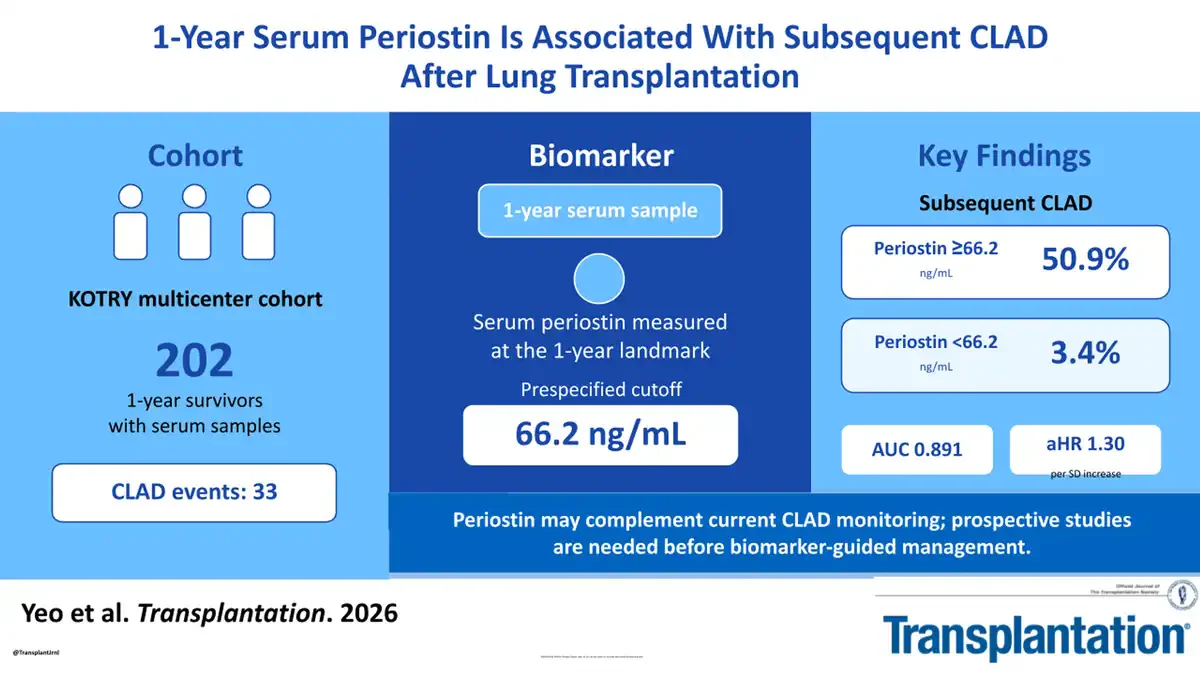
Serum periostin levels measured one year post-lung transplantation significantly predict future chronic lung allograft dysfunction (CLAD).
In a multicenter Korean cohort, higher periostin concentrations independently associated with increased CLAD risk after adjusting for clinical confounders.
A previously established periostin cutoff (66.2 ng/mL) effectively stratified transplant recipients according to CLAD-free survival.
Serum periostin thus emerges as a promising noninvasive biomarker for identifying lung transplant recipients at risk before functional decline.
Study Background
Lung transplantation remains a lifesaving treatment for selected patients with end-stage pulmonary disease. However, chronic lung allograft dysfunction (CLAD), encompassing a spectrum of persistent airway and parenchymal injury phenotypes, continues to be the principal cause of morbidity and mortality beyond the first posttransplant year. CLAD limits long-term graft survival despite advances in immunosuppression and surgical technique.
Early detection of patients predisposed to CLAD is critical to enable timely interventions and improve outcomes. Unfortunately, functional monitoring by spirometry detects lung function decline only after irreversible damage has occurred. Thus, there is a compelling need for reliable, clinically applicable biomarkers that can predict CLAD risk before overt lung function deterioration.
Periostin, a matricellular protein involved in tissue remodeling and fibrosis, has emerged as a potential biomarker candidate. Initial single-center studies linked elevated serum periostin levels with bronchiolitis obliterans syndrome, a CLAD subtype. However, validation in diverse populations and multicenter cohorts is essential to confirm its utility across different transplant settings and clinical practices.
Study Design
This study was a multicenter validation leveraging prospectively biobanked serum samples from the Korean Organ Transplant Registry (KOTRY). The cohort comprised 202 lung transplant recipients who survived at least one year post-transplantation, thereby focusing biomarker assessment on recipients beyond the early posttransplant complications.
Serum levels of periostin, transforming growth factor-beta 1 (TGF-β1), and interleukin-13 (IL-13) were measured from samples collected exactly one year after transplantation. The primary endpoint was the development of CLAD during subsequent follow-up, verified by clinical criteria.
Time-to-event analyses were landmarked at the one-year serum collection to evaluate associations between biomarker levels and CLAD occurrence. Cox proportional hazards models adjusted for pre-specified clinical covariates (including demographics, donor and recipient factors) quantified the independent predictive value of periostin. A pre-established periostin cutoff of 66.2 ng/mL from a prior discovery cohort was prospectively applied to test its discriminative performance.
Key Findings
Of the 202 recipients, 33 (16.3%) developed CLAD during the follow-up period after the one-year landmark. Those who subsequently developed CLAD had significantly higher median serum periostin at one year (84.4 ng/mL, interquartile range 73.0–114.6) compared to those who remained CLAD-free (38.2 ng/mL, interquartile range 26.6–54.3, P < 0.001).
Multivariable Cox regression modeling demonstrated that each standard deviation increase in periostin was associated with a 26% higher hazard of CLAD development (adjusted hazard ratio 1.26; 95% CI, 1.08–1.47; P=0.003), independent of other clinical factors.
The pre-specified cutoff of 66.2 ng/mL effectively stratified recipients into high-risk and low-risk groups for CLAD-free survival, confirming its potential utility for clinical risk prediction.
Serum TGF-β1 and IL-13 levels measured at one year did not show a significant association with subsequent CLAD, highlighting periostin’s comparatively stronger prognostic relevance.
Expert Commentary
This multicenter validation solidifies serum periostin as a promising biomarker for identifying lung transplant recipients at heightened risk of CLAD well before functional deterioration is clinically evident. The strength lies in replicating findings from a prior single-center cohort and confirming generalizability across multiple centers and a larger patient sample.
Mechanistically, periostin’s role in extracellular matrix remodeling and fibrotic processes plausibly links elevated serum levels to underlying pathological changes predisposing to chronic graft injury. Such biological plausibility enhances confidence in periostin as more than a mere associative marker.
However, limitations include the observational design and potential residual confounding by unmeasured clinical variables. Additionally, while periostin shows prognostic value, incorporation into clinical decision algorithms requires prospective trials assessing whether targeted interventions based on periostin stratification improve outcomes.
Future research should also explore periostin dynamics at multiple time points to improve predictive accuracy and establish standardized assay methods to ensure reproducibility across laboratories.
Conclusion
Measurement of serum periostin at one year post-lung transplantation offers an independent and clinically meaningful biomarker for predicting subsequent CLAD development. This allows for earlier identification of at-risk recipients, potentially leading to personalized surveillance and timely therapeutic interventions aimed at prolonging allograft survival.
The multicenter design and pre-specified cutoff validation underscore the robustness of these findings and support periostin’s integration into post-transplant risk assessment protocols pending further confirmatory studies.
Funding and Clinical Trials Registration
The study was supported by the Korean Organ Transplant Registry and associated institutions as detailed in the original publication. No clinical trials registration number was provided in the source document.
References
Yeo HJ, Jang JH, Choi E, Kim K, Lee JG, Kim SY, Park S, Jeon K, Lim SY, Cho WH, KOTRY study group. Serum Periostin at 1 y Is Associated With Subsequent Chronic Lung Allograft Dysfunction After Lung Transplantation: A Multicenter Validation Study. Transplantation. 2026 Nov 3. PMID: 42975965.
Verleden GM, Glanville AR, Lease ED, et al. Chronic lung allograft dysfunction: definition, diagnostic criteria, and approaches to treatment—a consensus report from the Pulmonary Council of the ISHLT. J Heart Lung Transplant. 2019 Feb;38(5):493-503.
Ojo AO, Held PJ, Port FK, et al. Chronic renal failure after transplantation of a nonrenal organ. N Engl J Med. 2003 Feb 27;348(8):931-9.