Highlight
– Transition from restrictive cardiopulmonary bypass (CPB) to criteria-based extracorporeal membrane oxygenation (ECMO-BC) was associated with a lower incidence of early major neurologic complications (EMNC), notably ischemic strokes, post-lung transplantation.
– ECMO-BC increased the use of intraoperative mechanical circulatory support but was accompanied by greater blood loss and impaired early graft function.
– The findings generate important hypotheses regarding the balance between cerebral protection and surgical risks, emphasizing the need for prospective studies to optimize ECMO use criteria in lung transplantation.
Study Background
Lung transplantation remains a definitive treatment for end-stage pulmonary diseases, yet it carries significant perioperative risks. Neurological complications, particularly early major neurologic complications (EMNC) such as ischemic stroke, are critical contributors to morbidity and mortality after the procedure. Hemodynamic instability and hypoxemia during surgery compromise cerebral perfusion, exacerbating neurologic sequelae.
Mechanical circulatory support (MCS) devices, including cardiopulmonary bypass (CPB) and extracorporeal membrane oxygenation (ECMO), are used intraoperatively to maintain systemic and cerebral perfusion. While CPB provides full cardiopulmonary support, it is independently associated with increased neurologic complications, potentially due to factors like systemic inflammation, embolic phenomena, or altered coagulation. Conversely, ECMO offers a more flexible support modality, although its optimal role and timing in lung transplantation remain subjects of ongoing investigation.
This study assesses the clinical impact of transitioning from a restrictive CPB strategy to a criteria-based ECMO approach (ECMO-BC) on the incidence of EMNC and related outcomes in a lung transplant cohort.
Study Design
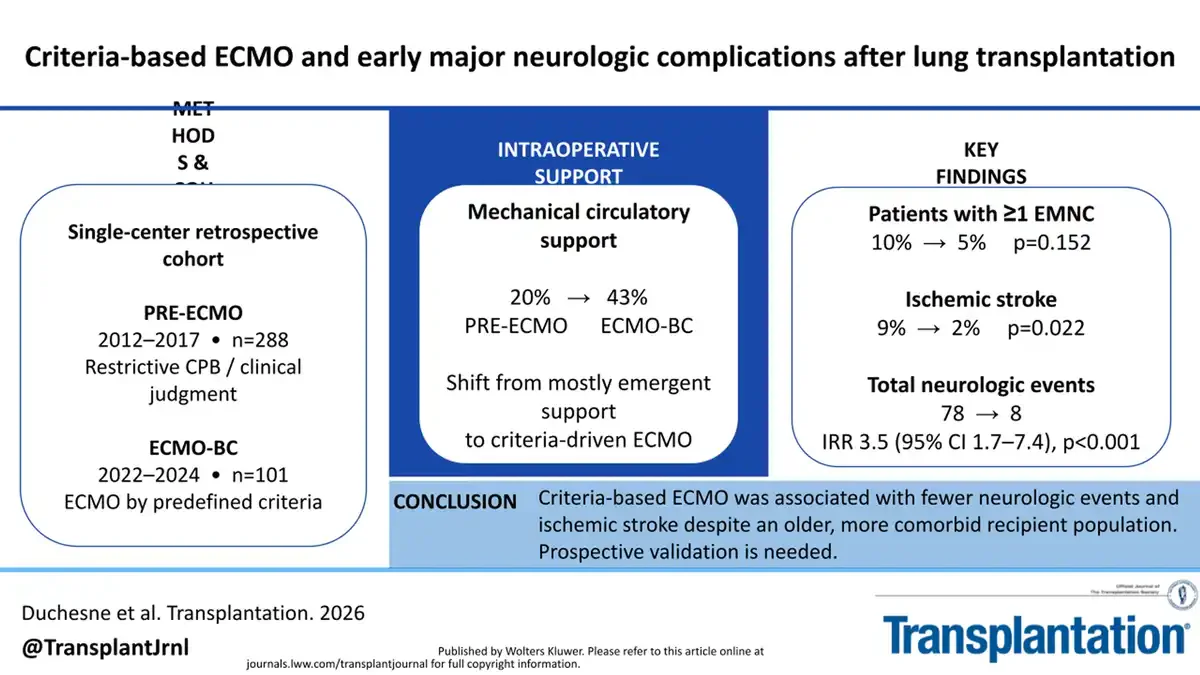
The investigators conducted a retrospective cohort study at a single center encompassing 389 adult lung transplant recipients. Patients were divided into two groups based on intraoperative management strategy: those from the PRE-ECMO era (2012–2017, n=288) managed with restrictive CPB and those in the ECMO-BC era (2022–2024, n=101) managed with criteria-based ECMO support.
The primary endpoint was the incidence of early major neurologic complications (EMNC) encompassing ischemic stroke and other significant neurological events occurring early postoperatively. Secondary endpoints included intraoperative mechanical circulatory support usage rates, intraoperative blood loss, and severity of primary graft dysfunction (PGD) at 24 and 72 hours post-transplant.
Key Findings and Results
The incidence of EMNC was reduced from 10% (29/280 patients) in the PRE-ECMO group to 5% (5/101 patients) in the ECMO-BC group, although the absolute difference did not reach conventional statistical significance (P=0.152). However, when counting total EMNC events, there were 78 in the PRE-ECMO group and 8 in the ECMO-BC group, yielding an incidence rate ratio of 3.5 (95% CI 1.7–7.4, P<0.001), indicating a significantly higher frequency of events per patient in the restrictive CPB era.
Specifically, ischemic strokes were significantly less frequent in the ECMO-BC cohort (2% vs. 9%; P=0.022), highlighting a key neurologic benefit of the ECMO approach. Intraoperative use of mechanical circulatory support rose notably from 20% in the PRE-ECMO group to 43% in the ECMO-BC group (P<0.001), reflecting the strategy shift.
Despite these neurologic improvements, ECMO-BC patients were older, had a greater burden of cardiopulmonary comorbidities, and demonstrated increased intraoperative blood loss (2489 ml vs. 1861 ml; P<0.001). Moreover, early graft function was worse in the ECMO-BC group, as indicated by more severe PGD scores at 24 and 72 hours (P<0.001), suggesting a trade-off between neurologic protection and early pulmonary outcomes.
Expert Commentary
The study provides valuable real-world evidence favoring the selective use of ECMO based on intraoperative criteria over routine or restrictive CPB use to mitigate neurologic risks in lung transplantation. The significant reduction in ischemic stroke incidence aligns with the understood pathophysiology of CPB-associated neurological injury, which includes embolic risk, systemic inflammatory response, and altered hemodynamics.
However, the findings also emphasize the complexity of managing hemodynamic and cerebral perfusion dynamics without compromising graft integrity. Increased blood loss and worse early graft function in the ECMO-BC group might relate to anticoagulation protocols, cannulation techniques, or extended operative duration. These aspects underscore the need for prospective, controlled trials to refine ECMO indications, timing, and management protocols to optimize both neurologic and pulmonary outcomes.
Limitations include the retrospective design, potential confounding by temporal changes in surgical and anesthetic practices, and patient population differences between eras, particularly older age and comorbidity in the ECMO-BC group. Larger multicenter studies and mechanistic investigations into the perioperative neuroprotection offered by ECMO are warranted.
Conclusion
The transition from a restrictive cardiopulmonary bypass approach to criteria-based extracorporeal membrane oxygenation in lung transplantation is associated with a meaningful reduction in early major neurologic complications, particularly ischemic strokes. Nonetheless, this strategy incurs increased intraoperative blood loss and impaired early graft function, revealing a complex balance between cerebral protection and transplant outcomes.
This study lays the groundwork for prospective research to delineate precise ECMO support criteria that optimize neurologic safety without compromising graft viability. Clinicians performing lung transplantation should weigh the benefits and risks of intraoperative circulatory support modalities tailored to individual patient profiles to improve overall prognosis.
Reference
Duchesne V, Moore A, Revelly E, Overbeek C, Zaouter C, Fortin M, Nasir BS, Ferraro P, Liberman M, Williams S. Incidence and Risk Factors for Early Major Neurologic Complications in Lung Transplantation: From Restrictive Cardiopulmonary Bypass to ECMO by Criteria. Transplantation. 2026 Nov 2. doi: 10.1097/TP.0000000000005961. Epub ahead of print. PMID: 42968367.