Highlight
Lateral extra-articular tenodesis (LET) is increasingly used adjunctively with anterior cruciate ligament reconstruction (ACLR) to enhance knee stability in pediatric patients.
This study found no significant alteration in early postoperative 3D gait biomechanics when LET was added compared to isolated ACLR.
Results support the biomechanical safety of LET in young patients, alleviating concerns about overconstraint or gait disturbances early after surgery.
Long-term and high-demand functional assessments remain necessary to fully understand LET’s impact beyond the initial recovery phase.
Study Background
Anterior cruciate ligament tears are a common and debilitating injury in pediatric and adolescent populations, often requiring surgical reconstruction to restore knee stability and prevent further joint damage. Lateral extra-articular tenodesis (LET) has gained traction as an adjunct procedure to ACL reconstruction (ACLR), aimed at reducing graft failure rates and improving rotational knee stability. Despite its biomechanical rationale, there has been concern that LET might overconstrain the lateral compartment of the knee joint, potentially altering normal gait biomechanics and increasing the risk of degenerative joint disease—concerns that may be especially relevant in the growing pediatric population.
Understanding how LET affects knee kinematics during functional activities like walking is critical for informing surgical decisions and rehabilitation strategies. This study aimed to rigorously analyze and compare three-dimensional gait biomechanics after ACLR with and without LET in children and adolescents, a population underrepresented in biomechanical gait research.
Study Design
This retrospective cohort study included 70 pediatric patients aged 18 years or younger who underwent ACLR between January 2023 and January 2026, divided equally into two groups: isolated ACL reconstruction (iACLR, n=35) and ACLR combined with lateral extra-articular tenodesis (ACLR+LET, n=35). The indication for adding LET was made by the treating surgeons based on clinical criteria.
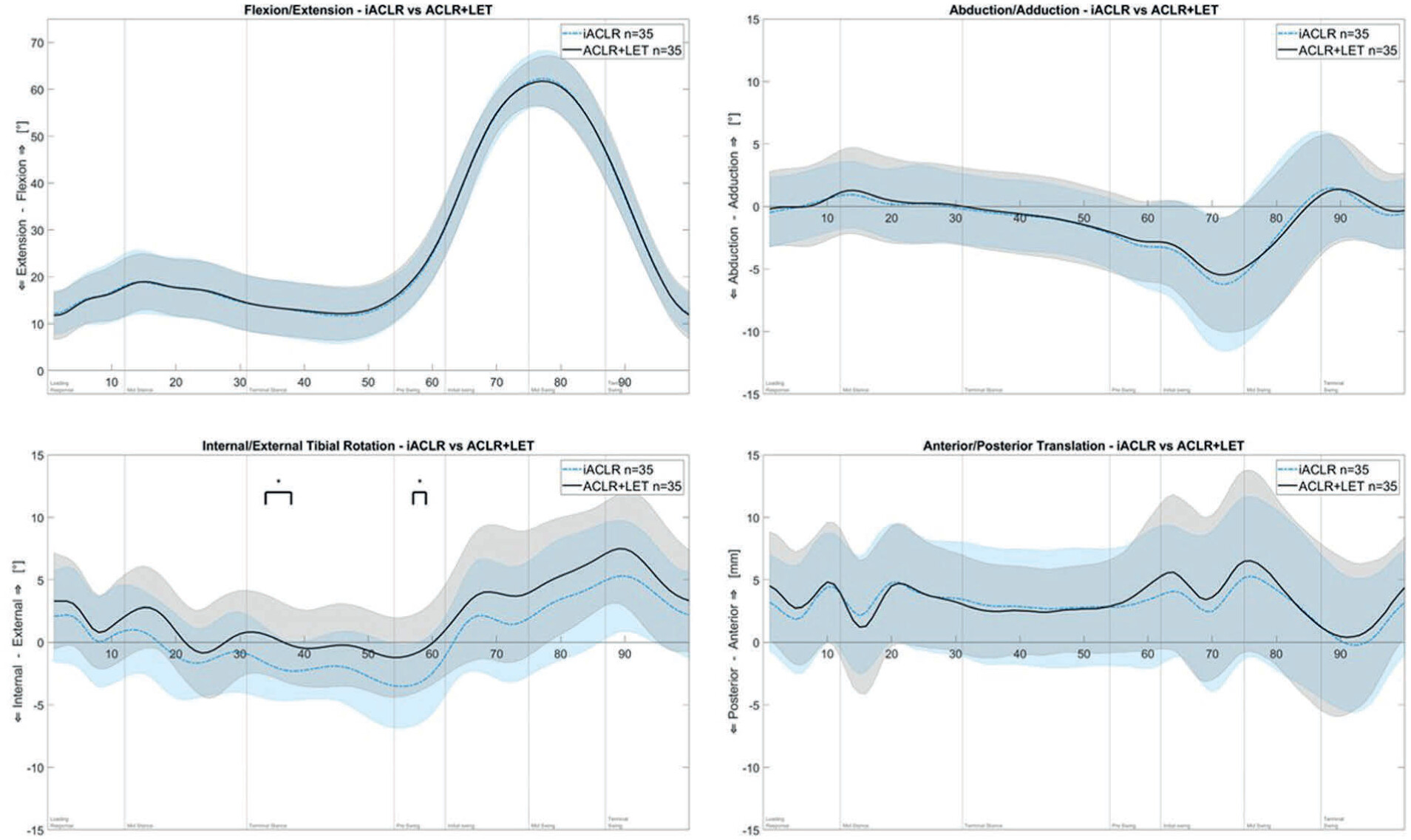
Each patient underwent standardized three-dimensional gait kinematic assessment using knee kinesiography, both before surgery and approximately four months postoperatively (mean 123.3 ± 58.4 days). Key outcome measures were the three-dimensional knee kinematic waveforms across the sagittal (flexion-extension), frontal (varus-valgus), and transverse (internal-external rotation) planes of motion. Statistical comparison between groups utilized one-dimensional statistical parametric mapping to identify differences over the gait cycle.
Key Findings
Preoperatively, minor but statistically significant differences in tibial rotation were detected between groups during specific gait phases, with a mean disparity of 1.8°. This finding likely reflects baseline variability in injury mechanics or anatomy.
At the postoperative assessment approximately four months after surgery, no significant differences were observed between the iACLR and ACLR+LET groups in any plane of knee motion throughout the gait cycle. Specifically, tibial internal rotation angles were comparable (mean 1.03°±4.27° for iACLR versus 1.61°±3.51° for ACLR+LET), indicating that LET did not restrict or alter transverse plane knee kinematics during walking.
Additionally, no notable differences emerged in knee valgus or varus angles or in sagittal-plane kinematics, contrasting with the hypothesis that LET would increase valgus or reduce tibial internal rotation during the unloading phase. These results suggest that at early postoperative follow-up, adding LET does not adversely impact gait biomechanics in pediatric patients.
Expert Commentary
These findings provide important clinical reassurance regarding the biomechanical safety of LET in conjunction with ACL reconstruction in children and adolescents, a group at heightened risk of reinjury and graft failure. Overconstraint by LET has been a theoretical concern, based on cadaveric and adult biomechanical studies, but this study’s in vivo gait analysis indicates that these effects are not manifest during early functional walking.
Limitations include the retrospective design, modest sample size, and relatively short-term follow-up focused on gait during level walking, which is a low-demand activity. High-demand dynamic tasks such as cutting, pivoting, and sports-specific maneuvers, as well as longer-term surveillance for joint health, remain important areas for future research.
Clinicians should weigh these data alongside patient-specific factors when considering LET addition, particularly in young athletes with high-grade rotational instability or revision ACLR.
Conclusion
The addition of lateral extra-articular tenodesis in pediatric ACL reconstruction does not modify early postoperative three-dimensional knee gait biomechanics. This supports LET’s safety as an adjunct procedure with no evident adverse biomechanical effects during walking approximately four months post-surgery. Continued investigation with extended follow-up and functional assessments under higher biomechanical loads will elucidate the long-term implications of LET on knee function and joint health in the pediatric population.
Funding and Registration
No specific funding source or clinical trial registration was reported for this study.
References
1. Manitiu A, Mazy D, Bayol A, Blouin V, Saunders P, Hagemeister N, Nault ML. Lateral Extra-articular Tenodesis Does Not Alter Early Gait Biomechanics After ACL Reconstruction in a Pediatric Population: A Motion Analysis Study. Am J Sports Med. 2026 Oct 9; doi:10.1177/03635465261487281. PMID: 42852835.