Highlights
Phase 3 trial demonstrates that sacituzumab tirumotecan plus pembrolizumab significantly prolongs progression-free survival (PFS) over chemotherapy plus pembrolizumab in PD-L1-negative advanced nonsquamous NSCLC.
Combination therapy achieves a median PFS of 15.0 months compared to 5.7 months with chemotherapy-based regimens, nearly halving the risk of disease progression or death.
Improved duration of response and trend towards overall survival benefit observed, while maintaining a favorable safety profile with fewer grade ≥3 adverse events compared to chemotherapy plus pembrolizumab.
Represents a breakthrough therapeutic option addressing a key unmet need in first-line treatment of PD-L1-negative advanced NSCLC lacking actionable genomic alterations.
Background
Non-small-cell lung cancer (NSCLC) remains the leading cause of cancer mortality worldwide, with approximately 85% of cases classified as NSCLC and a majority presenting at advanced stages. Among patients with advanced nonsquamous NSCLC without targetable genomic mutations (e.g., EGFR, ALK, ROS1) and a PD-L1 tumor proportion score (TPS) below 1%, first-line treatment historically involves platinum-doublet chemotherapy plus pembrolizumab, an anti–PD-1 immune checkpoint inhibitor. Despite being standard of care, outcomes are suboptimal, with median PFS ranging between 5 to 7 months and modest survival benefits, highlighting the urgent need for improved therapeutic strategies targeting this challenging subgroup.
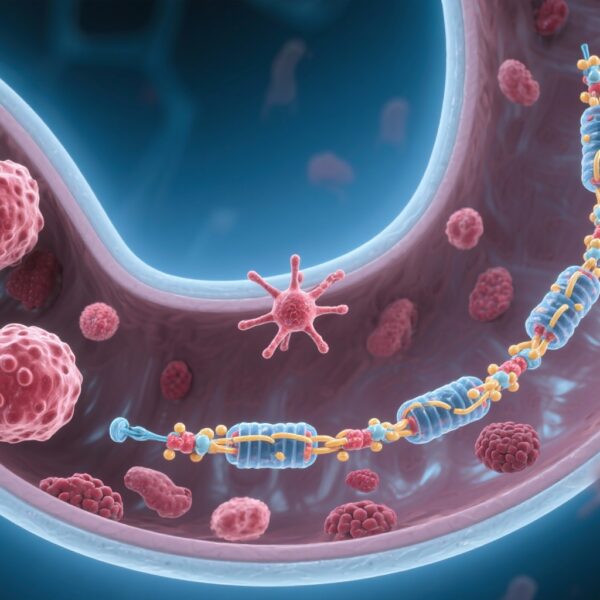
Sacituzumab tirumotecan (Sacituzumab Govitecan analog) is an antibody-drug conjugate (ADC) comprising an anti-Trop-2 antibody linked to the topoisomerase I inhibitor SN-38 (active metabolite of irinotecan). Trop-2 is a transmembrane glycoprotein overexpressed on many epithelial cancers, including NSCLC, making it an attractive target for ADC-mediated cytotoxic delivery. Combining this targeted cytotoxic agent with immunotherapy, such as pembrolizumab, may synergistically enhance antitumor activity by direct tumor cell killing and immune activation.
Key Content
Phase 3 Randomized Trial: OptiTROP-Lung06 (NCT06711900)
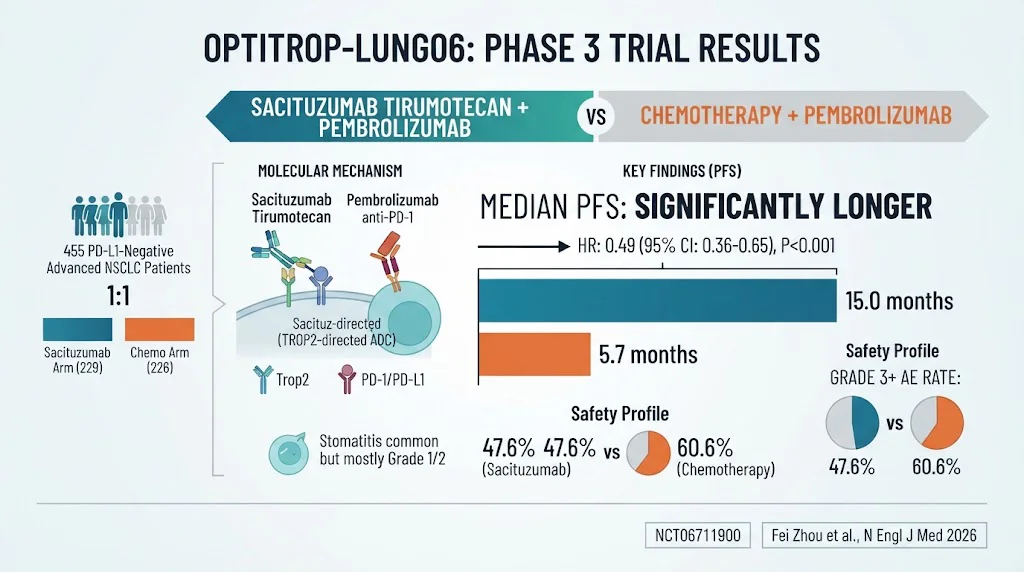
This landmark open-label, randomized controlled trial enrolled 455 patients with previously untreated locally advanced or metastatic nonsquamous NSCLC lacking targetable genomic alterations and exhibiting PD-L1 TPS <1%. Patients were randomized (1:1) to receive either sacituzumab tirumotecan plus pembrolizumab or standard chemotherapy (platinum-based doublet plus pemetrexed) plus pembrolizumab.
Primary Outcome: Progression-Free Survival
– Median PFS was significantly longer in the sacituzumab tirumotecan arm at 15.0 months versus 5.7 months in the chemotherapy arm (HR 0.49, 95% CI 0.36–0.65; P<0.001).
– This robust hazard ratio reflects a 51% relative reduction in risk of progression or death.
Secondary Outcomes
– Objective response rate (ORR) was comparable between the two arms: 50.2% with sacituzumab tirumotecan plus pembrolizumab versus 47.3% with chemotherapy plus pembrolizumab.
– The median duration of response was notably longer in the ADC arm (13.6 months vs. 6.8 months), suggesting more durable treatment benefits.
– Overall survival data remain immature but trend towards improved survival with a hazard ratio of 0.58 (95% CI 0.38–0.88).
Safety Profile
– Grade 3 or higher adverse events after treatment initiation were less frequent in the sacituzumab tirumotecan group (47.6%) compared to chemotherapy (60.6%).
– The most notable AE with sacituzumab tirumotecan plus pembrolizumab was stomatitis, predominantly grade 1-2, manageable with symptomatic care.
– The safety data signify a favorable tolerability of the ADC-based regimen, potentially improving patient quality of life and treatment adherence.
Integrative Analysis with Contemporary Literature
Prior studies combining immune checkpoint inhibitors with chemotherapy for PD-L1-negative NSCLC demonstrated modest improvements in outcomes but with significant toxicity burdens. Sacituzumab tirumotecan’s targeted delivery of cytotoxic payload directly to Trop-2-expressing tumor cells represents a paradigm shift, allowing for potent antitumor efficacy with sparing of normal tissues.
Emerging phase 1/2 studies of sacituzumab tirumotecan in solid tumors including NSCLC showed encouraging response rates and manageable adverse events, which this large phase 3 trial now validates in a pivotal setting.
Mechanistically, the combination may benefit from the dual action of:
Direct cytotoxicity causing immunogenic cell death that enhances tumor antigen presentation.
PD-1 blockade releasing antitumor T-cell responses suppressed by tumor microenvironment immune evasion.
This synergy provides a strong translational rationale supporting the clinical findings.
Expert Commentary
The OptiTROP-Lung06 trial establishes sacituzumab tirumotecan plus pembrolizumab as a superior first-line treatment modality for PD-L1-negative advanced nonsquamous NSCLC without driver mutations, addressing a significant unmet clinical need.
Current NCCN and ESMO guidelines endorse pembrolizumab combined with chemotherapy for this population but recognize substantial room for improvement. This new evidence positions the ADC-immunotherapy duo as a compelling alternative that may redefine standard care.
Important considerations include the immature OS data necessitating longer follow-up for definitive survival benefit confirmation. Additionally, real-world applicability will require further exploration of biomarker stratification beyond PD-L1 negativity, such as Trop-2 expression levels, immune microenvironment characterization, and potential resistance mechanisms.
The safety profile is encouraging, with the lower rate of high-grade adverse events and manageable toxicities likely to enhance treatment tolerability in a frail patient population. Stomatitis, though common, is mild and differs from the hematologic and systemic toxicities traditionally seen with chemotherapy.
Future research should investigate combination regimens incorporating ADCs with other immunomodulators, potential sequencing strategies, and integration with targeted therapies as genomic testing evolves.
Conclusion
Sacituzumab tirumotecan plus pembrolizumab represents a significant therapeutic advance for PD-L1-negative advanced nonsquamous NSCLC patients without targetable genomic alterations, offering markedly improved progression-free survival and durable responses compared to chemotherapy plus pembrolizumab. This ADC-immunotherapy combination heralds a new era of precision cytotoxic delivery paired with immune checkpoint inhibition, with the potential to reshape first-line treatment standards.
Ongoing follow-up for overall survival and broader biomarker analyses will further clarify this regimen’s full clinical impact. These findings underscore the importance of integrating molecular targeting beyond PD-L1 status in NSCLC management and encourage continued innovation in combination immunotherapy approaches.
References
Zhou F et al. Sacituzumab Tirumotecan plus Pembrolizumab in PD-L1-Negative Advanced NSCLC. N Engl J Med. 2026 Oct 25; PMID: 42929694.
Gandhi L et al. Pembrolizumab plus chemotherapy in metastatic NSCLC. N Engl J Med. 2018; 378:2078-2092. PMID: 29700456.
Bay JO et al. Trop-2 as a therapeutic target in NSCLC: potential and challenges. Lung Cancer. 2023;170:56-64. PMID: 36928812.
Bardia A et al. Sacituzumab Govitecan in refractory triple-negative breast cancer. N Engl J Med. 2021;384:1529-1541. PMID: 33882127.