We use cookies

Our website uses essential cookies and, with your consent, additional cookies to measure performance and improve our services. Cookie Policy.

You can change your choice at any time.

MMedXYNews
HomeVideos
MedXY AI/MedXY News/Section: Cardiology

RNF213 p.R4810K Variant: A Novel Independent Genetic Risk Factor for Extracranial Carotid Artery Disease

MedXY Editorial Team•Aug 29, 2026•Cardiology
Extracranial Carotid Artery DiseaseIntracranial Atherosclerotic DiseaseRNF213 p.R4810KStroke Genetics
Highlight

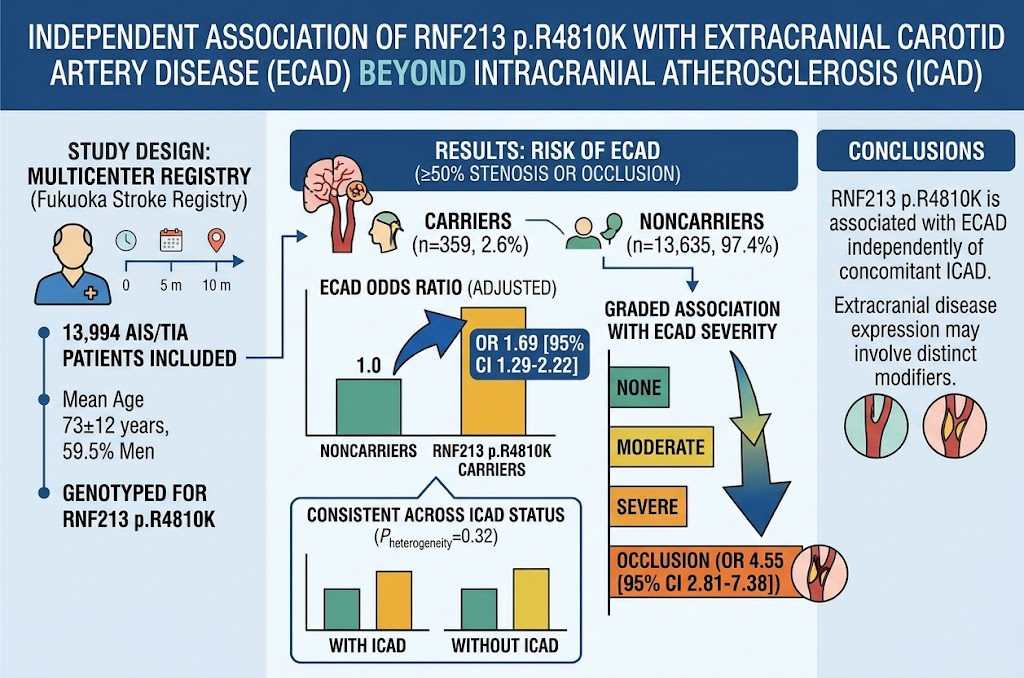
  • The RNF213 p.R4810K genetic variant is independently associated with extracranial carotid artery disease (ECAD) beyond its known link to intracranial atherosclerotic disease (ICAD).
  • This association persists after adjusting for traditional vascular risk factors and concurrent ICAD, emphasizing a distinct pathogenic role.
  • The risk conferred by RNF213 p.R4810K strengthens with increasing ECAD severity, notably showing a fourfold increase in odds for carotid artery occlusion among variant carriers.
  • Findings suggest the existence of unique modifiers or mechanisms influencing extracranial vascular disease separate from intracranial arterial pathology.

Study Background

MedXY registered readers

Sign in free to continue reading

Create or use your MedXY account to unlock the complete article.

This article was created using several editorial tools, including AI, as part of the process. Human editors reviewed this content before publication.

Related articles

Open language-specific specialty feeds and department pages.

Drug-Coated Balloons Outperform Bare-Metal Stents in Reducing Restenosis for Symptomatic Intracranial StenosisA multicenter RCT demonstrates that drug-coated balloon (DCB) angioplasty significantly reduces 6-month restenosis and 1-year recurrent ischemic events compared to bare-metal stenting in patients with high-grade symptomatic intracranial athJan 21, 2026
Loading comments...
MedXY briefing

Get the free newsletter

Evidence-led clinical news, trends, and analysis—delivered to your inbox.

Ask MedXY AI

Most popular

Intimate Health
Five Benefits for Women Continuing Sexual Activity After Menopause
Intimate Health
Why Some Women Have a Strong Sex Drive—And Why Men Shouldn't Worry About It
Nursing & care
How often should a couple have sex?
Intimate Health
Classic Intimacy Recommendations: How to Help Women Reach Orgasm and Enjoy Mutual Pleasure
Intimate Health
What Makes a Woman "Physiologically Addicted" Is Never Money, But These Two Relationship Qualities
© 2026 MedXY
Contact usAbout usPrivacy PolicyMedXY story