Highlight
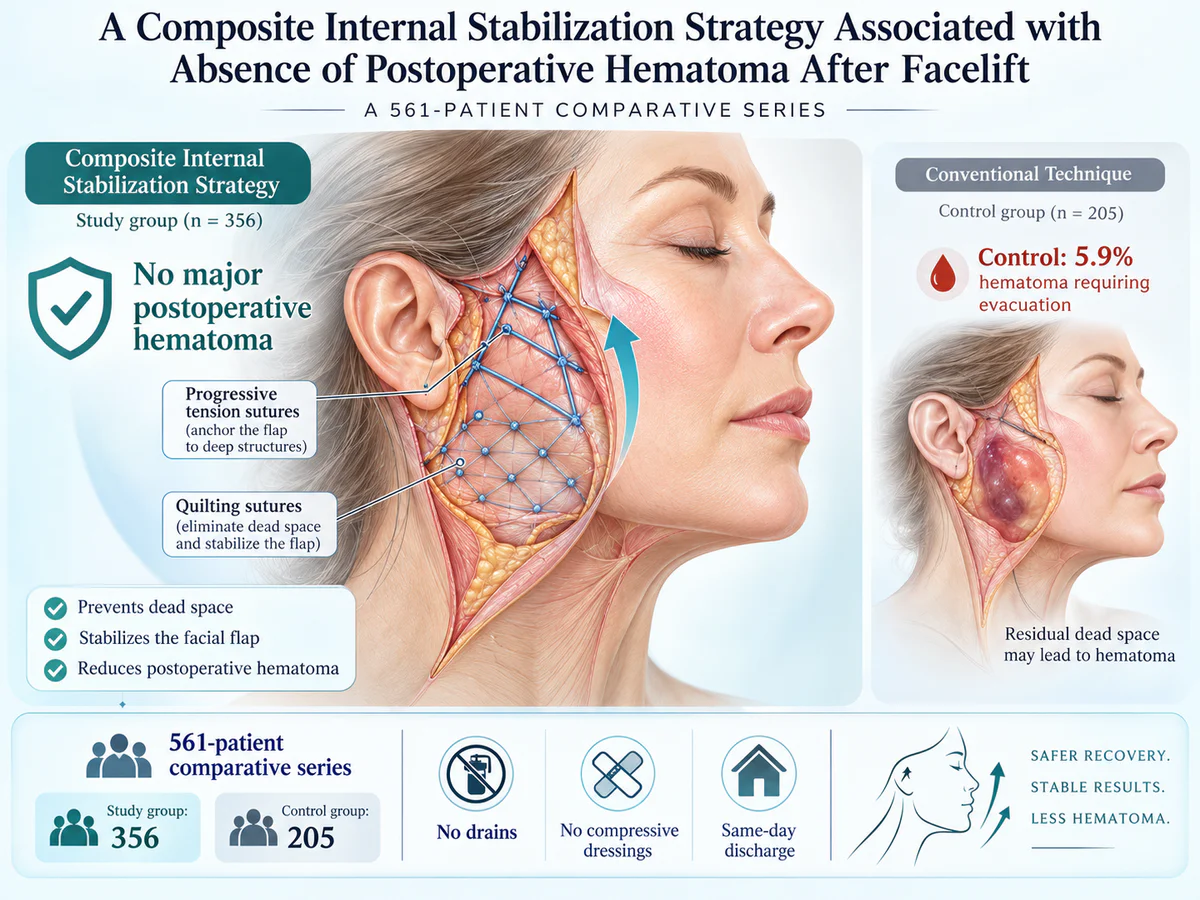
The internal hemostatic network (IHN) combining progressive tension and quilting sutures eliminates dead space and stabilizes the facial flap during facelift surgery.
In a retrospective comparative study of 561 patients, use of IHN resulted in zero major hematomas requiring surgical evacuation, compared to 5.9% incidence in a control group.
IHN use obviated the need for drains and compressive dressings, facilitating day-of-surgery discharge and potentially faster postoperative recovery.
The safety profile showed no flap necrosis or seromas and transient, fully reversible facial nerve weakness in 10.4% of cases.
Study Background
Rhytidoplasty, or facelift surgery, is a commonly performed cosmetic procedure aimed at facial rejuvenation. Despite advances in surgical techniques, postoperative hematoma remains the most frequent and feared complication, with published incidence rates ranging from 0.5% to 8%. Hematomas can necessitate urgent reoperation, increase patient morbidity, delay recovery, and sometimes result in skin flap necrosis. Reducing hematoma incidence thus remains a critical surgical objective.
Traditional preventive strategies include careful blood pressure control, the use of suction drains, and application of external compressive dressings. Surgical innovations such as progressive tension sutures and quilting techniques target dead space reduction to promote flap adherence and reduce hematoma risk. However, a standardized comprehensive technique that synthesizes these approaches into an effective, reproducible protocol remains lacking.
In this context, Pellini et al. developed an “internal hemostatic network” (IHN), a composite suturing strategy integrating established principles to eliminate dead space, maintain flap stabilization, and minimize bleeding without requiring drains or compressive dressings.
Study Design
The authors conducted a retrospective comparative cohort study encompassing 561 patients who underwent facelift surgery at a single center. The study group included 356 consecutive patients treated between 2018 and 2025 using the IHN technique, combining progressive tension and quilting sutures for flap stabilization. Notably, this group did not utilize suction drains or external compressive dressings.
The control group comprised 205 patients who underwent conventional rhytidoplasty with superficial muscular aponeurotic system (SMAS) plication or SMASectomy between 2011 and 2017, employing suction drains routinely and using traditional postoperative dressings.
The primary endpoint was the incidence of postoperative hematoma requiring surgical evacuation. Secondary endpoints assessed included hospital stay duration, other postoperative complications such as seroma formation, flap necrosis, and facial nerve dysfunction.
Key Findings
In the IHN group, no major hematomas necessitated surgical intervention. Only three patients (0.8%) developed minor, localized blood collections managed successfully with simple aspiration, without progression to significant hematomas. Importantly, no seromas or flap necrosis events were observed.
Transient facial nerve weakness occurred in 10.4% of the IHN group, mainly impacting the marginal mandibular branch. All these deficits resolved completely within an average of 7 weeks without permanent sequelae.
The mean hospital stay for the IHN group was approximately 5 hours, with all patients discharged the same day of surgery, indicating a streamlined postoperative course.
In contrast, the control group experienced 12 cases (5.9%) of hematoma requiring surgical evacuation, in addition to the use of suction drains and compressive dressings. Statistical analysis using Fisher’s exact test demonstrated a highly significant reduction in hematoma incidence with the IHN technique (p < 0.00001).
Clinical Significance
These results strongly support the efficacy of the IHN technique in minimizing hematoma risk after facelift while eliminating the need for drains and compressive dressings. The reduced hematoma incidence could translate into lower morbidity, fewer reoperations, and more rapid recovery with shorter hospital stays.
Expert Commentary
The integration of progressive tension and quilting sutures into a composite internal stabilization strategy represents a meaningful technical advancement in facelift surgery. By effectively obliterating dead space and securing the flap, the IHN addresses two major contributors to hematoma formation.
The absence of major hematomas in over 350 procedures suggests excellent reproducibility and clinical robustness, although this retrospective single-center study design inherently limits causality interpretation. The transient facial nerve dysfunction rate aligns with expected postoperative neuropraxia from dissection maneuvers and resolved fully, indicating acceptable safety.
Notably, the omission of drains and compressive dressings simplifies postoperative care and may enhance patient comfort and satisfaction. However, further prospective multicenter studies with randomized controlled designs would be valuable to confirm these findings and define best practices.
Conclusion
The internal hemostatic network technique offers a compelling, evidence-based approach to eliminate postoperative hematoma after facelift surgery. This composite suturing method minimizes dead space, stabilizes the facial flap internally, and obviates the need for drains and compressive dressings, leading to zero major hematoma events in a large patient cohort.
Its adoption could substantially improve surgical outcomes and patient recovery, reducing complication-related morbidity and healthcare resource utilization. Future research should validate these promising results across diverse surgical settings and explore optimization strategies for facial nerve preservation.
Funding and Clinical Trials
No funding information or clinical trial registration was reported for this retrospective comparative cohort study.
References
Pellini E, Vellone V, Finocchi V. A Composite Internal Stabilization Strategy associated with Absence of Postoperative Hematoma After Facelift: A 561-Patient Comparative Series. Plastic and Reconstructive Surgery. 2026 Oct 14. PMID: 42873118.
Heyes, G.J., et al. “Incidence and prevention of hematoma following facelift surgery.” Aesthetic Surgery Journal, 2017; 37(5): 615-623.
Stuzin, J.M., et al. “Techniques for prevention of hematoma in facelift surgery: the role of progressive tension sutures.” Plastic and Reconstructive Surgery, 2008;122(6):1709-17.
Kumar, N., et al. “Facial nerve function after rhytidectomy: a systematic review.” Facial Plastic Surgery, 2019;35(5):441-449.