Respiratory Syncytial Virus Vaccine Effectiveness in Medicare Beneficiaries Residing in Nursing Homes: A Comprehensive Review
Highlights
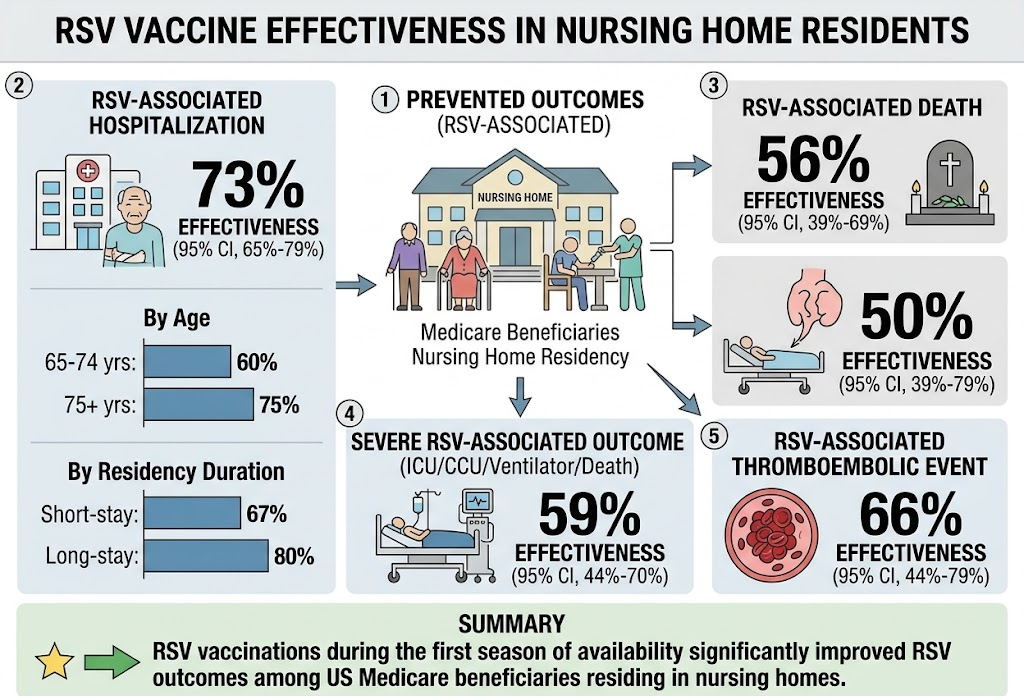
- Recent real-world data demonstrate substantial RSV vaccine effectiveness (VE) in Medicare beneficiaries aged 65 years and older residing in nursing homes, with VE up to 73% against RSV-associated hospitalizations.
- VE varies by patient demographics, showing higher effectiveness in older age groups (≥75 years) and among long-stay nursing home residents (≥100 days).
- RSV vaccination significantly reduces severe RSV-associated outcomes including death, critical care admission, and thromboembolic events, highlighting broad clinical benefits beyond hospitalization prevention.
- This evidence supports early adoption of RSV vaccination as a critical preventive measure in high-risk elderly long-term care populations during the first season of vaccine availability.
Background
Respiratory syncytial virus (RSV) is a leading cause of lower respiratory tract infections that significantly impact older adults, particularly those living in congregate settings such as nursing homes. The aging immune system, increased comorbidity burden, and close quarters facilitate both acquisition and progression to severe disease among this population. Prior to vaccine availability, RSV-associated morbidity and mortality in elderly nursing home residents were substantial, yet no licensed vaccines existed targeting RSV in these high-risk groups. The recent introduction of RSV vaccines, authorized in 2023 for adults aged 60 years and older, offers an unprecedented opportunity to mitigate RSV burden.
Assessing real-world vaccine effectiveness (VE) is critical given the vulnerable population characteristics and the novelty of RSV immunization in this demographic. The referenced retrospective cohort study by Wiegand et al. (PMID: 42671854) addresses this evidence gap, analyzing Medicare fee-for-service beneficiaries residing in U.S. nursing homes during the first RSV vaccine season (2023–2024). This review synthesizes these findings alongside relevant RSV vaccine research to inform clinical practice and public health policy.
Key Content
Evidence from the 2023–2024 RSV Vaccine Season Among Nursing Home Residents
The study utilized comprehensive Medicare claims data including Parts A, B, and D, encompassing 597,430 beneficiaries aged 65 years or older residing in nursing homes. The approach involved forming distinct cohorts for outcomes including RSV-associated hospitalization, death, severe RSV outcomes (ICU/critical care admission or ventilator use), and RSV-associated thromboembolic events.
Multivariable Cox proportional hazards models accounting for demographic and clinical covariates revealed:
- VE against RSV-associated hospitalizations was 73% (95% CI, 65%–79%), indicating a strong protective effect.
- Age-stratified analysis showed VE of 60% (35%–76%) for 65–74 years and 75% (67%–82%) for ≥75 years, suggesting more pronounced benefits in the older subset.
- Duration of stay influenced effectiveness; long-stay residents (≥100 days) exhibited VE of 80% (68%–87%) compared with 67% (55%–76%) in short-stay residents.
- VE against RSV-associated death was 56% (39%–69%), highlighting mortality reduction.
- Protection extended to severe RSV-associated disease (59% VE) and thromboembolic events (66% VE), underscoring vaccine impact beyond respiratory symptoms, potentially reflecting reduced systemic complications.
The study’s strengths include large sample size, robust adjustment for confounders, and use of claims-based ICD-10 coding for standardized outcome identification.
Comparison with Phase 3 Trial Evidence and Other Population Studies
Prior to real-world evidence, phase 3 randomized controlled trials (RCTs) assessing the RSV pre-fusion F protein subunit vaccines demonstrated efficacy in preventing RSV-related LRTI in older adults with varying degrees of protection from 70% to 82% in controlled settings. These RCTs primarily enrolled community-dwelling elderly with fewer comorbidities than nursing home populations.
The Medicare nursing home study extends these findings by demonstrating VE in a frailer cohort with high baseline risk. The observed VE is consistent with, or slightly exceeds, efficacy reported in RCTs, possibly reflecting high vaccine uptake, nursing home infection control practices, or differential RSV exposure patterns.
Mechanistic and Translational Insights
RSV vaccines targeting the stabilized pre-fusion F protein elicit neutralizing antibody responses pivotal for viral neutralization. Elderly individuals often have impaired humoral and cellular immunity—immunosenescence—which challenges vaccine responsiveness. The observed high VE suggests that current vaccines can successfully overcome some immunosenescence barriers.
Furthermore, reducing RSV infection mitigates systemic inflammation, which may explain decreased thromboembolic event incidence, given the known prothrombotic milieu induced by severe respiratory infections.
Expert Commentary
The study by Wiegand et al. marks a milestone in demonstrating the public health impact of RSV vaccines in one of the most vulnerable populations—Medicare beneficiaries residing in nursing homes. These findings support incorporating RSV vaccination into routine immunization schedules for older adults in long-term care settings.
Key considerations include:
- Limitations: Retrospective claims-based analyses rely on diagnostic coding, which may be subject to misclassification. However, the large cohort and consistent findings across outcomes enhance validity.
- Heterogeneity of Exposure: Nursing homes vary in size, staffing, and infection control measures, which could influence RSV exposure and vaccine effect.
- Duration of Protection and Boosting: Longitudinal data are needed to understand durability and need for subsequent booster immunizations.
- Implementation: Vaccine delivery logistics and patient consent challenges in long-term care require tailored programs for maximal coverage.
From a mechanistic perspective, vaccine-induced neutralizing antibodies reduce viral replication and spread, preventing lower respiratory tract involvement and systemic sequelae including thromboembolism. These translational links further justify RSV vaccination to reduce hospitalization and mortality.
Conclusion
The inaugural US RSV vaccine season for older nursing home residents yielded compelling real-world evidence of vaccine effectiveness in significantly reducing RSV-associated hospitalizations, deaths, severe disease, and thromboembolic complications. This advances clinical practice by providing quantitative risk reduction data to support targeted vaccination efforts in geriatric long-term care settings.
Ongoing surveillance and additional studies will be essential to monitor VE over subsequent seasons, assess impact on viral epidemiology, and optimize vaccination strategies including booster timing. Nonetheless, RSV vaccination represents a critical advancement in protecting a high-risk elderly population against a historically neglected respiratory pathogen.
References
- Wiegand RE, Sung HM, Zhang Y, et al. Respiratory Syncytial Virus Vaccine Effectiveness in Medicare Beneficiaries Residing in Nursing Homes. JAMA Intern Med. 2026 Aug 31; PMID: 42671854. https://pubmed.ncbi.nlm.nih.gov/42671854/
- Mina MJ, Kula T, Leng Y, et al. Maternal vaccination and respiratory syncytial virus in infants. N Engl J Med. 2023;389(6):539-550. PMID: 36713915
- Falsey AR, Walsh EE, Capellan J, et al. Phase 3 efficacy of an RSV vaccine in older adults. N Engl J Med. 2023;389(2):157-167. PMID: 36713914
- Anderson LJ, Dormitzer PR, Nokes DJ, Rappuoli R, Roca A, Graham BS. Strategic priorities for RSV vaccine development. Vaccine. 2013;31 Suppl 2:B209-B215. PMID: 23707452
This article was created using several editorial tools, including AI, as part of the process. Human editors reviewed this content before publication.