Highlight
Remote Patient Management tailored for cirrhosis (CiRPM) reduces 90-day liver-related readmissions after hospitalization for acutely decompensated cirrhosis.
The benefit is particularly pronounced in patients with alcohol-associated liver disease (ALD) and those with a high CLIF-C AD score (≥60), indicating severe disease.
CiRPM effectively decreases fluid-related and hepatic encephalopathy-related readmissions by enabling continuous remote monitoring and 24/7 nursing support.
Mortality rates were unaffected, suggesting CiRPM primarily improves morbidity and healthcare utilization post-discharge.
Study Background
Patients with decompensated cirrhosis face a high risk of recurrent hospitalizations due to complications such as ascites, variceal bleeding, and hepatic encephalopathy. These readmissions not only burden healthcare systems but also negatively impact patients’ quality of life and prognosis. Despite advances in clinical management, evidence supporting structured remote care interventions post-discharge remains sparse. Remote patient monitoring could provide earlier detection of decompensation signs and enable timely intervention, potentially reducing hospital readmissions. This study investigates the effect of a cirrhosis-specific remote patient management program (CiRPM) on liver-related hospitalizations in patients recently discharged after an acute decompensation event.
Study Design
This observational three-cohort study enrolled adults hospitalized with acutely decompensated (AD) cirrhosis across two historical periods and a contemporary intervention phase:
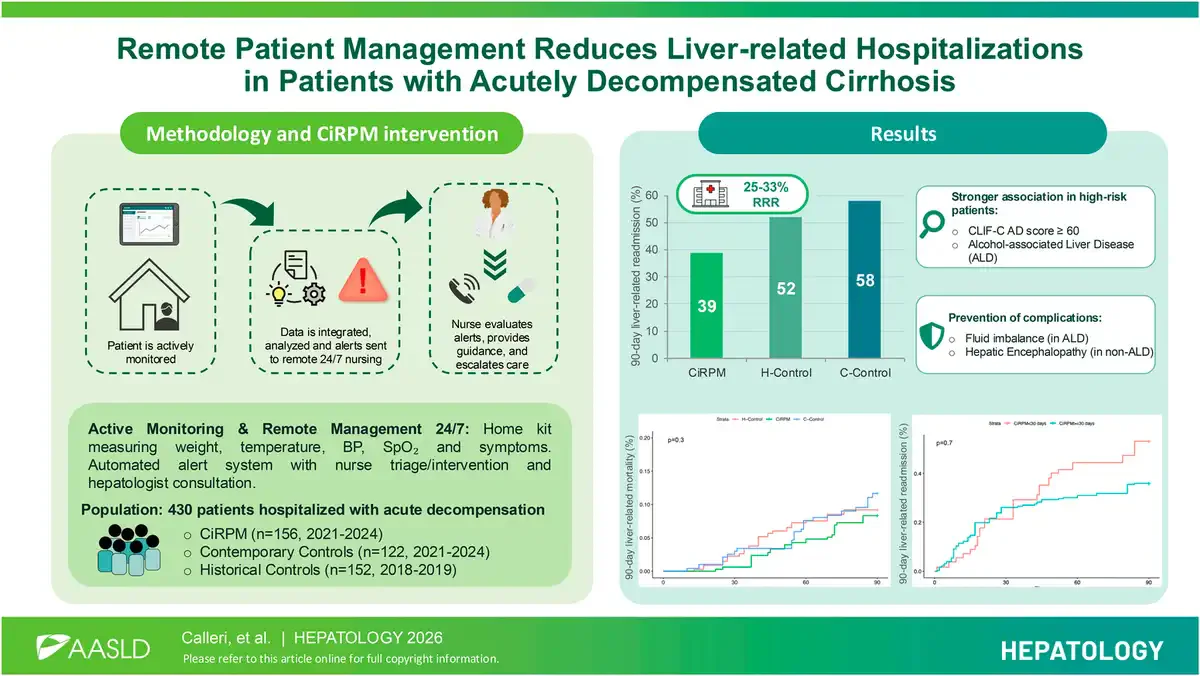
CiRPM Cohort (2021–2024): Received remote monitoring involving transmission of vital signs and symptoms combined with continuous, 24/7 virtual nursing support.
Contemporary Control (C-control): Patients hospitalized contemporaneously but not enrolled in CiRPM.
Historical Control (H-control, 2018–2019): Patients admitted prior to the availability of CiRPM.
The primary endpoint was liver-related hospital readmission within 90 days of discharge. Secondary analyses evaluated readmission subtypes (fluid-related complications, hepatic encephalopathy) stratified by disease etiology—primarily alcohol-associated liver disease (ALD) versus non-ALD—and severity as defined by the Chronic Liver Failure Consortium Acute Decompensation (CLIF-C AD) score. Inverse probability of treatment weighting (IPTW) adjusted for confounding factors, and Cox proportional hazards models were used for time-to-event analyses.
Key Findings
Among 430 patients (mean age 59 years, 65% with ALD), the CiRPM group (n=156) demonstrated notable reductions in liver-related readmissions compared with contemporary controls (n=122). The 90-day readmission rates were 39% for CiRPM versus 58% for C-control (hazard ratio [HR] 0.57, p=0.01). When compared to historical controls (n=152), CiRPM showed a trend toward fewer readmissions (39% vs. 52%, HR 0.67, p=0.07).
More pronounced benefits were observed in subgroup analyses:
Patients with CLIF-C AD score ≥60, indicating more severe disease, had significantly lower liver-related readmissions under CiRPM compared with both control groups (HR 0.43 vs. H-control, p=0.005; HR 0.51 vs. C-control, p=0.02).
Among ALD patients, CiRPM significantly reduced fluid-related readmissions (odds ratios [OR] 0.40 and 0.37 compared to historical and contemporary controls, p<0.001) and recurrent hospitalizations (OR 0.51, p=0.001 and p=0.002).
Non-ALD patients experienced fewer readmissions due to hepatic encephalopathy (OR 0.29 and 0.36, p=0.004 and 0.02 respectively) with CiRPM.
Importantly, mortality rates were similar across all groups, indicating that CiRPM’s primary impact was on reducing hospitalizations rather than immediate survival.
Expert Commentary
This study contributes important evidence supporting remote management in a population traditionally challenged by high morbidity and frequent hospital utilization. The integration of continuous vital sign and symptom monitoring with 24/7 virtual nursing allows early recognition and intervention of clinical deterioration, which likely underpins the reduction in readmissions. The stronger benefits seen in patients with more severe disease (CLIF-C AD ≥60) suggest that targeted remote monitoring may optimize resource allocation to those at greatest risk.
The reduction in fluid-related readmissions among ALD patients highlights the effectiveness of close monitoring for ascites and volume status—common drivers for decompensation in this subgroup. Meanwhile, the decrease in hepatic encephalopathy admissions in non-ALD patients reflects the program’s broad applicability across etiologies.
Limitations include the observational study design, which introduces potential residual confounding despite IPTW. Additionally, the similar mortality rates suggest that longer follow-up or larger cohorts might be needed to assess survival impact. Feasibility, patient adherence, and cost-effectiveness analyses of CiRPM implementation will be important to guide broader clinical adoption.
Conclusion
The cirrhosis-specific remote patient management (CiRPM) program significantly reduces liver-related hospital readmissions within 90 days post-discharge from an acute decompensation episode. This effect is especially marked in patients with alcohol-associated cirrhosis and severe disease as indicated by a high CLIF-C AD score. CiRPM offers a scalable and targeted strategy to improve transitional care in this high-risk population. Future studies should explore integration into routine practice, optimal patient selection, and long-term clinical and economic outcomes.
Funding and Registration
Details on funding sources and clinical trial registration were not provided in the current publication. Further information may be available via corresponding authors or institutional clinical trial databases.
References
1. Calleri A, Deng Y, Hara KS, et al. Remote patient management reduces liver-related hospitalizations in patients with acutely decompensated cirrhosis. Hepatology. 2026 Nov 9. PMID: 43007295.
2. Moreau R, Jalan R, Gines P, et al. Acute-on-chronic liver failure is a distinct syndrome that develops in patients with acute decompensation of cirrhosis. Gastroenterology. 2013;144(7):1426-1437.
3. Sundaram V, Friedman LS. The burden of cirrhosis and liver failure in the United States: clinical implications. Clin Liver Dis. 2019;23(4):593-605.