Highlight
– Larger lymphatic vessel diameter and higher number of successful lymphovenous anastomoses correlate with better postoperative volume reduction.
– Lower degrees of lymphatic sclerosis and peripheral tissue fibrosis markedly improve surgical outcomes.
– Enhanced intraoperative lymphatic flow post-anastomosis predicts superior functional recovery.
– Detailed preoperative imaging and intraoperative assessment are critical for optimizing LVA/LNVA success.
Study Background
Lymphedema is a debilitating chronic condition characterized by impaired lymphatic drainage, manifesting as progressive limb swelling and secondary tissue changes such as fibrosis and sclerosis. These alterations compromise lymphatic vessel function and pose significant treatment challenges. Conservative therapies often provide limited relief, particularly in advanced stages, prompting increasing adoption of surgical interventions aimed at reconstructing lymphatic circulation.
Lymphovenous anastomosis (LVA), which connects lymphatic vessels directly to nearby veins, and lymph node to vein anastomosis (LNVA) have emerged as microsurgical techniques designed to restore lymphatic flow and reduce limb swelling. Although promising, surgical outcomes have varied, largely due to heterogeneous patient factors and intraoperative lymphatic vessel conditions. Identifying intraoperative characteristics that predict successful outcomes is crucial for refining patient selection, surgical technique, and postoperative management.
Study Design
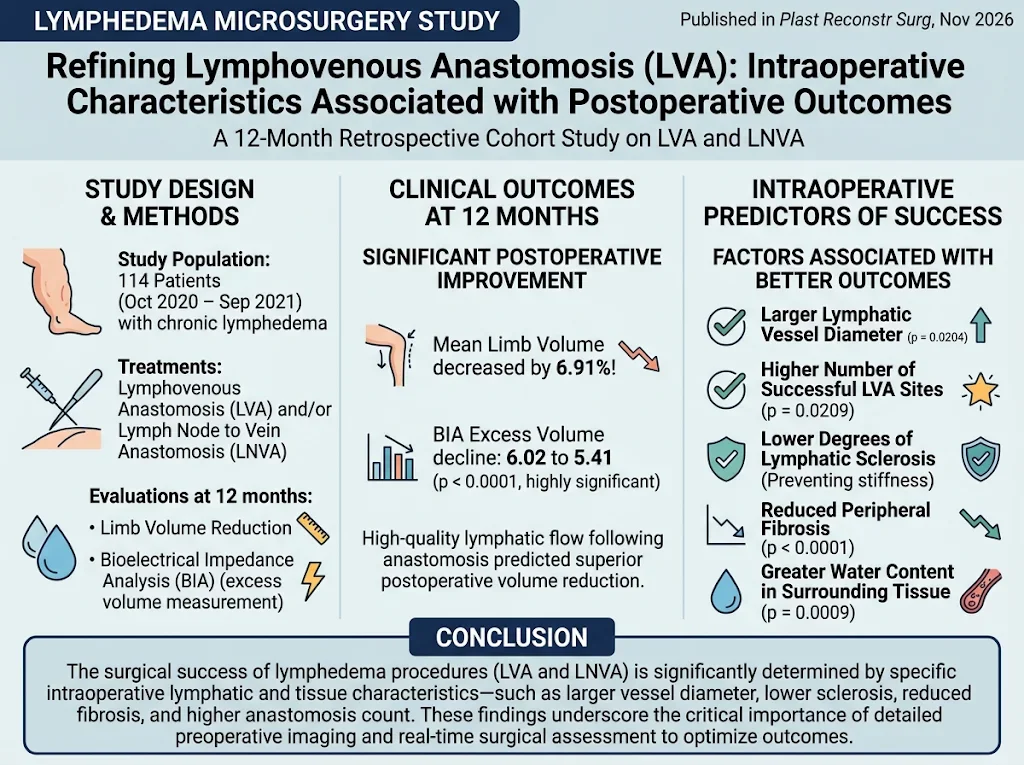
This retrospective analysis included 114 patients undergoing lymphatic microsurgery (LVA and/or LNVA) between October 2020 and September 2021. Inclusion criteria encompassed patients with clinical lymphedema affecting upper or lower limbs. Demographics, disease duration, severity, and baseline limb volume were recorded. Intraoperative assessment detailed lymphatic vessel and vein diameters, degrees of lymphatic sclerosis, tissue fibrosis, and lymphatic flow parameters following anastomosis.
Surgical outcomes were predominantly measured by percentage limb volume reduction and bioelectrical impedance analysis (BIA) excess volume at 12 months postoperatively. Statistical analyses examined correlations between intraoperative factors and clinical improvement.
Key Findings
At one year following lymphatic microsurgery, patients demonstrated a significant mean limb volume reduction of 6.91%, accompanied by a decline in BIA excess volume from 6.02 to 5.41 (p < 0.0001), indicating improved lymphatic fluid balance.
Notably, larger lymphatic vessel diameters correlated positively with greater postoperative volume reduction (p = 0.0204). Similarly, the number of successfully performed lymphovenous anastomoses was associated with improved outcomes (p = 0.0209), underscoring the importance of multiple functional bypasses to enhance lymph drainage.
Intraoperative assessments revealed that lower degrees of lymphatic sclerosis (p = 0.0205) and peripheral tissue fibrosis (p < 0.0001) significantly favored better surgical results. These findings highlight the detrimental effect of chronic tissue remodeling on vessel patency and lymph flow restoration.
Additionally, patients with greater water content in the peri-lymphatic tissue, as assessed intraoperatively, exhibited more favorable outcomes (p = 0.0009), implying less fibrotic tissue obstruction and better lymph fluid mobility.
Crucially, effective lymphatic flow achieved immediately after anastomosis was a strong predictor of longer-term clinical improvement, reinforcing the need for real-time intraoperative functional evaluation.
Expert Commentary
These findings align with emerging evidence emphasizing the microanatomical and functional integrity of lymphatic vessels as key determinants of success in reconstructive lymphatic surgery. The study robustly demonstrates that not all lymphedema patients may equally benefit from LVA or LNVA, particularly those with advanced fibrosis and sclerosis.
Preoperative high-resolution imaging modalities, including indocyanine green lymphography and ultrasonography, are indispensable for mapping viable lymphatics and planning optimal surgical sites. Surgeons should incorporate intraoperative vessel diameter measurement and flow assessment as standard procedural steps to maximize therapeutic outcomes.
Limitations include the single-center retrospective design and absence of control groups; longer follow-up is warranted to evaluate durability. Nevertheless, the data provide practical insights for refining surgical decision-making and tailoring patient-specific approaches.
Conclusion
Lymphovenous anastomosis and lymph node to vein anastomosis outcomes are significantly influenced by intraoperative lymphatic vessel size, tissue fibrosis, sclerosis, and immediate postoperative lymph flow. Integrating meticulous preoperative imaging with comprehensive intraoperative evaluation can enhance surgical efficacy in lymphedema treatment. Future research should focus on prospective trials, standardized assessment protocols, and strategies to mitigate perivascular fibrosis to improve patient outcomes further.
Funding and Clinical Trials
The study does not report external funding sources or clinical trial registrations.
References
Cho J, Lee SJ, Hong JP, Pak C, Suh HP. Refining Lymphovenous Anastomosis: Intraoperative Characteristics Associated With Postoperative Outcomes in Patients with Lymphedema. Plastic and reconstructive surgery. 2026 Nov 9. PMID: 43002092.
Dayan JH, McBride AM, Singhal D, Mehrara BJ. Lymphatic Microsurgical Preventive Healing Approach (LYMPHA) for Lymphedema Prevention: A Critical Review. Plast Reconstr Surg Glob Open. 2016;4(8):e1017.
Koshima I, Narushima M, Yamamoto T. Lymphaticovenular anastomosis for lymphedema: Surgical technique standardization and long term results. Plast Reconstr Surg. 2010;126(3):769-778.
Becker C, Assouad J, Riquet M, Hidden G. Postmastectomy lymphedema: long-term results following microsurgical lymph node transplantation. Ann Surg. 2006;243(3):313-315.