Highlight
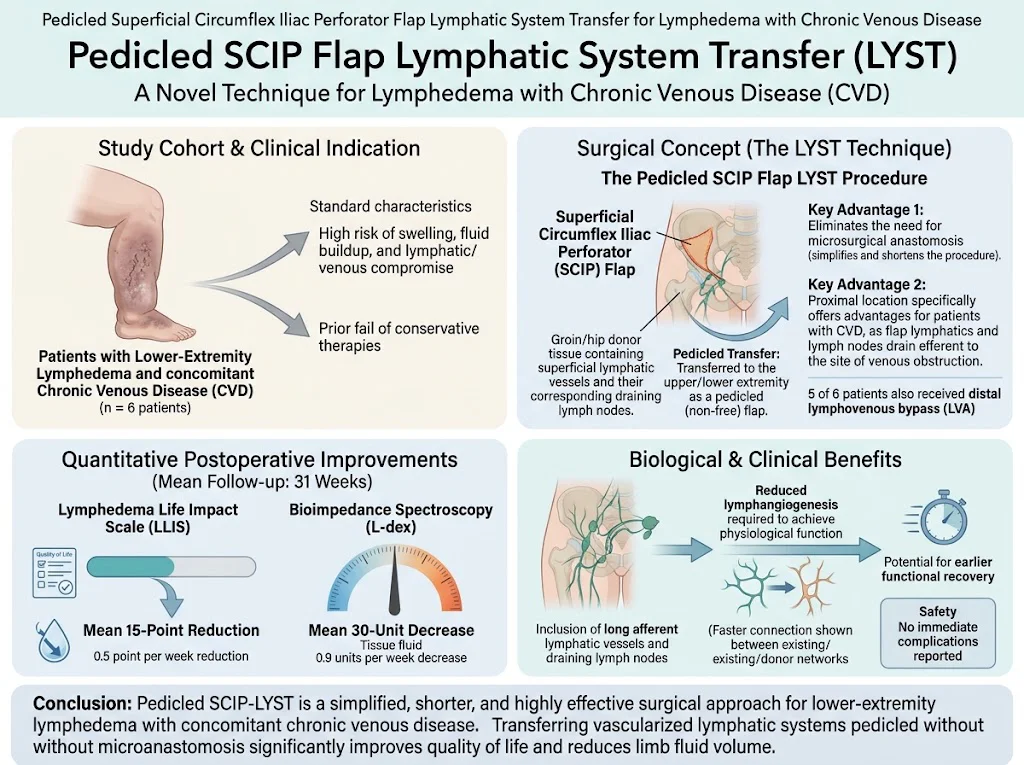
A novel pedicled superficial circumflex iliac perforator (SCIP) flap technique was developed for lymphatic system transfer to treat lower-extremity lymphedema with chronic venous disease.
The procedure integrates vascularized lymph nodes with long afferent lymphatic vessels, potentially accelerating functional lymphatic restoration.
Pedicled transfer avoids microsurgical anastomosis, simplifying surgery and enhancing flap viability.
Early clinical outcomes showed significant reduction in lymphedema symptoms and favorable safety profile without immediate complications.
Study Background
Lymphedema is a debilitating chronic condition characterized by lymphatic fluid accumulation, often leading to limb swelling, fibrosis, and functional impairment. Secondary lower-extremity lymphedema frequently coexists with chronic venous disease, which complicates management due to impaired venous return and lymphatic overload. Conventional treatments include conservative measures and microsurgical interventions such as vascularized lymph node transfer (VLNT) and lymphovenous bypass to restore lymphatic drainage. However, challenges remain regarding early functional recovery and reducing surgical complexity. The recently introduced lymphatic system transfer (LYST) technique combines vascularized lymph nodes with their corresponding lymph vessels to enhance physiological lymphatic function. This article evaluates a novel pedicled modification of LYST using the superficial circumflex iliac perforator flap, aiming to optimize treatment outcomes in this complex patient population.
Study Design
The study involved six patients diagnosed with lower-extremity lymphedema and concomitant chronic venous disease. All patients underwent pedicled superficial circumflex iliac perforator lymphatic system transfer. Five out of the six patients additionally received distal lymphovenous bypass to augment lymphatic drainage. The flap harvest included both superficial lymphatic vessels with their draining lymph nodes and associated vascular pedicle, maintaining their anatomical blood supply. The procedural design avoided microvascular anastomosis by preserving the pedicle, theoretically reducing operative time and risks. Patients were followed up for an average duration of 31 weeks, with clinical assessments and bioimpedance spectroscopy performed.
Key Findings
Postoperative outcomes demonstrated a mean improvement of 15 points on the Lymphedema Life Impact Scale (LLIS), translating to approximately 0.5 points per week during the follow-up period. This scale improvement reflects enhancement in quality of life and functional status. Quantitative bioimpedance spectroscopy, measured by L-dex values, showed a significant average reduction of 30 units (approximately 0.9 units per week), indicating decreased lymphatic fluid accumulation. Notably, no immediate postoperative complications such as flap failure, infection, or donor-site morbidity were reported.
The inclusion of both lymph nodes and afferent lymphatic vessels allowed for potentially faster re-establishment of physiological lymphatic function, reducing dependency on local lymphangiogenesis. This mechanism may contribute to earlier symptomatic relief and limb volume reduction. Moreover, the pedicled nature of the flap circumvented the need for microsurgical vascular anastomosis, markedly simplifying procedural complexity and shortening surgery duration.
Given the anatomical proximity of the pedicled flap to the affected lower extremity and its drainage pattern suitable for chronic venous disease, this approach offers pathophysiological advantages by directing lymphatic drainage towards proximal venous obstruction sites.
Expert Commentary
The current study provides promising preliminary evidence supporting the pedicled superficial circumflex iliac perforator flap lymphatic system transfer as an effective intervention for combined lymphedema and chronic venous pathology. A key strength lies in the technique’s preservation of native vasculature and inclusion of afferent lymphatic pathways, potentially expediting functional lymphatic recovery. Eliminating microsurgical anastomosis reduces operative risks and broadens applicability, especially in centers with limited microsurgical expertise.
However, the limited sample size and relatively short follow-up necessitate cautious interpretation. Additional studies with larger cohorts and longer-term follow-up are essential to validate durability, compare with free flap transfers, and ascertain impact on venous disease progression. Furthermore, standardized protocols for patient selection, adjunct distal lymphovenous bypass, and postoperative rehabilitation remain to be established to optimize outcomes.
Mechanistically, by restoring both lymph nodes and afferent vessels in continuity, this approach might restore more physiological lymph flow than isolated node transfer. This paradigm aligns with evolving concepts in lymphedema microsurgery focusing on lymphatic pathway reconstruction rather than mere lymph node transplantation.
Conclusion
Pedicled superficial circumflex iliac perforator flap lymphatic system transfer represents an innovative surgical advancement for managing lower-extremity lymphedema complicated by chronic venous disease. The technique combines anatomical and physiological rationales to achieve improved lymphatic function with reduced procedural complexity. Early clinical results demonstrate significant functional improvements and an encouraging safety profile. Future research should focus on larger-scale trials, comparative effectiveness, and long-term functional outcomes to confirm its role in comprehensive lymphedema care.
Funding and Clinical Trials
The original study did not specify funding sources or clinical trial registration. Further prospective studies could consider formal registration to enhance methodological transparency.
References
Xu KY, Finkelstein ER, Wu S, Tadisina K, Mella-Catinchi J. Pedicled Superficial Circumflex Iliac Perforator Flap Lymphatic System Transfer for Lymphedema with Chronic Venous Disease. Plast Reconstr Surg. 2026 Feb 12;158(5):871e-874e. PMID: 41677268.
Chang DW, Suami H, Skoracki R. Lymph node transfer for lymphedema: surgical techniques and outcomes. Plast Reconstr Surg. 2013;132(5):1139-1156.
Campisi C, Bellini C, Boccardo F. Surgical treatment of peripheral lymphedema: a long-term follow-up study. Ann Surg Oncol. 2011;18(5):1323-1328.
Becker C, Assouad J, Riquet M, et al. Postmastectomy lymphedema: long-term results following microsurgical lymph node transplantation. Ann Surg. 2006;243(3):313-315.