Reevaluating the Frequent Exacerbator Phenotype in Bronchiectasis: Insights from the EMBARC Registry
Highlight
• Each prior exacerbation in bronchiectasis progressively increases future exacerbation and severe exacerbation risk, with no clear threshold to define frequent exacerbators.
• Prior severe exacerbations markedly elevate the risk of future severe episodes.
• The frequent exacerbator phenotype remains consistent across various bronchiectasis etiologies and geographic regions.
• Large observational data from the EMBARC registry sheds new light on risk stratification and management strategies in bronchiectasis.
Background: Understanding the Burden of Frequent Exacerbations in Bronchiectasis
Bronchiectasis is a chronic respiratory disease characterized by permanent dilation of the airways, leading to recurrent respiratory infections and exacerbations. Exacerbations, defined as acute deteriorations requiring antibiotic therapy and symptomatic management, represent key events contributing to disease progression, worsening quality of life, and increased mortality. Historically, a “frequent exacerbator” phenotype has been used to identify patients at higher risk, typically defined by the presence of three or more exacerbations annually. However, despite being a widely adopted concept, the proportional impact of each preceding exacerbation on future risk and the influence of severe exacerbations and patient heterogeneity have remained inadequately explored. These uncertainties have hampered precision in risk stratification and targeted therapeutic strategies.
Study Design and Methods
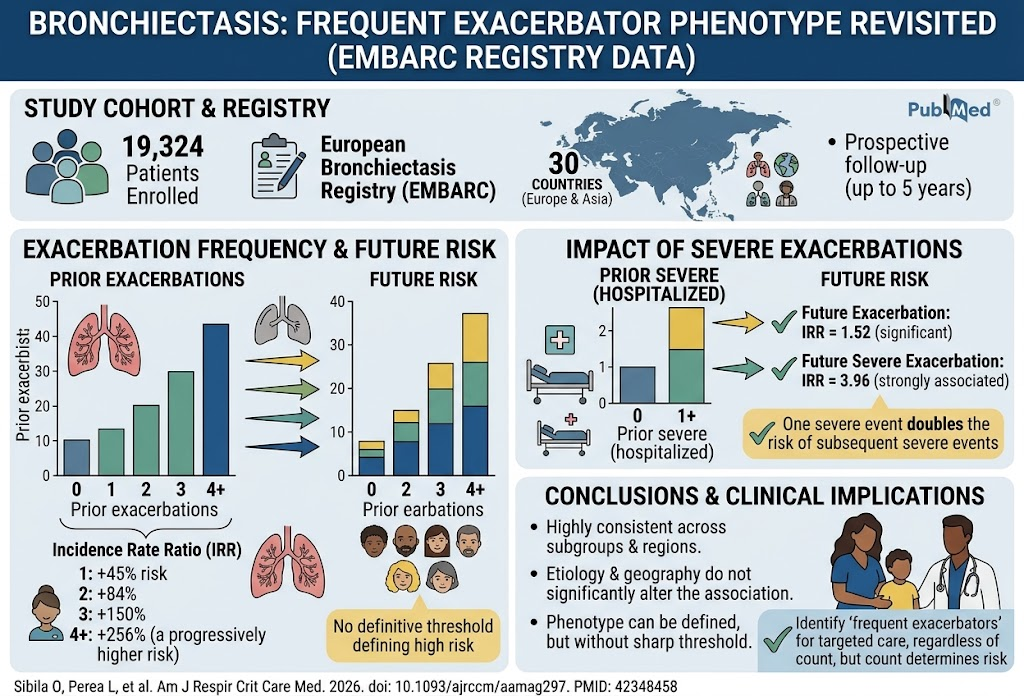
This study utilized comprehensive longitudinal data from the European Multicentre Bronchiectasis Audit and Research Collaboration (EMBARC) registry, encompassing 19,324 patients from 30 countries across Europe and Asia. The large multinational cohort includes diverse bronchiectasis etiologies, allowing evaluation across various subpopulations.
The primary objective was to quantify the incremental risk associated with each prior exacerbation in forecasting future exacerbations and, specifically, severe exacerbations defined by hospitalization. Patients were stratified by number of baseline exacerbations: none, one, two, three, and four or more in the prior year. Negative binomial regression models accounted for follow-up periods up to five years, adjusting for demographic and clinical covariates. The investigators performed subgroup analyses across disease etiologies and geographic regions to assess consistency of findings.
Key Findings
The principal results demonstrated a robust, incremental association between number of prior exacerbations and subsequent exacerbation risk:
- One prior exacerbation increased the incidence rate ratio (IRR) for future exacerbations to 1.45 (95% CI: 1.34–1.58, P < .001).
- Two prior exacerbations: IRR 1.84 (95% CI: 1.69–1.99, P < .001).
- Three prior exacerbations: IRR 2.50 (95% CI: 2.29–2.73, P < .001).
- Four or more prior exacerbations: IRR 3.56 (95% CI: 3.32–3.82, P < .001).
This dose-response relationship indicates no clear cut-off to dichotomize patients into high and low risk groups but rather a continuum of escalating risk.
Regarding severe exacerbations, a history of one prior severe exacerbation was significantly associated with increased future exacerbation risk (IRR 1.52, 95% CI 1.45–1.60, P < .001) and an even stronger predictor of future severe events (IRR 3.96, 95% CI 3.71–4.22, P < .001). This highlights the prognostic importance of severe exacerbations beyond frequency alone.
Importantly, these associations held consistent across multiple bronchiectasis etiologies—such as post-infectious, idiopathic, and immune-related—and across diverse geographic regions, underscoring the generalizability of the frequent exacerbator concept.
Expert Commentary
These landmark findings have several clinical and research implications. First, the data challenge the conventional use of a fixed exacerbation count (≥3 per year) as a rigid threshold to define frequent exacerbators. Instead, a graduated risk approach may better reflect the biological continuum and facilitate personalized risk stratification. Clinicians should recognize that even one prior exacerbation portends higher future risk, prompting early intervention and closer monitoring to potentially prevent escalation.
Second, the disproportionately high risk conferred by prior severe exacerbations underscores their role as sentinel events marking patients at imminent risk for hospitalization and adverse outcomes. Integrating exacerbation severity into prognostic models may improve accuracy and guide resource allocation.
Furthermore, the consistency across etiologies and regions lends confidence in applying these findings globally, facilitating harmonized clinical guidelines.
Methodologically, the extensive sample size and longitudinal design strengthen the evidence. However, registry-based observational data may lack granular details on exacerbation triggers or treatment adherence. Residual confounding and heterogeneous diagnostic criteria across centers may persist. Future prospective studies incorporating biomarkers and mechanistic insights could further refine risk prediction.
Conclusion
The EMBARC registry analysis robustly confirms the frequent exacerbator phenotype in bronchiectasis as a consistent, clinically relevant construct with a dose-dependent relationship between prior and future exacerbation risk. Rather than a fixed threshold, a continuum-based assessment incorporating both frequency and severity better captures patient risk and can inform personalized management strategies. This approach supports early identification, preventative interventions, and resource optimization across diverse global populations. Translating these findings into clinical practice will enhance care for this vulnerable patient group and improve outcomes.
Funding and Clinical Trials
The EMBARC registry is supported by the European Respiratory Society and multiple research grants. No specific interventional trials were conducted in this study. The observational nature leverages real-world data from multiple centers.
References
1. Sibila O, et al. The frequent exacerbator phenotype in bronchiectasis revisited: data from EMBARC registry. Am J Respir Crit Care Med. 2026 Sep 1;212(9):1999-2010. PMID: 42348458.
2. Chalmers JD, et al. Bronchiectasis. Nat Rev Dis Primers. 2018;4:45.
3. Polverino E, et al. Understanding bronchiectasis: current concepts and future directions. Lancet Respir Med. 2017;5(12):996-1014.
4. De Soyza A, et al. A multi-dimensional approach to bronchiectasis assessment. Eur Respir J. 2014;43(5):1357-67.
This article was created using several editorial tools, including AI, as part of the process. Human editors reviewed this content before publication.