Reevaluating Radioactive Iodine Therapy in T3b Differentiated Thyroid Cancer: Insights from a SEER-Based Cohort Study
Highlight
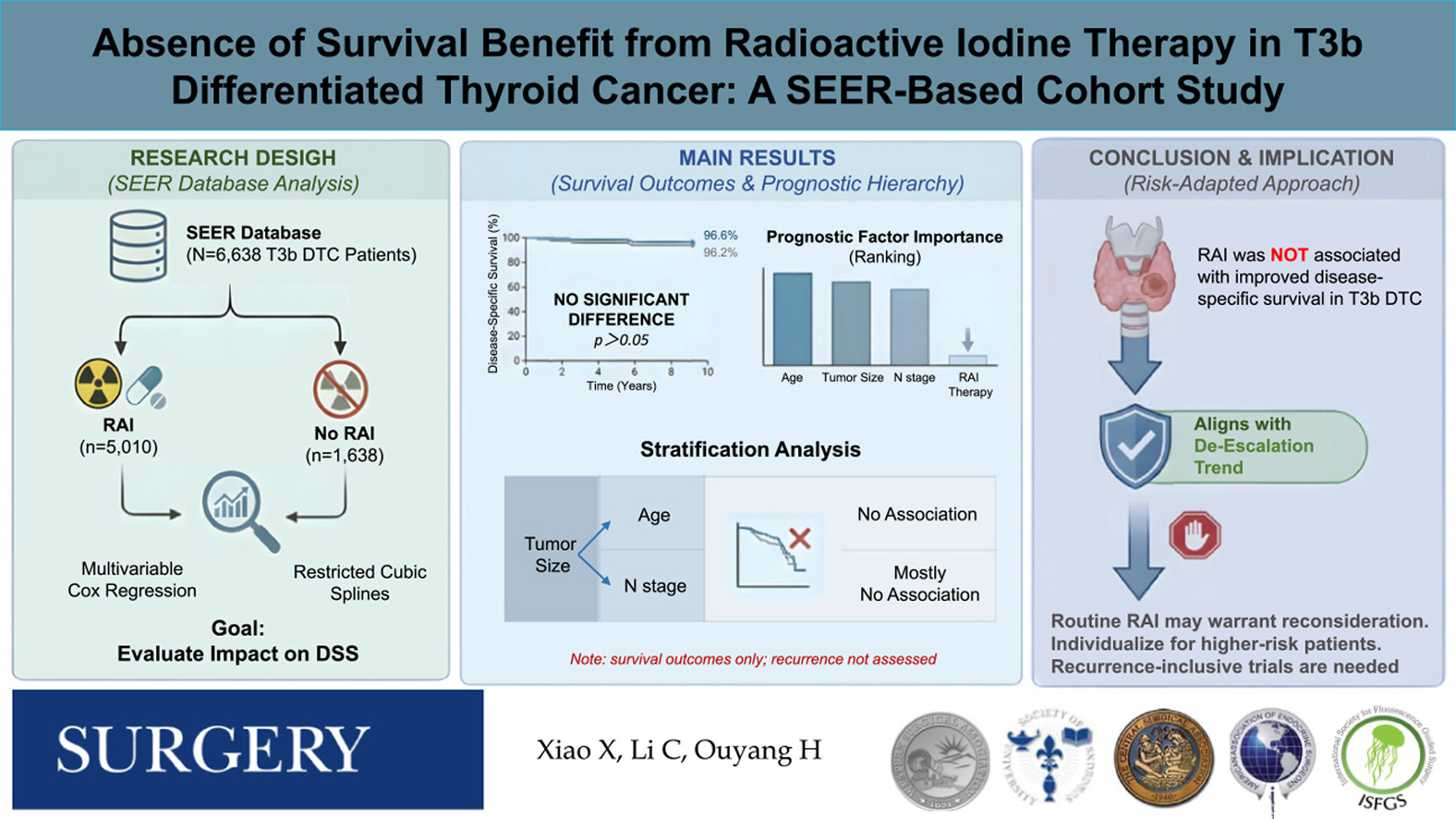
- Largest SEER database study exploring radioactive iodine (RAI) therapy impact in T3b differentiated thyroid cancer reveals no disease-specific survival benefit.
- Age, tumor size, and nodal status are dominant prognostic factors, while RAI ranks low in predicting survival outcomes.
- Survival rates were similar at 10 years regardless of RAI treatment, consistent across subgroups defined by tumor size, age, and lymph node involvement.
- Findings underscore the importance of prospective studies focusing on recurrence data to refine treatment decision-making in intermediate-risk thyroid cancer.
Study Background
Differentiated thyroid cancer (DTC), encompassing primarily papillary and follicular variants, is the most common endocrine malignancy. Although generally associated with excellent prognosis, certain subgroups with locally advanced disease, such as T3b tumors that demonstrate gross extrathyroidal extension invading the strap muscles, remain clinically challenging. Adjuvant radioactive iodine (RAI) therapy has been widely used to reduce recurrence and improve survival in high-risk DTC. However, its role in intermediate-risk groups like T3b remains uncertain and debated due to variability in tumor behavior and risk stratification. Current clinical guidelines acknowledge controversy, emphasizing a need for data-driven individualized treatment planning. This study addresses the gap by analyzing a large, nationally representative cohort to clarify the impact of RAI on disease-specific survival in T3b DTC patients.
Study Design
The authors performed a retrospective cohort analysis of 6,638 patients diagnosed with T3b differentiated thyroid cancer between 2004 and 2022, utilizing the Surveillance, Epidemiology, and End Results (SEER) database. Key inclusion criteria mandated T3b classification, encompassing tumors with gross invasion of strap muscles but no distant metastases at diagnosis. The primary intervention was adjuvant radioactive iodine therapy versus no RAI post-surgical resection. The primary endpoint was disease-specific survival. Prognostic factors were analyzed using random survival forests to assess variable importance with SHapley Additive exPlanations (SHAP) and permutation methods. Cox proportional hazards regression evaluated the association of RAI therapy with survival, including rigorous testing of proportional hazards assumptions by Schoenfeld residuals. To explore potential tumor size effect modification, restricted cubic spline modeling was applied. Sensitivity analyses included propensity score matching for confounding control, subgroup restrictions to papillary histology, node-negative patients (T3N0), and a Fine-Gray competing risk model accounting for non-thyroid cancer deaths.
Key Findings
The comprehensive statistical modeling identified patient age, tumor size, and nodal stage as the most influential prognostic variables influencing disease-specific survival — a finding consistent with established risk stratification frameworks. In contrast, RAI therapy demonstrated a low variable importance rank, suggesting limited impact on survival outcomes.
Adjusted multivariable Cox analysis revealed no statistically significant association between RAI therapy and disease-specific survival in the overall T3b cohort (adjusted hazard ratio 0.89; 95% confidence interval 0.63 to 1.25; P = .502). The proportional hazards assumption was satisfied (Schoenfeld test P = .156), supporting model validity. Notably, the 10-year disease-specific survival rates were almost equivalent: 96.9% with RAI therapy and 97.2% without, implying negligible survival advantage.
Exploratory restricted cubic spline analyses demonstrated no evidence that tumor size modified the RAI-survival relationship across the observed tumor size range, even among patients with large tumors over 40 mm. Furthermore, stratified and sensitivity analyses reinforced this absence of benefit across subgroups including older patients (≥55 years) and those with N1b nodal involvement, who traditionally are considered more at risk and possible candidates for adjuvant therapy.
Propensity score-matched cohorts and competing risk modeling yielded consistent results, minimizing confounding bias and accounting for mortality causes other than thyroid cancer. Subgroup restrictions to papillary carcinoma type and node-negative status did not materially alter the findings, suggesting robustness across histologic and nodal strata.
Expert Commentary
This investigation challenges conventional paradigms favoring routine RAI therapy in all locally advanced differentiated thyroid cancers. The equivocal survival benefit observed aligns with emerging perspectives emphasizing risk-adapted, tailored approaches that weigh the morbidity of RAI (such as salivary gland dysfunction, secondary malignancies, and reproductive risks) against uncertain survival gains in intermediate-risk patients.
The large sample size and modern SEER data enhance the generalizability of findings. The use of advanced machine-learning methods adds nuanced insight into prognostic factor hierarchies, advocating attention to well-established clinical parameters over blanket RAI use.
Nevertheless, the study’s retrospective design and reliance on registry data impose inherent limitations. Important clinical details such as recurrence rates, biochemical markers like thyroglobulin, RAI dosing, and exact protocols are unavailable, restricting assessment of RAI’s impact on disease control beyond mortality. The absence of prospective randomized data in this subgroup continues to preclude definitive therapeutic guidelines.
Guidelines from bodies like the American Thyroid Association increasingly recommend selective RAI use based on detailed risk personalization, and these data provide evidence supporting restrained, individualized decisions rather than default adjuvant RAI administration in T3b patients.
Conclusion
This SEER-based large cohort study demonstrates no survival advantage from adjuvant radioactive iodine therapy in patients with T3b differentiated thyroid cancer. Notably, survival remained excellent regardless of RAI treatment, even among patients with larger tumors, older age, or involved lymph nodes. These results emphasize the primacy of clinical features like age, tumor size, and nodal status over RAI use for prognostication in this intermediate-risk group.
Future prospective trials focusing on recurrence outcomes, quality of life, and functional status are warranted to refine the role of RAI. Until such data emerge, multidisciplinary clinical assessment and patient preference should guide individualized therapeutic strategies to avoid overtreatment and minimize adverse effects while preserving survival outcomes.
Funding and ClinicalTrials.gov
The study was funded by institutional and governmental sources as reported in the original publication. No specific clinical trial registration number was cited given the retrospective nature of this SEER database analysis.
References
- Haugen BR, et al. 2015 American Thyroid Association Management Guidelines for Adult Patients with Thyroid Nodules and Differentiated Thyroid Cancer. Thyroid. 2016;26(1):1-133.
- Durante C, et al. The Risk of Recurrence in Differentiated Thyroid Cancer: A Comprehensive Review. J Clin Endocrinol Metab. 2018;103(10):4239-4248.
- Vaisman F, et al. Radioiodine Remnant Ablation and Outcomes in Patients with Differentiated Thyroid Carcinoma. J Oncol. 2015;2015:135017.
- Xiao X, Li C, Ouyang H. Absence of survival benefit from radioactive iodine therapy in T3b differentiated thyroid cancer: A Surveillance, Epidemiology, and End Results-Based cohort study. Surgery. 2026;197:110382. PMID: 42385380.
This article was created using several editorial tools, including AI, as part of the process. Human editors reviewed this content before publication.