We use cookies

Our website uses essential cookies and, with your consent, additional cookies to measure performance and improve our services. Cookie Policy.

You can change your choice at any time.

MMedXYNews
HomeVideos
MedXY AI/MedXY News/Section: Allergy & Immunology

Rademikibart and Eosinophil Counts in Moderate-to-Severe Asthma: Insights from a Phase 2b Randomized Trial
MedXY Editorial Team•Sep 18, 2026•Allergy & Immunology
EosinophilsRademikibartIL-4Rα Inhibitionasthma

Highlight

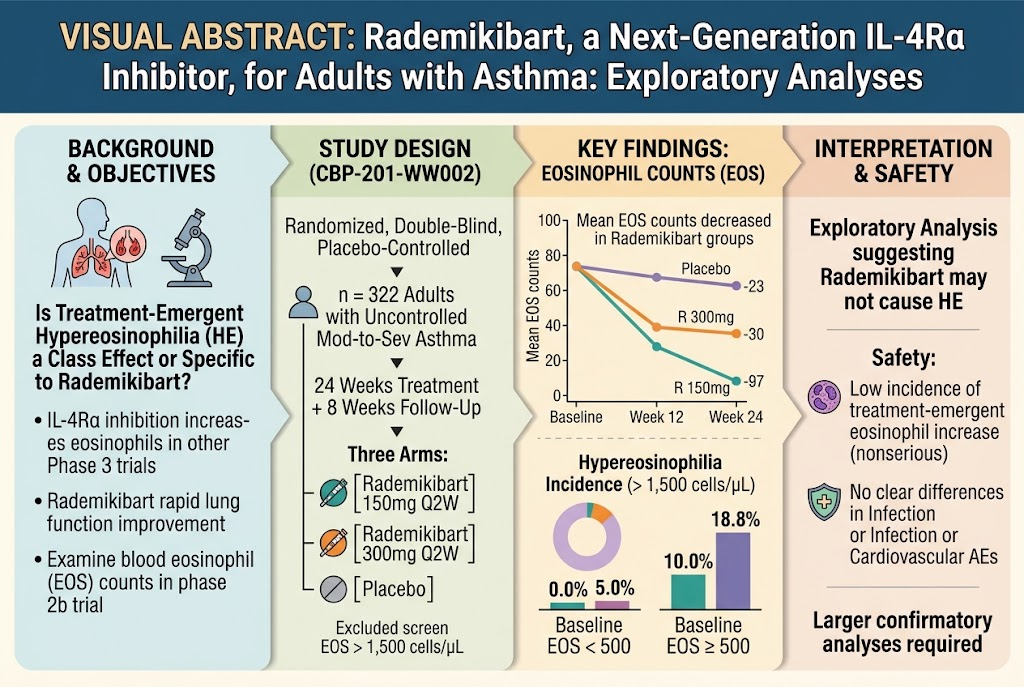
– Rademikibart, a next-generation IL-4Rα inhibitor, provides sustained lung function improvements in moderate-to-severe asthma patients without significantly increasing eosinophil counts.
– Unlike prior anti-IL-4Rα agents, exploratory analyses suggest rademikibart does not induce hypereosinophilia as a class effect.
– The randomized phase 2b trial showed stable or reduced eosinophil counts over 24 weeks compared to placebo.
– Larger and confirmatory studies are necessary to validate these findings and discern clinical implications.

Study Background

MedXY registered readers

Sign in free to continue reading

Create or use your MedXY account to unlock the complete article.

This article was created using several editorial tools, including AI, as part of the process. Human editors reviewed this content before publication.

Related articles

Open language-specific specialty feeds and department pages.

From Mild-to-Moderate to Severe Asthma: Risk Factors and Patient Profiles from the NORDSTAR Cohort and Advances in Severe Asthma ManagementThis review summarizes the progression risk from mild-to-moderate to severe asthma based on the NORDSTAR cohort and integrates emerging evidence on biologic therapies that improve severe asthma outcomes across diverse patient profiles.Sep 17, 2026Empowering Climate-Conscious Inhaler Prescribing: A Patient-Physician Conversation AidA novel conversation aid was developed and refined iteratively with patients and physicians to support shared decision-making for low carbon footprint inhaler prescribing in asthma and COPD, balancing environmental impact with safety and paJun 30, 2026Early Neutrophil and Persistent Eosinophil Gene Signatures in Childhood AsthmaA longitudinal blood gene-expression study in children found an early neutrophil-driven immune pattern at age 1, followed by a persistent eosinophilic signature from 4.5 to 10.5 years in those who later developed asthma.Jun 19, 2026
Loading comments...
MedXY briefing

Get the free newsletter

Evidence-led clinical news, trends, and analysis—delivered to your inbox.

Ask MedXY AI

Most popular

Intimate Health
Five Benefits for Women Continuing Sexual Activity After Menopause
Intimate Health
Why Some Women Have a Strong Sex Drive—And Why Men Shouldn't Worry About It
Nursing & care
How often should a couple have sex?
Intimate Health
Classic Intimacy Recommendations: How to Help Women Reach Orgasm and Enjoy Mutual Pleasure
Intimate Health
What Makes a Woman "Physiologically Addicted" Is Never Money, But These Two Relationship Qualities
© 2026 MedXY
Contact usAbout usPrivacy PolicyMedXY story
Dietary Patterns and Asthma Endotypes in Puerto Rican Youth
In Puerto Rican youth, an unhealthy diet was linked to higher odds of T17-high asthma, suggesting diet may influence asthma through immune pathways beyond allergy-related inflammation.
Jun 4, 2026
Blood Eosinophil Count at COPD Exacerbation Predicts Long-Term Cardiovascular Risk: A Retrospective Cohort StudyA large retrospective cohort study of 143,517 patients reveals that non-eosinophilic acute exacerbations of COPD carry a significantly higher one-year risk of major adverse cardiovascular events compared with eosinophilic exacerbations, sugApr 11, 2026
Redefining Reliever Therapy: Budesonide-Formoterol Outperforms SABA in Controlling Airway Inflammation Among Patients on Maintenance CorticosteroidsThe INFORM ASTHMA trial demonstrates that budesonide-formoterol as a reliever significantly reduces Type 2 airway inflammation (FeNO) compared to terbutaline in adults already using maintenance inhaled corticosteroids, establishing a new evFeb 19, 2026