We use cookies

Our website uses essential cookies and, with your consent, additional cookies to measure performance and improve our services. Cookie Policy.

You can change your choice at any time.

MMedXYNews
HomeVideos
MedXY AI/MedXY News/Section: news

Proteinuria as a Prognostic Marker for Pregnancy Outcomes in Preterm Pre-Eclampsia During Expectant Management
MedXY Editorial Team•Sep 23, 2026•news
Proteinuriapre-eclampsiaAngiogenic markersPregnancy latencymaternal outcomes

Highlight

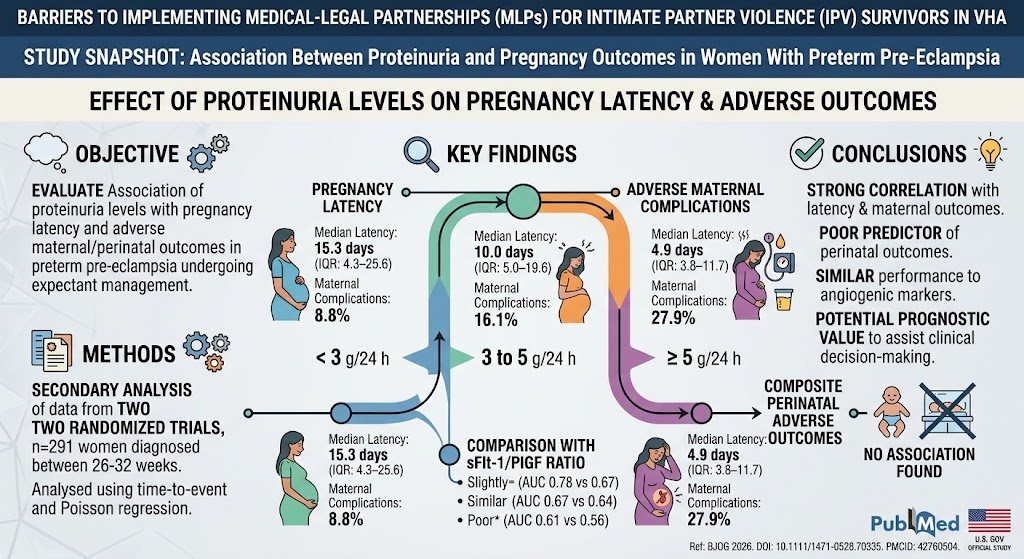
– Proteinuria levels in women undergoing expectant management for preterm pre-eclampsia strongly correlate with pregnancy latency duration.
– Higher proteinuria is associated with increased risk of adverse maternal outcomes but does not predict perinatal adverse outcomes.
– Proteinuria performs comparably to angiogenic biomarkers (sFlt-1/PIGF ratio) in predicting pregnancy latency and maternal complications.
– Proteinuria measurement may serve as a practical prognostic tool to guide clinical decision-making in preterm pre-eclampsia.

Study Background

MedXY registered readers

Sign in free to continue reading

Create or use your MedXY account to unlock the complete article.

This article was created using several editorial tools, including AI, as part of the process. Human editors reviewed this content before publication.

Related articles

Open language-specific specialty feeds and department pages.

Escalating Antihypertensive Therapy in Early-Onset Severe Preeclampsia: Dynamic Marker of Maternal Risk During Expectant ManagementEscalation of antihypertensive treatment in expectant management of early-onset preeclampsia with severe features correlates with increased maternal adverse outcomes, suggesting treatment trajectory as a dynamic risk indicator.Sep 23, 2026Proteinuria in Preeclampsia and Long-Term Risk of Maternal Kidney and Cardiovascular DiseaseHigher proteinuria in preeclampsia was linked to greater long-term risk of maternal hypertension and chronic kidney disease, with overall increased risk of cardiovascular disease as well.Aug 18, 2026Sibeprenlimab Achieves 51% Reduction in Proteinuria for IgA Nephropathy: Key Interim Insights from the Phase 3 VISIONARY TrialThe Phase 3 VISIONARY trial interim analysis demonstrates that sibeprenlimab, a monoclonal antibody targeting APRIL, significantly reduces proteinuria and pathogenic IgA1 in patients with IgA nephropathy, offering a promising upstream theraFeb 22, 2026Selective TRPC6 Inhibition Emerges as a Novel Therapeutic Paradigm for Focal Segmental Glomerulosclerosis
Loading comments...
MedXY briefing

Get the free newsletter

Evidence-led clinical news, trends, and analysis—delivered to your inbox.

Ask MedXY AI

Most popular

Intimate Health
Five Benefits for Women Continuing Sexual Activity After Menopause
Intimate Health
Why Some Women Have a Strong Sex Drive—And Why Men Shouldn't Worry About It
Nursing & care
How often should a couple have sex?
General Surgery
Optimizing Postoperative Opioid Prescriptions After Intra-Abdominal Cancer Surgery: Comparing the 5x-Multiplier and 3-Tier Models
Intimate Health
Classic Intimacy Recommendations: How to Help Women Reach Orgasm and Enjoy Mutual Pleasure
© 2026 MedXY
Contact usAbout usPrivacy PolicyMedXY story
A Phase 2 trial of BI 764198, a selective TRPC6 inhibitor, demonstrates significant proteinuria reduction in patients with focal segmental glomerulosclerosis. This study provides the first clinical evidence for podocyte-targeted therapy, ma
Feb 15, 2026
Natural Ovulation Regimens for Frozen Embryo Transfer: Equivalent Efficacy with Enhanced Maternal SafetyA large multicentre RCT demonstrates that natural ovulation cycles for frozen embryo transfer yield comparable live birth rates to programmed cycles while significantly reducing risks of pre-eclampsia, placental disorders, and postpartum heJan 22, 2026
Scheduled Early-Term Birth: A Proven Strategy to Prevent Pre-eclampsia in High-Risk PregnanciesThe PREVENT-PE trial demonstrates that risk-stratified scheduled birth at 37–38 weeks reduces pre-eclampsia incidence by 30% without increasing neonatal morbidity or emergency cesarean sections, offering a new standard for late-pregnancy maJan 17, 2026