Highlight
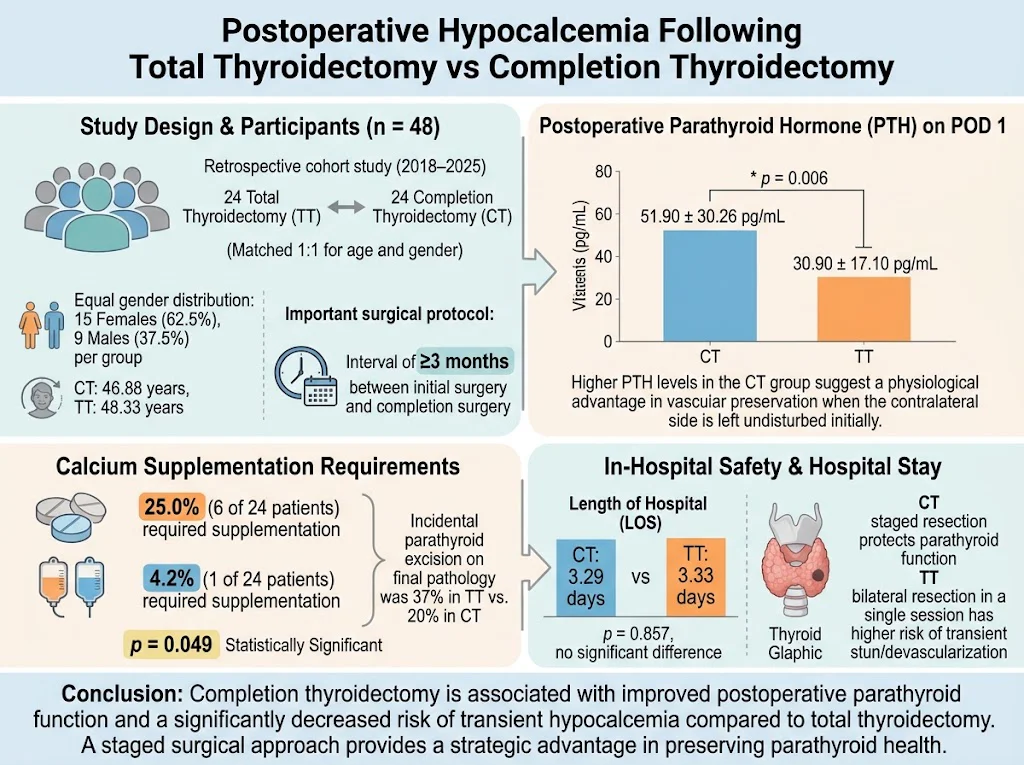
Completion thyroidectomy with a minimum three-month interval results in significantly higher postoperative parathyroid hormone (PTH) levels, indicating better parathyroid preservation than total thyroidectomy. Correspondingly, rates of postoperative hypocalcemia and calcium supplementation requirement are much lower following completion thyroidectomy. These findings emphasize the clinical advantage of staged thyroid surgeries in mitigating transient hypocalcemia.
Study Background
Thyroidectomy is a common surgical procedure indicated for benign and malignant thyroid diseases. Total thyroidectomy involves removing the entire thyroid gland in one operation, whereas completion thyroidectomy is a staged procedure, where the remaining thyroid tissue is excised after an interval, typically following initial lobectomy. Hypocalcemia due to transient or permanent hypoparathyroidism remains one of the most frequent complications after thyroid surgery, with significant impact on patient quality of life and healthcare utilization.
The parathyroid glands are small endocrine organs adjacent to the thyroid, crucial for calcium homeostasis through PTH secretion. Surgical trauma, devascularization, or accidental parathyroidectomy during thyroid surgery can impair parathyroid function, leading to hypocalcemia. Strategies to minimize postoperative hypocalcemia include meticulous surgical technique, identification and preservation of parathyroid glands, and in some contexts, staging the thyroidectomy procedure.
This study by Cicek et al. investigates the comparative outcomes regarding postoperative hypocalcemia and parathyroid function between total thyroidectomy and completion thyroidectomy performed at least three months apart. The rationale is that staged surgeries may allow better parathyroid preservation and recovery, decreasing transient hypocalcemia rates.
Study Design
This retrospective cohort study enrolled patients undergoing either primary total thyroidectomy or completion thyroidectomy with a minimum inter-surgical interval of three months. The population included patients requiring thyroid surgery for various clinical indications. The primary endpoints were postoperative parathyroid hormone levels, occurrence of transient hypocalcemia, and requirement for calcium supplementation. Postoperative serum PTH and calcium levels were measured to assess parathyroid gland function and hypocalcemic complications.
Key Findings
The study demonstrated a robust and statistically significant difference in postoperative parathyroid hormone levels: patients undergoing completion thyroidectomy had mean postoperative PTH levels of 51.90 ± 30.26 pg/mL compared to 30.90 ± 17.10 pg/mL in the total thyroidectomy group (p = 0.006). This indicates superior preservation of parathyroid gland function in the completion thyroidectomy cohort.
Moreover, the incidence of patients requiring postoperative calcium supplementation was markedly lower after completion thyroidectomy (4.2%) versus total thyroidectomy (25.0%), with this difference reaching statistical significance (p = 0.049). These results underscore a significant clinical benefit of the staged surgical approach in reducing transient hypocalcemia risk.
The data suggest that the interval between initial and completion thyroidectomy may provide parathyroid glands an opportunity to stabilize or recover vascular supply and function before the second procedure, thereby enhancing overall outcomes.
Expert Commentary
Preservation of parathyroid gland function is a critical goal in thyroid surgery due to its direct relationship with calcium homeostasis and patient morbidity. This study supports earlier evidence that a staged surgical approach, by spacing operations, minimizes cumulative trauma to parathyroid glands.
However, limitations include the retrospective design and potential selection biases inherent to surgical timing and patient complexity. The generalizability may also depend on surgeon expertise, institutional protocols, and precise intraoperative parathyroid identification techniques, such as fluorescence angiography or rapid PTH assays, which were not described here.
Current thyroid surgery guidelines advocate for total thyroidectomy in specific indications such as bilateral malignancies but recognize completion thyroidectomy as a reasonable option in selected cases. The findings here provide quantitative support for completion thyroidectomy reducing transient hypocalcemia and associated morbidity.
Conclusion
Completion thyroidectomy performed after at least a three-month interval confers a clear functional advantage in preserving parathyroid gland activity compared to upfront total thyroidectomy. This strategy significantly reduces postoperative hypocalcemia and the need for calcium supplementation, thereby improving patient safety and postoperative quality of life. Surgeons should individualize the timing and approach to thyroidectomy, balancing oncological imperatives with complication risk reduction.
Future prospective randomized studies and incorporation of advanced parathyroid preservation techniques could further optimize surgical outcomes and clarify patient selection criteria.
Funding and ClinicalTrials.gov
The original article does not specify funding sources or clinical trial registration.
References
1. Cicek MT, Koca ÇF, Tan M, Algan B. Postoperative Hypocalcemia Following Total Thyroidectomy Versus Completion Thyroidectomy. The Laryngoscope. 2026 Aug 10;136(11):5094-5100. PMID: 42576168.
2. Lorente-Poch L, Sancho J, Muñoz-Núñez J, et al. Hypocalcemia After Thyroid Surgery: Incidence and Risk Factors. J Surg Res. 2015;195(1):1-10.
3. Lang BH, Yih PC, Lo CY. Risk Factors of Post-thyroidectomy Hypocalcemia and Development of a Predictive Scoring Model. Ann Surg Oncol. 2013;20(9):2916-23.
4. Bergenfelz A, Kristoffersson A, Thomsen J, et al. Complications to Thyroid Surgery: Results as Reported in a Database from a Multicenter Audit. World J Surg. 2008;32(7):1351-8.